Showing posts sorted by relevance for query halloween week. Sort by date Show all posts

Saturday, October 31, 2009

Halloween Week: October Dreams: A Celebration of Halloween edited by Richard Chizmar and Robert Morrish (short stories and essays)

Anthologies are usually, simply by their nature, uneven. When you depend on many different brains to come up with quality stories, you're bound to get some duds. It is this expectation that makes October Dreams such a pleasant surprise. In fact, there are so many good pieces in here, that it's easier to pick out the minuscule number of lesser ones (Hugh B. Cave, Dominick Cancilla) in this well-executed tribute to Halloween.

October Dreams is subtitled "A Celebration of Halloween" and it takes its task seriously. Interlaced with classic Halloween stories — and new ones written especially for this collection — are "My Favorite Halloween Memory" reminiscences from the authors, as well as a reading list, a film list, and a history of Halloween that focuses on the modern cultural aspects (as opposed to the usual approach of dwelling on its pagan origins).

Usually in an anthology, I've found a few disappointments by the time I've read five stories, but October Dreams has to be the most consistent collection of stories I have ever read. I didn't find anything to criticize until about the middle of the book. Editors Richard Chizmar (publisher of the dark suspense magazine Cemetery Dance) and Robert Morrish (the magazine's editor until he stepped down recently) have really done their work here. Of course, with a selection of authors like Dean Koontz, Poppy Z. Brite, Ray Bradbury, Ramsey Campbell, Peter Straub, and F. Paul Wilson, how could they go too far wrong?

A few stories stand out from the pack, and these were the ones I chose to read out loud on Halloween night. First was "The Circle" by Lewis Shiner which is a Twilight Zone–style tale of a group of people who gather to read stories on Halloween and get a surprise when one of their members is absent but sends in a story to read anyway. Viewers of the series will probably detect the twist before the end, but it is still an enjoyable read because it follows the formula so well. The other stand out is "Mask Games" by John Shirley, where a family invites a mysterious cousin over for a Halloween party and she brings a strange game for everyone to play. This one was disturbing and creepy and kept me riveted throughout its thirty-five pages.

That "Mask Games" is one of the longer offerings is also a bonus, as any story in October Dreams can generally be read in one sitting. The one exception is "Porkpie Hat" by Peter Straub, which is a seventy-odd page novella and another disappointment. The length, I think, is the main problem. Straub, known for being long-winded at times in his fiction, takes far too long to relate the central story within the story and made me wish he would just get on with it. The beginning and end were much tighter and contained an idea I would like to see expanded upon, that of an interview with a reclusive jazz legend.

Some people have pointed a finger at F. Paul Wilson's story "Buckets" — about an abortion doctor who is terrorized by the spirits of his pre-natal victims — saying it does not belong in an anthology that is supposed to be a celebration, because they didn't like its "agenda." I disagree. I think that Wilson, as a practicing physician, is simply tapping into his own fears — sort of a "what if?" — which makes the terror that much more palpable.

Terror is an emotion that is not rampant in these tales, most of which walk along the fun side of fear, while others aim merely for disturbing. Surprisingly, "Heavy Set" by Ray Bradbury is one of these. The ending does not spell out the actions of the character in question, which makes us project our own ideas and let our imagination run wild. Sometimes, since so much focus is placed on the nostalgic nature of his tales, it's easy to forget that Bradbury is quite a hand at the horror story.

October Dreams is perfect reading for the week before Halloween. (I know, because that's when I read it.) It really gets the reader into the spirit of the holiday. Plus, the reading list ("Trick-or-Read" by Stefan Dziemianowicz) and film list ("'First of all, It Was October...'" by Gary Braunbeck) give other suggestions for holiday entertainment to be relished after you've finished with this wonderful book.

Happy Halloween!

Saturday, October 24, 2009

Sunday night begins Halloween Week on Somebody Dies!

Halloween is my favorite holiday. No other celebration combines the frightening and the fun in such a wonderfully equal measure. Plus, it happens during the fall, which is my favorite season. (Though it's possibly the two are related.)

In honor of this, I'll be posting reviews all this coming week of Halloween-related stories: five books, one movie, and one novelty that can only be called "other."

Hope to see you there!

Monday, October 26, 2009

Halloween Week: Dark Harvest by Norman Partridge (horror novella)

This is an expanded version of the review that was originally published in Down in the Cellar. Copyright 2006. Reprinted with permission.

"He's the October Boy ... the reaper that grows in the field, the merciless trick with a heart made of treats, the butchering nightmare with the hacksaw face ... and he's gonna getcha! That's what they always told you ... he's gonna getcha so you know you've been got!!!!!" — from Dark Harvest

From the jack-o'-lantern on the cover, it's easy to tell that this novella from author Norman Partridge is a Halloween-related offering. Whereas most pumpkin-heads are fairly innocuous-looking, however, the one on the cover of Dark Harvest is positively threatening, which gives you some idea of the book's contents: intense effects in a short amount of time.

In fact, Dark Harvest is so much better than the early fiction that came out in the recent rerelease of his short-story collection Mr. Fox and Other Feral Tales that it is hard to believe they were written by the same person.

You know this kind of story: it's the legend every small midwestern town has, and Partridge has managed to keep things familiar and yet fill this novella with surprises. It's got the nostalgia of Ray Bradbury's classic Something Wicked This Way Comes with a touch of The Twilight Zone and the kind of dark suspense that Partridge specializes in, but the author has also included a melancholy thread that adds depth.

It's that time again: Halloween night, the night when all teenage boys are released, after being locked in their rooms for five days, and set off to find "The October Boy," a midwestern nightmare with a jack-o'-lantern for a head and one thing on its mind: getting to the church on time (no, really). The boy who kills this awful creature (also known as "Sawtooth Jack") gets to leave town, or "jump the Line," something that has become increasingly more difficult, especially with Officer Jerry Ricks enforcing the border. But Pete McCormick thinks this is his year. He has stolen Officer Ricks's .45 and he is determined to get out of the town that has been holding him and his family, and everyone else in it, down for generations.

Dark Harvest is by turns frightening and sad, scary and tragic. It is a pure Halloween horror story, but one whose ripples extend past the time it takes to read it (only a few hours). The characters are people you know, only in a situation you couldn't have imagined that nevertheless feels entirely plausible given the right set of circumstances. I believe that Partridge has crafted a new Halloween classic, one that should find a permanent place on the shelf of every fan of the holiday who appreciates solid writing with no spare parts.

Wednesday, October 28, 2009

Halloween Week: The Baby by Al Sarrantonio (Orangefield horror novella)

This review originally appeared in somewhat different form on Down in the Cellar. Copyright 2006. Reprinted with permission.

From the jack-o'-lantern on the cover, it's easy to tell that this novella from author Al Sarrantonio was one of the Halloween-related offerings for 2006 from Cemetery Dance Publications. Whereas most pumpkin-heads at least attempt to be frightening, however, the one on the cover of The Baby (as drawn by Keith Minnion) is positively adorable, which nicely reinforces the title.

The Baby is part of Al Sarrantonio's Orangefield series that includes the novels Hallows' Eve, Horrorween, and other stories with similarly holiday-oriented titles. It is also the third in the Signature Series of books from Cemetery Dance. These focus on giving somewhat less story but considerably more art for a comparable price to their usual books.

Detective Bill Grant wishes that "weird shit" wouldn't happen in Orangefield every Halloween, but the town's resident Celtic Lord of the Dead, Samhain, is going to make sure his wish isn't about to come true. After spending a night out with the boys, Jack Carlin comes home a little after one o'clock in the morning to fulfill his promise to his wife Marianne: to try and make a baby. She's a little miffed that she’s had to wait, but they make love and she quickly falls asleep afterward, only to wake up an hour later to find Jack gone again.

Detective Grant has to inform her that Jack actually died outside the bar ... a little before one in the morning. But the fact remains that she is now pregnant. How this happened and what exactly happened to Jack are up for debate. What is not, is that Samhain has plans for this baby ("life created from death"), and he is not above cashing in a couple of favors to do it. But favors for Samhain have a way of making people dead.

The Baby is a thin, narrow volume of 129 pages, with two dozen beautifully rendered realistic and evocative illustrations from artist Keith Minnion. The story reads very quickly, however, and followers of Sarrantonio may feel that the extra money was not well spent. (Minnion fans like myself will likely be more pleased with the quality and value.) Nevertheless, the book itself is beautiful, stands out on the shelf, and the story is engaging and tautly written enough to justify revisiting it every Halloween.

Since this review was first written, The Baby has been expanded by Sarrantonio into the novel-length Halloweenland. This novel is a different take on the story, and reprinters Leisure Books have included the text of The Baby (sans Minnion's art) as a bonus in the paperback. Both versions are just as entertaining, and Sarrantonio's alternate take on the story — especially the ending of the novella — is definitely worth a look.

Sunday, October 25, 2009

Halloween Week: October Dark by David Herter

The latest in Earthling Publications' series of Halloween offerings is October Dark by David Herter. Originally titled Dark Carnivals, it centers around the unfinished film Dark Carnival, expanded for the screen by Ray Bradbury from his short story "The Black Ferris." Plagued by problems, the film was eventually dropped, and Bradbury later novelized his screenplay into Something Wicked This Way Comes.

The story concerns two aspiring "FX filmers," Will and Jim. With the help of their friends, they discover that a celebrity of sorts is living in their town of Grenton. Lester Deerton worked with the great Willis O'Brien, stop-motion animator extraordinaire.

Meanwhile, a little special-effects movie called Star Wars has just been released, and it's just the thing these two boys need to fill their summer days. What they don't realize is their summer is about to be filled with a lot more interesting, and dangerous, events.

Ambitious in scope and execution, October Dark is a love letter to Bradbury, Star Wars, Halloween, and the special effects masters of the cinema, most prominently Ray Harryhausen and Willis O'Brien, the latter a character in the story.

Herter mixes fact, fiction, and fantasy seamlessly, and it's often difficult to separate the three. (I was fooled in many instances. For example, don't go searching for certain titles or you'll be greatly disappointed.) The more you know about the life and work of folks like O'Brien and Bradbury, the more enjoyment you'll get out of October Dark.

Tuesday, October 27, 2009

Halloween Week: The Two Sams: Ghost Stories by Glen Hirshberg (novella collection)

This review originally appeared in somewhat different form on The Green Man Review. Copyright 2004. Reprinted with permission.

"Any resemblance to places living or dead is sort of coincidental." — from the dedication page of The Two Sams

This collection from author Glen Hirshberg is a welcome refreshment from what has become a decreasingly represented subgenre: the ghost story. In the introduction of The Two Sams, British horror author Ramsey Campbell compares Hirshberg's output to the seminal work of M.R. James, Fritz Leiber, and Thomas Ligotti, and Campbell is willing to "stake [his] reputation that history will hail him as a crucial contributor to the field." That's quite a high expectation for a collection of five novellas, but Hirshberg appears to be up to the test.

From the beginning of The Two Sams, Hirshberg shows that, above all, he knows how to set a mood. He seems to rely on a type of sneaky eerieness to carry these spectral stories through to their seldom predictable conclusions. "Struwwelpeter" is a particularly good example of this practice.

On the surface, the narrator in "Struwwelpeter" appears to merely be relating an adolescent that-one-time-I-got-really-scared reminiscence. The author, however, makes sure the reader understands (if only subconsciously) that these events will build into something else and it's not going to be pretty. "Struwwelpeter" was nominated for the World Fantasy Award and was selected for inclusion in The Year's Best Fantasy and Horror #15.

Often, as in "Shipwreck Beach," the fright comes from an unexpected place, with Hirshberg using the stage magician's trick of misdirection to get the reader thinking he is being led towards one conclusion while Hirshberg devises an alternate. It's not always obvious where he is going, but he always plays fair and only one of the five stories in The Two Sams is anything less than immensely satisfying.

"Mr. Dark's Carnival" is a particular favorite. It concerns an urban legend come to life and contains a description of a Halloween "haunted house" that had my nerves rattling. Glen Hirshberg can host me on Halloween anytime. "Mr Dark's Carnival" was nominated for both the International Horror Guild Award and the World Fantasy Award and appeared in The Year's Best Fantasy and Horror #14.

The next story, "Dancing Men," is the only clunker in The Two Sams, seeming to go nowhere in the space of forty pages. I've read other stories involving the Holocaust and not been as unaffected by it as in this one. Even so, it was chosen for inclusion in Ellen Datlow's ghost story anthology, The Dark (not too surprising given how Datlow has nurtured Hirshberg's career throughout, not least by her tenure as the coeditor of those Year's Best Fantasy and Horror books previously mentioned).

Luckily, the final and title story, "The Two Sams," is short and instantly compelling. It begins by addressing the ghosts in our memories but soon reveals itself to be about more tangible fears. Coming after the disappointment of "Dancing Men," it makes a terrific closer by reminding the reader of Hirshberg's strengths, one of which is his ability to cover a lot of ground in a few pages.

Taken individually, each tale in The Two Sams offers a chance to appreciate the subtleties that aren't apparent upon first reading, allowing them to simmer subconsciously until the flavors steam forth. Reading them all at once would be like an unnecessary trip back to the buffet — an overwhelming sense of too much, too soon. Tread slowly, and savor.

Friday, October 30, 2009

Halloween Week: Ghost Stories Deck by S.E. Schlosser (illustrated by Paul Hoffman)

We've all been there. You're at a Halloween party, or some other equally spooky occasion, and somebody asks for a scary story. Everybody looks at you, and you draw a blank! You can't even remember how the story about the hook goes, let alone some terrifying tale that your audience hasn't heard before.

Well, never again. Not with the Ghost Stories Deck. Just shuffle the deck, draw one of the 50 flash cards, and you're the life of the party again (even if it's just a party of one)!

OK, maybe not, but author S.E. Schlosser and illustrator Paul Hoffman have certainly assembled an interesting novelty: an actual deck of cards, each one containing an entire spooky story on front and back. The 50 stories in the Ghost Stories Deck are culled from the duo's series of books entitled Spooky Stories, and each one is rated on a skull system according to its potential scariness. (Though of course how scary they are to you and yours will depend on the individual.)

The stories themselves aren't always written out in the most effectively frightening manner. ("Don't Turn on the Light" perhaps comes closest.) But the pieces are all there for aspiring storytellers to make the tale their own and tell it in a manner that suits their audience, whether around a campfire, at a slumber party, or any other gathering where the call arises for a spooky tale told well. (And, in case you need a refresher, the Ghost Stories Deck also includes the one about the hook.)

Thursday, October 29, 2009

Halloween Week: The Collingswood Story directed by Michael Costanza (starring Stephanie Dees, Johnny Burton, Diane Behrens)

This review originally appeared in somewhat different form on The Green Man Review. Copyright 2003. Reprinted with permission.

The Collingswood Story (2002). Screenplay by Michael Costanza.

Note: With all the buzz surrounding the newest microbudget horror film Paranormal Activity, I thought this was a good time to bring some more attention to another film that didn't get much attention when it came out, but that is equally successful at a similar ambition: to be both thrifty and scary.

It has been a long time since a horror film actually scared me. I grew up watching them, so apart from the occasional disturbing image, it is rare for a film to have a physical effect on me. I've just seen too many. The last one to do so was The Blair Witch Project in 1999, and then The Collingswood Story did it — it actually gave me goosebumps, which I was certainly not expecting.

Winner of "Best Indie Film" at the 2002 Horror Review Awards, The Collingswood Story concerns Rebecca (Stephanie Dees), who has left her hometown — and her boyfriend, John (Johnny Burton) — behind to go to college in Collingswood, New Jersey. For her birthday, John sets them both up with "phone cams" so they can communicate with each other. Phone cams are presented as identical to Web cams with one important difference: you have to dial the person's telephone number in order to contact them.

Collingswood starts off gently, with John and Rebecca talking to each other about their relationship, the distance, and the insecurities it brings up. Having experienced a long-distance relationship myself, it was easy to identify with the situation and the characters' feelings.

That same night, John phones his friend, Billy (Grant Edmonds), who seems to exist only to provide some sophomoric comic relief, and the phone cam number of various phone cam "freaks," including an elderly exotic dancer. Also on this list of gag calls is psychic-for-hire Vera Madeline (Diane Behrens), whom John recommends Rebecca call on a lark.

When Rebecca calls Vera, she finds out more than she expected. Vera knows all about the town of Collingswood and its past, including a series of cult-related murders orchestrated by their leader, Alan Tashi, and a particularly gruesome set that occurred in the house where Rebecca is staying.

From here on, The Collingswood Story provides quite a ride.

Rebecca's laptop allows portability (courtesy of an extra-long phone cord), so viewers are treated to shots of different rooms in the house as well as her recordings of trips around Collingswood searching for the infamous Lees Lane and the home of Alan Tashi. The portability also allows her to climb into the darkness of the attic and broadcast to John as she searches for evidence of the murders. This climactic scene is a 20-minute crescendo into terror. The fact that we pretty much know what to expect and are still carried along makes writer/director Michael Costanza's feat all the more admirable.

The Collingswood Story is the kind of film that thrives on a small budget. The inability to show violence (due to expense) is part of the draw because what happens is unseen and all the scarier. Consider the following titles: Psycho, Halloween, Blair Witch — all movies made on the cheap, and yet always in the top of fright fans' favorites lists in terms of scariness.

It is most often in the scripts that the quality lies. And The Collingswood Story is certainly no slouch in that department. Costanza has captured simple and natural dialogue, allowing the actors to give fully realistic performances, and a plot that flows directly from the characters' actions.

Costanza has managed to gather a terrific cast. Diane Behrens' role as Vera Madeline is the film's main source of information, and Behrens' performance is key to its credibility. Stephanie Dees as Rebecca is adorable and engaging. Her role is the heart of the film and without her complete believability, none of the rest of The Collingswood Story would stick.

Johnny Burton is solid in his supportive role, eliciting sympathy in his eventual helplessness. Even the phone cam ecdysiast is funny for his short time onscreen. Grant Edmonds' turn as Billy is the only real setback, as he tries for complete obnoxiousness and thus eschews all subtlety. The contrast to the others is painfully noticeable, but he is fortunately onscreen little.

All these factors combine in making what is bound to become one of the great indie fright flicks — certainly the best I've seen lately. Though the ending has struck some as confusing and/or unbelievable, it worked for me. Simply put, if it's been a long time since a movie affected you the way a horror film is supposed to, give The Collingswood Story a try.

Thursday, February 3, 2011

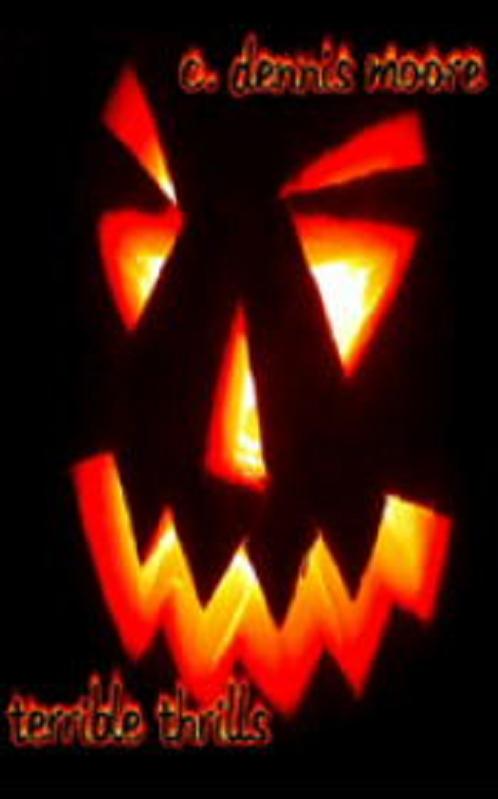
Friday's Forgotten Book: Terrible Thrills by C. Dennis Moore (horror short stories)

For more of Friday's Forgotten Books, this week visit Sweet Freedom.

The best thing about electronic publishing is the opportunity for authors to get their out-of-print work available once again to readers in a way that gets royalties flowing in their direction. I am very happy to see that C. Dennis Moore's short-story collection Terrible Thrills is available as an ebook. Here's the review I wrote back when the print version came out in 2005....

Author C. Dennis Moore definitely knows his way around a short story. His mastery of the form is especially evident in the two dozen examples comprising his debut collection, Terrible Thrills (as in "...'When worlds collide,' said George Pal to his bride, 'I'm going to give you some....'").

Conciseness is key in Terrible Thrills. Moore has selected only his shortest stores for inclusion: most are around eight pages, with a handful of flash pieces covering only half a page. It is difficult to decide which is more effective.

The flash fiction works like a sucker punch to the eye, but the longer stories — given Moore's economy with words — allow him to drag us through quite a range of terrors. For example, the title story is really two in one, connected by the premise of a Halloween CD with two troublemaking tracks entitled "Murder" and "Mayhem." It feels much longer, but only because so much happens.

Despite this choice of shorter fiction for Terrible Thrills, Moore does offer a glimpse of his facility with longer works. Two presumably unconnected stories, "The Strange Thing that Happened at the SpinCycle Laundry" and "The Salvation of Victor," come together within a third, "The Flesh-Method and Myriad." The ending of the latter makes me eager to read the expansion of these stories, Revelations.

As good as this whole collection is, some stories stand out about all the rest. "The Legend of Mr. Cairo" is one. It's not the most original selection in Terrible Thrills, but that's part of its charm. Its familiarity makes it memorable, the way Moore fulfills our expectations, instead of subverting them, and feels comfortable doing it. I like surprises, but in "Cairo"'s case, predictability works best.

A few more highlights include the personification of the seasons is "Winter's Reign." "Luck of the Draw" combines Shirley Jackson, the Grimm Brothers, and M. Night Shyamalan in a creatively derivative tale with a few surprises. "The Son of Man" dramatically illustrates a New Testament prophecy of the Second Coming (Luke 21:27, to be precise): "And they shall see the Son of Man coming in a cloud with great power and glory." For three friends (who just happen to share their names with saints), it is doubtful whether their "redemption is near," or they're just in deep trouble of the worst kind.

Bodies that cannot be depended upon are the subjects of "Plaything" and "Parliament of Jim." While neither has a truly satisfactory ending, they were both thrilling reads and I especially enjoyed Moore's use of different fonts to represent different points of view. The aftermath of Mr. Seagle's wife Astrid's death from lung cancer also plays out in two very different ways in "Preparations" and "Astrid Like a Candle" — one darkly humorous, the other disturbingly scary.

But if there is a perfect story in Terrible Thrills, it is "Working for the Fat Man," which takes a universally familiar concept and gives it a hard twist while remaining faithful to the original feeling of the source. It combines the best parts of "unpredictable" and "not surprising," resulting in a feeling of inevitability, an utter "rightness" to all the events. Look for it to be anthologized for years to come.

The one thread that ties all the stories together is Moore's wonderfully skewed imagination. From the first paragraph, I was drawn in. Moore writes with a voice I know, his phrasings feel similar to my own, and this put me instantly at ease. The more he shocked me, the more I wanted to be shocked. I was ready to go wherever he wanted to take me — even to Enlil (and "Bob's Leg" will tell you all you need to know about that place). In short, reading Terrible Thrills is like being tortured by a good friend.
Related Posts with Thumbnails