Showing posts with label serial killers. Show all posts

Sunday, November 25, 2012

Re-Kindling Interest: Serpent Girl by Ray Garton (horror novella)

This is one of a series of reviews focusing on out-of-print works that have become available again via a variety of e-book formats.

Newly retired from his well-paying job, Steven Benedetti decides to celebrate with a visit to the carnival. There he meets Elise, the Serpent Girl (she dances with snakes), herself newly unemployed due to a fight with her boss/lover. Elise (whose real name is Carmen Mattox) and Benedetti subsequently hit the road together, spending the night in a roadside motel where they share their bodies and their histories — but not their secrets. That comes later; pieces slowly reveal themselves as the couple have a lot of sex and begin to think they're perfect for each other.

Author Ray Garton is probably best known as a writer of horror fiction (The New Neighbor, Live Girls), but Serpent Girl, originally one of his long line of books from Cemetery Dance Publications, seems to display the influence of the hardboiled crime novels and films of the 1940s and '50s: to wit, the beautiful woman whom trouble seems to follow and the world-weary man who is so attracted to her that he doesn't realize what he's gotten into until very late in the game. Steven and Elise fit their roles well, but each has a little secret in store for the other.

This blend of sex, horror, and crime fiction (I like to call it "erotic noirror," but your mileage may vary) plays to Garton's strengths: creative plots and the rare ability to know when to paint with broad strokes and when to be more detailed. Serpent Girl certainly has its flaws (conversations that border on the tedious, two-dimensional characters, and an abrupt ending), but they don't keep this novella from pulling the reader through to the somewhat unexpected conclusion. Its menacing foreshadowing alone would guarantee that, even if Garton didn't have a couple of surprises up his sleeve.

Garton's longtime fans will definitely be satisfied by Serpent Girl, and those concerned that he might be devoting himself to crime fiction entirely can be assuaged by his recent werewolf novel Ravenous (and its sequel, Bestial). Those, however, wanting more of this direction of the author's work should seek out his two books originally published under the pseudonym Arthur Darknell and now out under his own: Loveless and Murder Was My Alibi.

This review is an updated and revised version of the one that originally appeared in The Green Man Review in 2008. Reprinted with permission.

Sunday, February 13, 2011

No One Will Hear You by Max Allan Collins and Matthew Clemens (serial killer thriller)

This second in the new series from authors Max Allan Collins and Matthew Clemens starts much better than the first, which I wasn't all that impressed with. Nevertheless, I held out hope for the follow-up since other Collins series have only improved as they went along.

No One Will Hear You delivers on that promise with a fantastic opener that delivers thrills and introduces a killer's motives: reality show stardom. He's filming his kills so they'll be broadcast on J.C. Harrow's hit show, Crime Seen. Harrow's family was murdered the night he saved the President from assassination, and he subsequently launched Crime Seen to catch other criminals.

But now that his family's killer has been taken down — with the help of Harrow's hand-picked Killer TV crew — what is left? Even as he helps conquer a money-laundering meth lab, Harrow notes his lack of personal satisfaction — and that his team is not sure they want to go forward into a third season. Meanwhile, they're on the search of a serial killer the cops dubbed "Billy Shears" (a pun on the sharp instruments used to emasculate the male victims) even before the first victim has been identified.

No One Will Hear You is a considerable improvement over its predecessor, You Can't Stop Me, with more of what's expected from a serial-killer novel: the serial killer — either two sharing an M.O. of sharp implements and Rohypnol, or a single, bisexual murderer perpetrating both series of murders.

The truth turns out to be far more interesting in this fascinating new side to Max Allan Collins that will hopefully gain him even more new readers. No One Will Hear You contains instantly memorable chapters from a killer's point of view that are comparable to classic serial-killer novels like Shane Stevens's By Reason of Insanity, Thomas Harris's Red Dragon, and Michael Slade's Headhunter.

Early on, I was able to pause and savor both the style and substance of the book, but as events headed toward the unguessable conclusion, I grabbed every available moment to turn even just one more page in the excitement of the journey. Far exceeding my expectations, Collins and Clemens expand on the potential of their first J.C. Harrow book and produce what may become a classic of the serial-killer genre, continuing plot threads begun in You Can't Stop Me while solidly standing on alone in its cleverness and originality.

Collins has really been showing his range lately, from the light cozy series with his wife as Barbara Allan to finishing the posthumous works of Mickey Spillane in true hardboiled mode to touching on horror with the Harrow books written with longtime collaborator Matthew Clemens.

These co-writers allow Collins to produce even more work than usual, making 2011, the 40th anniversary of his first sale, a bang-up year with no less than 8 new books seeing publication (including the postponed Quarry's Ex). I'm really looking forward to it.

Wednesday, September 1, 2010

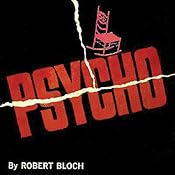
Psycho by Robert Bloch (unabridged audio book read by Paul Michael Garcia)

Nearly everyone knows the story of Psycho, of how a woman named Crane steals $40,000 from her employer and takes off to marry her boyfriend. A rainstorm causes her to make a wrong turn off the main highway, and she stops for the night at the one beacon of light on that deserted stretch, the Bates Motel, run by the unassuming mama's boy Norman Bates.

Bates himself has become an iconic figure, synonymous with the psychotic murderer and more often the source of parody than fear. So, how does one approach the original novel by author Robert Bloch with a fresh eye?

Surprisingly, it is fairly simple: one cannot. If you have seen the classic film as directed by Alfred Hitchcock, you've experienced the story in its tightest form.

Hitchcock and screenwriter Joseph Stefano delivered a very faithful adaptation, and if that is enough for you, so be it. But if you long for more depth of character, more insight into motive and history, and especially more internal monologue, then Psycho the novel is just the thing for you.

Audiobook reader Paul Michael Garcia delivers a better performance than I thought possible, inhabiting all the characters fully. This allowed me to forget that I was listening to "Psycho" and just immerse myself in Bloch's world one more time — almost, if I tried really hard, as if for the first time.

Wednesday, May 26, 2010

Joyride by Jack Ketchum (includes bonus novella Weed Species)

This review originally appeared in somewhat different form on The Green Man Review. Copyright 2008. Reprinted with permission.

Author Jack Ketchum's specialty is fictionalizing the exploits of real-life criminals, something he has done to great effect in The Lost and Off Season, and especially in the book most consider his masterpiece: The Girl Next Door. The paperback reprint of Joyride (which includes the novella Weed Species) continues this tradition with different but equally disappointing results.

When Wayne — who always wanted to kill someone but never had the guts — sees Carole and Lee murder Carole's stalker ex-husband Howard, he knows these are some people he'd really like to hang out with. So, he kidnaps them and, inspired by their gumption, sets off on his own spree.

If this setup sounds vaguely familiar, Ketchum found inspiration for Joyride in an unlikely source — Emile Zola's classic La Bete Humaine — though the two authors take a different approach. (Other character details were pulled from Ketchum's usual source, the multivolume Bloodletters and Badmen by Jay Robert Nash.)

Originally printed in 1995 in the U.S. (and the U.K., where it was called Road Kill) and rereleased in a limited edition by Cemetery Dance Publications in 2007 with a new afterword from the author, Joyride differs from Ketchum's usual style in that it eschews graphic sex and violence for the most part. Sometimes it hardly seems like a Ketchum novel at all. The suggestion and actions are there, but the loving descriptions of carnage and mayhem are mostly absent. Instead, the author includes his characters' thoughtful inner monologues on the different qualities of their relationships. Sheer suspense regarding how far Wayne will go carries the reader to the end, and even with that, it was a struggle.

Weed Species, however, is extreme to its detriment. A novella spanning about 80 pages in hardcover (the Cemetery Dance limited edition includes a handful of full-page illustrations by Glenn Chadbourne), it starts right off by chronicling Sherry's Christmas gift to her boyfriend Owen: her teenage sister to rape and a camcorder to film it. This opening scene would have put the author firmly among the "extreme horror" crowd if he weren't in fact a founding member. In it, Ketchum clearly portrays the couple as irredeemable. Later events only serve to underline this fact.

Sometimes it seems as if in Weed Species Ketchum is only out to disturb us; he has said he does this by disturbing himself first. The book's theme can be summed up in three words: "cruelty begets cruelty" (an idea underscored by the book's title and illustrations and by the actions of another of Owen's victims; she survives only to hurt another).

This underlying story behind the story would have been served better by a shorter rendering. Ketchum's need to stick to reality (Owen and Sherry are also based on real people) prevents him from giving Weed Species the satisfying punch of an ending it requires to circumvent these flaws. As a result, it feels like purposeless sensationalism, though it contains some of the author's most brutal and visceral prose yet.

Many people have attempted to thread their horror with social commentary, and Ketchum has done it so much better before that it's difficult to recommend this to any but his most hardcore fans. Weed Species and Joyride thus make an interesting pair. Put together, they seems like two parts of a whole, but taken separately, each feels as if it is missing something vital.

Sunday, February 7, 2010

By Reason of Insanity by Shane Stevens (serial killer novel)

With his book By Reason of Insanity, author Shane Stevens has created one of the classic novels of the serial killer subgenre. He approaches the exploits of Thomas Bishop — serial murderer and son of Sara Bishop, who was assaulted by robber-rapist Caryl Chessman — with a detachment usually reserved for news reports.

This gives By Reason of Insanity the feel of a true-crime book, though Stevens's book is otherwise brilliant imagination. Here's a sample from the early pages that sets the scene: "Caryl Chessman's death at the start of the sixties marked the beginning of an age of bloodletting with is not yet over.... To see why and how this came about, one must first go back to the early postwar years of Los Angeles."

This is not to say that Stevens missed out on the emotional impact Bishop's actions have on his victims' families. To wit, this passage: "Unlike the average layman, he understood precisely what was written in the report, and as he read he saw exactly what had been done to his daughter. Tears welled in his eyes; he found it hard to swallow. The one who had done these things was a devil."

But a highly intelligent and astute devil, as we see when Bishop plans his escape from the state hospital he has called home for the last 15 years, since he burned his abusive mother alive in their wood stove at age ten. He acquires some very recognizable accessories and becomes known for having them always with him.

Then he befriends another man, Vincent Mungo, and invites him along on the escape, during with they exchange clothes and Bishop kills and butchers Mungo unidentifiably, leaving the accessories on him. For four months, the police are looking for Mungo and thinking Bishop is dead while Bishop goes on a murder spree — going from location to location, and identity to identity, keeping one step ahead (and sometimes only one step ahead) of the hunters.

This is chronicled in detail by Stevens's skillful hand, which it seems can handle innumerable characters with all their various histories and ambitions. So much happens with so few words that By Reason of Insanity could easily have been stretched out to a four-book series by a less disciplined writer.

After three months of police failure, Newstime magazine, the main coverer of the Mungo story, sends its star reporter (and current case expert) Adam Kenton on a one-man manhunt. Kenton will use all the resources at Newstime's disposal — even the highly guarded confidential sources — and will have all the money he needs, provided he "captures" Mungo before the police do.

If the police catch the killer first, Kenton will be considered as having failed. Also, Kenton cannot tell anyone what he is doing — all communication is to be coded — and he must act fast, because who knows when the police may close in on their shared target.

By Reason of Insanity is divided into three sections. The first ("Thomas Bishop") focuses on Bishop's mother, his childhood, his time incarcerated, and his subsequent escape and reign of terror. The second portion ("Adam Kenton") tells the story of that point primarily from the viewpoint of the reporter, showing his investigation with the suspense inherent in such a risky venture that may end unexpectedly.

Then the final section ("Thomas Bishop and Adam Kenton") closes in on the inevitable meeting of the two, and we realize that Bishop and Kenton are more similar than perhaps the reporter would like to believe. We get some insight into Kenton's thought processes, but this is mostly used to show that he has begun to think like Bishop and guess his next actions.

As I mentioned, the usual tone is one of distance, so when Stevens does occasionally address the reader directly, it has a very powerful effect. By Reason of Insanity also includes several well-placed moments of dry humor, and it seems Stevens has a particularly snide view of a popular nightly broadcast:
That evening he ... fell asleep watching a TV show that featured a double rape by a gang of toughs, a murder in which pools of blood were shown close up, a child thrown out of a fifth-floor window by a parent, and a shoot-out between police and a gunman holding hostages. All of which occurred in the first fifteen minutes. The program was called the Eleven O'Clock Evening News.
By Reason of Insanity is a wholly absorbing book is recommended for those with strong stomachs and hearts. Shane Stevens has written the serial killer novel that all others should be compared to. (Yes, even Thomas Harris's.) It is dated in some ways, primarily how in 1973, Bishop gets away with stealing identities and leaving DNA at crime scenes, two things that would never be allowed now, almost 40 years later. But, though it is a snapshot of its time, it is even more a timeless portrait of the mind of a murderer, something that will likely never go out of style.

Tuesday, December 22, 2009

The Chase by Clive Cussler (historical action mystery)

April 1950 — A fisherman searching the bottom of a lake for his lost outboard motor finds something quite a bit more impressive, and soon a dredging company unearths (unwaters?) Baldwin locomotive #3025 (and its 3 saponified corpses) from the silt and muck it sank in back in 1906.

Nearby, a tall, anonymous observer watches closely. He knows what happened 44 years ago. He was there....

January 1906 — A bank robber disguised as a wino makes off with a $325,000 mining payroll, leaving three dead victims in his wake. This is at least his fifteenth such undertaking, and the public knows him as the Butcher Bandit.

Joseph Van Dorn, founder of the famous detective agency that carries his name, puts his best man on the Butcher Bandit case: Isaac Bell, who feels that the bandit plans his escapades so well that he will undoubtedly be tripped up by a single overlooked mistake. Bell proposes that it is the job of the Van Dorn detectives "to find that insignificant mistake."

Jacob Cromwell is president of the Cromwell National Bank, but where he got his initial capital is a mystery. His sister Margaret seems to have some connection with the Bandit, but that, too, is not clear. With little else to go on, Bell focuses his sights on the Cromwell siblings, though they appear to be San Francisco's biggest philanthropists.

Clever villains make for the most interesting reading, and author Clive Cussler's The Chase offers up one of the cleverest in the Butcher Bandit. He robs and kills, and yet always escapes due to his very careful planning. (Some may say that this much planning is unbelievable, but Cussler never allows it to slip into parody, though he may have his tongue in his cheek.) But the Butcher's ambition and ego may just be his downfall.

However, as bright as the Butcher is, Cussler's newest hero Isaac Bell is at least as clever. Bell is from an independently wealthy family, so his interest in investigation is pure; he's not doing it for the money. He has his quirks, but he is a mostly relatable hero. The reader learns who the Bandit is fairly early on, and from then on The Chase offers a suspenseful ride of wondering when Bell and the Bandit will meet.

The Chase also features a close-up view of the San Francisco earthquake of that year. And Cussler caps things off with a thrilling locomotive chase across the Sierra Nevadas and north to Montana, with no working telegraph lines to warn of oncoming trains keeping the suspense at similarly mountainous heights.

The historical aspects of The Chase are also fun. It takes place mostly just after the turn of the 20th century, so it has many aspects of a Western (since that's only about 25 years after most Westerns are usually set). I especially enjoy a good Western-mystery, so this one really fits the bill, especially with the added adventure.

The Chase was first appreciated as a standalone thriller. But an also train-related sequel set the following year in 1907, The Wrecker (written with Justin Scott), has since appeared, with presumably more to come.

Trivia: Cussler tips his hat to a classic bank-robbery film by having Salt Lake police detective John Casale have nearly the same name as John Cazale, the actor who played Sal to Al Pacino's Sonny in Dog Day Afternoon.

Friday, December 18, 2009

Child 44 by Tom Rob Smith (unabridged audio book read by Dennis Boutsikaris)

In 1933, a time when hunger is rampant, two young Russian brothers chase down a cat, and one of them disappears. Twenty years later in 1953, another of a different pair of brothers meets a mysterious end, and MGB agent Leo Demidov follows the official line that it was an "accident."

For, in the Stalinist Soviet Union, crime officially does not exist. This is an era when bad driving can get you sent to the gulag for twenty years. But some growing doubts Leo has about the government's interrogation methods (like the popular practice of torturing until a confession is made) come to a head when he is asked to investigate his own wife, Raisa.

Meanwhile, a serial killer runs free, eventually amassing over 50 victims — a killer with an astonishing motive. But this "killer" officially does not exist in a time and place where paranoia is a survival tactic under a dictatorship that believes even sadness to be a punishable protest against the government's policies.

Author Tom Rob Smith crafts his debut with care, though Child 44 does require some patience. Smith introduces the murders, then spends a great deal of time developing the character of Leo and his surroundings before returning to the violence some time later. Though I predicted the "revelation" early on (it could not have going any other way and still have been fair to the truly attentive reader), that did not lessen the novel's effect, due to the author's admirable skill.

Actor Dennis Boutsikaris reads Child 44 with deftness and confidence. He exhibits a level of comfort with the complex prose (not to mention the ubiquitous Russian accents) that one suspects would exceed even that of the author himself.

In addition, his voice is smooth and flows easily into the ear, reminiscent of Kevin Spacey (himself an audiobook reader at one time), with an undercurrent of menace that matches well to a story wherein one wrong word can mean instant death — and where even a slow death may be preferable to government sanctioned "justice." (Where even a government agent's reputation can rise and fall as often as the barometric pressure.)

The first sequel in this projected trilogy of novels, The Secret Speech, is already available. It is also read by Boutsikaris, who won a 2009 Audie Award in the Thriller/Suspense category for his work on Child 44.

Friday, October 16, 2009

The Midnight Room by Ed Gorman (dark suspense)

Detective Steve Scanlon's life is out of control. Married with kids, he also has an expensive mistress — or thinks he does. Actually, ever since Nicole found out he was married, she'd rather he left her alone, that he's stop buying her expensive gifts in a desperate attempt to re-win her affections.

Steve doesn't give up easily, but he needs more money. He's been neglecting his family, his wife and kids, his brother Michael (also a cop), and their father in the nursing home, leaving Michael to continually make up stories to cover for him more than Michael wants or their father believes.

But Steve had a solution to all his problems. He originally meant only to rob Dr. Peter Olson, but now he knows what the doctor has been up to: kidnapping local girls and torturing them to death in his basement dungeon. Steve found in Olson's safe the DVDs the doctor made of his last two captives, and Olson will pay to keep them secret. It is therefore in Scanlon's best interest that Dr. Olson is not discovered for his latest victim — a recently missing girl named Cindy Baines.

The police have stepped up the investigation since the last victim's skull arrived in her mother's mailbox. Luckily, Scanlon is the investigating officer on the case along with his partner, Kim Edwards — who, not coincidentally, Dr. Olson has just begun dating. And that's just the beginning of author Ed Gorman's The Midnight Room, a dark ride that isn't even over when the main story has played out. There's more to come, and it's even more shocking.

Ed Gorman is one of the great dark suspense novelists working today, and The Midnight Room is his best work yet. Its pieces are assembled bit by bit, and it takes a while for the reader to figure out what exactly is going on. (The strangely misleading blurb on the back cover — which seems to be advertising the book as a horror novel — goes a long way toward clouding the waters.) But Gorman always plays fair and is only keeping back some information for greater effect in later pages.

The Midnight Room is a wholly modern novel, but its roots lie in the Gold Medal novels of the 1950s and '60s. Gorman's influences are right there on the page. His skill at plotting is highly reminiscent of John D. MacDonald's standalone (that is, non–Travis McGee) novels. But his deft control of a multitude of major characters shows the marked influence of John Farris, particularly the author's intriguingly complex Harrison High. (Though Farris also wrote a handful of Gold Medals himself under the name Steve Brackeen.)

Gorman himself has called The Midnight Room his own "Gold Medal novel" and dedicates it to four "old friends who were masters of the form": Peter Rabe, Stephen Marlowe, William Campbell Gault, and Robert Colby. I think they would be proud to be connected to this book. It is the culmination of a life-long love of hardboiled crime novels and is a worthy addition to their ranks.

Wednesday, August 26, 2009

BoneMan's Daughters by Ted Dekker (unabridged audio book read by Robert Petkoff)

Navy captain Ryan Evans has never been much of a husband to his wife Celine or father to his daughter Bethany. His work with military intelligence has always taken first priority and has caused not only his absence in their lives but even their house via his multiple deployments. In fact, Celine and Bethany have decided to continue their lives as if Ryan were never a part of them, which they've believed for years.

But Ryan's experience as a prisoner of war changes his priorities, and suddenly he wants nothing more than to be the perfect husband and father. Meanwhile, Phil Switzer, whom district attorney Burton Welsh prosecuted to conviction for the "BoneMan" killings, has been released from prison due to new doubts about the evidence.

Elsewhere, the real BoneMan is making plans for his next abduction. In his search for the perfect daughter, and after seven unsuccessful tries that had to be eliminated (shades of The Stepfather), he thinks he's found just the right girl: Bethany.

In early 2005, I was sent a review copy of a novel by an author totally new to me. Obsessed was Ted Dekker's eleventh novel for Christian fiction publisher Thomas Nelson, and it suffered from Dekker's insistence on making the characters purely "good" or "evil." Four years and twenty (!) novels later, Dekker's craft has greatly improved, and his characters have gotten far more complex. All the people in BoneMan's Daughters are flawed, and yet all also manage to elicit our sympathy. (The book is Dekker's first with a mainstream publisher, namely the vast Hachette conglomerate.)

BoneMan's Daughters is utterly compelling from start to finish, though Dekker still relies too heavily on Judeo-Christian God and Satan metaphors for my taste (especially the pervasive father/Father motif) and the ending is unbelievable. Despite these major flaws (though some readers will not see them as such), the author has produced a thrilling and worthy addition to the canon of serial-killer fiction. In BoneMan, he has created the most fascinating serial killer since Francis Dolarhyde. (You'll never look at Noxzema lotion the same way again.)

Audiobook reader Robert Petkoff (Beat the Reaper) does a marvelous job with the varied characters, capturing the voice of each character perfectly. His ability to go from hero to villain, switching between two characters displaying very different emotions from each other in a single conversation, is nothing short of stunning. I don't think BoneMan's Daughters would be nearly as effective on the page.

Saturday, August 1, 2009

Mortal Wounds by Max Allan Collins (omnibus of CSI tie-in novels Double Dealer, Sin City, and Cold Burn)

Anyone who reads this and asks: "Why is Max Allan Collins writing CSI novels?" must have forgotten (or never knew) that, in between his various graphic novel and historical mystery projects, Collins has had a lively TV/movie tie-in sideline going on for some time now. In fact, it was his novelization of Saving Private Ryan that gave him the "New York Times Bestselling Author" designation that has appeared on nearly every one of his book covers since.

The bottom line is that Collins writes intelligent, detail-oriented, fast-paced novels (mysteries for the most part) and so is a perfect fit for CSI. His experience writing in the voices of already-extant characters also serves well in his representation of Grissom, Willows, Brass, Brown, Stokes, and Sidle: every line reads as if it were delivered by the actors; and remember, these are original plots, not novelizations of previously filmed teleplays, making the result that much more admirable.

Mortal Wounds collects the first three novels Collins wrote connected with this long-running TV series, a job that has since been continued by other authors as Collins moved his focus on to novels related to other series like Bones and Criminal Minds.

Double Dealer is the first novel in the series and contains a good amount of extra detailed history, in-depth predictive reenactments, and copious description, while still respecting the "reality" of the events from the first season. (Something that is also good to remember: later season events, relationships, and promotions are not reflected here, the only major drawback to reading a novel based on an ongoing television series.)

A mummified corpse is discovered that carries the same shooter's-signature as a more recently dispatched victim. However, true to form, Grissom considers the two to be separate cases until the evidence proves otherwise. I'm hesitant to provide too much detail about the plot, but series fans will love how Collins follows the normal procedure of a typical episode in Double Dealer -- all the way down to the jaw-dropping climax and the non sequitur ending. In addition, he adds his own brand of humor, particularly in the form of in-jokes during an interrogation in a video store. (He not only name-drops his own innovative DVD Real Time: Siege at Lucas Street Market, but also a classic from actor William Petersen's past.)

A satisfying read all around, Double Dealer enhances the CSI mythology without having to go outside the expected realm and leaves plenty of room for further development, making it perfect for fans but also approachable for the uninitiated. (Of course, this metafiction-loving reviewer would be tickled pink to see the worlds collide by having this novel adapted into a future CSI movie, bringing everything full circle.)

Sin City repeats everything that was good about Double Dealer: solid plotting, familiar characterization, loyalty to the format. It's the rare sophomore effort that improves upon its predecessor. That it is also longer makes this feat even more surprising.

Las Vegas earns its notorious nickname when a man's wife disappears and their neighbors suspect the husband, particularly since the wife gave them a secreted cassette tape with the husband threatening to dismember her recorded on it. Meanwhile, a stripper is murdered in the lap-dance room at Dream Dolls (where Catherine used to work before she got her degree in the forensic sciences) and the surveillance cameras point to her boyfriend, who was not only under a restraining order, but also claims he was home watching the game at the time.

Sin City fulfills on all levels. The voices are perfect and one can go from watching the television series to reading the novels seamlessly, which is likely the best compliment one can give to a genre that gains little respect from the literary community but has been vastly appreciated by TV watchers and readers alike for decades.

Collins (with help once again from researcher and plotter extraordinaire Matthew V. Clemens) again delivers the forensic goods in Cold Burn. In the time between Thanksgiving and Christmas, two wintry murders, separated by most of the continental United States, tax the resources of the Las Vegas CSI team. While Catherine, Warrick, and Nick remain on home turf to take care of the mysteriously wet and naked dead female dropped on a park trail, Sara and Grissom are on their way to a seminar in New York, a working vacation. Surprised by work in its midst, they come across an ad hoc funeral pyre in the middle of a snowstorm.

Collins stays faithful to the existing characters while taking advantage of the novel format, creating new storylines and suspects that fit the surroundings but that stretch the usual boundaries with their use of more realistic murders and even rough language. A highlight of this novel is watching Grissom learn new techniques when a Canadian CSI shows his particular skills in working a crime scene covered with snow.

I find reading the novels a perfect way to pass the time instead of watching another rerun for the fourth or fifth time, given how many stations are carrying the show in syndication. (Coincidentally, however, an episode that is referred to as "the Marks case" in Cold Burn was conveniently rebroadcast on the night I read about it, allowing me to get deeper insight into the actions of one of the regulars.)

I still feel as if I have just begun this series, and I'm not about to stop now. More novels follow the three included in the Mortal Wounds omnibus, and I've read one, Body of Evidence, so far, with equally entertaining results. Collins also wrote a handful of other novels for this series and a couple of CSI: Miami novels, as well as a selection of CSI graphic novels, and the plots for CSI video games and at least one CSI board game. For a while there, Max Allan Collins was the go-to guy for nearly all the related materials, and his immersion in that world shows in the quality of his work.

Monday, July 6, 2009

Very Mercenary by Rayo Casablanca

Leigh Tiller, beautiful New York socialite and "billionaire fashionista" (remind you of someone?), is kidnapped by a bear, a monkey, a penguin, and a cat. By chance, she is later noticed in a penthouse window by one Laser Mechanic — ambitious head of the Strategic Art Defense, a group of guerrilla artists (yes, you read that right) — and he is instantly struck by her beauty.

Soon, the life's goal of Laser the asthmatic artist becomes to rescue Leigh and return her to her father, Kip Tiller, at his casino in Las Vegas. (While, of course, spreading his SAD agenda to a wider audience through the inevitable media coverage.)

Trouble is, Kip doesn't want her back. Always one to take advantage of an opportunity, he has therefore hired The Serologist, a sadistic doctor with an ultraloyal assistant named Olivier, to ensure he never has to deal with his daughter again.

What results is Very Mercenary, a road-trip novel of Gumball Rally proportions. Numerous groups, including Momma Gash's "girls" and a preteen street gang called the Black Sultans, eventually head West in pursuit, all rocketing toward an explosive finale that made me laugh and cringe at the same time.

Author Rayo Casablanca (6 Sick Hipsters) draws his characters with broad strokes so they're easily identifiable, and his novel manages to be both extremely clever and cleverly extreme at the same time. He lays on the happy ending a little thick, but everything in Very Mercenary is painted with a wide brush. It's not a great book, but it is a lot of fun, and sometimes that's all you want out of a novel.

Nitpicker's Note: If you want to "liven it up a bit," you want to add "flair." Only add "flare" if by "liven it up" you mean "burn it down."

Monday, May 18, 2009

The Maze by Catherine Coulter (audio book read by Susan Ericksen)

Seven years ago, Lacey Sherlock's sister was murdered by a serial killer that the newspapers dubbed the String Killer for his tactic of making his victims follow a string to the center of a maze before killing them. Now Lacey is an FBI agent determined to use her access to find the perpetrator. But when she offers herself up as bait, the String Killer has a surprise for her....

The Maze was my first venture into the so-called "romantic suspense" genre. I had not originally intended to take this trip down a previously untraveled road, but I found the audiobook on a table of free stuff at work and decided it would be an experiment that was relatively free of risk.

My low expectations led to a pleasant surprise. I had feared that The Maze would be basically a romance novel with suspense overtones, but Coulter actually does a fine job capturing all the nuances I've come to expect from the serial-killer subgenre (if not the explicit violence a horror fan like myself would anticipate).

Of course, given the target audience, Lacey's relationship with her boss Dillon Savich instantly turns into antagonistic flirting (which everyone recognizes but them) and quickly progresses beyond that (albeit with unrealistic speed). But that is a minor quibble, and the existence of sequels featuring the pair told me that would happen, anyway. The Maze is actually quite suspenseful and fast-paced and kept me guessing to the end. And that's all I was looking for.

Tuesday, March 17, 2009

Dark Side of the Morgue by Raymond Benson (prog-rock mystery)

Oddly enough, I got this book because I'm excited about an upcoming book. Raymond Benson is one of six authors tapped to write for the newest venture from Hard Case Crime founder Charles Ardai: pulp adventure novels in the old style featuring a new character, Gabriel Hunt.

I've been highly anticipating this series since it was first announced because the other five authors (Ardai himself, David J. Schow, Christa Faust, James Reasoner, and Nicholas Kaufmann) have proven themselves to be quite skilled at fast-paced narratives. Benson is the only one I'd not read before, so when I saw that his second Spike Berenger novel, Dark Side of the Morgue was available, I leapt.

Part of the attraction came from the concept of a rock and roll P.I. Spike Berenger used to be in a progressive rock band called The Fixers, but they didn't last long (though they still have some devoted fans). Now Berenger and his partner Rudy Bishop run Rockin' Security, a service for the music industry. Berenger also has his private investigator's license because it sometimes helps with business. Suzanne Prescott, a former Goth devotee now into Transcendental Meditation (T.M.) and martial arts, is his investigation partner.

A blonde wearing sunglasses and a big, floppy hat has been killing members of Chicago's prog-rock scene (known locally as "Chicagoprog"), and Zach Garriott (guitarist and vocalist for the seminal bands North Side and Red Skyez, but gone solo since 1980) wants Berenger's help finding the suspect — he's on the list. The trouble is, the main suspect is Sylvia Favero, and she's been dead since 1970.

Berenger, a little bored with his current caseload involving Iggy Pop's dogs and Debbie Harry's landlord, decides to take the case, partly because he's friends and former colleagues with many of the participants. Here, Benson's knowledge of the prog-rock industry serves him well (he wrote The Pocket Guide to Jethro Tull and is himself a composer and songwriter). After a long exposition introducing character relationships and band histories, Benson's feel for the high points brings authenticity to the story and never feels just like some guy trying to write a rock novel. (A Chicagoprog "family tree" at the front of the book is great for reference, and the table of contents is actually a "track listing" of song titles.)

Dark Side of the Morgue is funny, disturbing, and filled with deep knowledge of the music industry and abnormal psychology, all combined to make a really terrific read that I wanted to pick up whenever I had a free moment. It is assembled from P.I./thriller tropes we've seen many times before, but Benson has put them together in a way that feels fresh and original, and results in the reader responding to them as if they were brand new (a skill no doubt useful in his upcoming Gabriel Hunt novel, Hunt through Napoleon's Web).

Also speaking well of his skill at adventure, Benson is the author of six recent original novels featuring Ian Fleming's James Bond — only the fourth author chosen to do so — in addition to the first two Tom Clancy's Splinter Cell novels (written under the pseudonym "David Michaels") and other thrillers like Sweetie's Diamonds and the first Berenger "hit," A Hard Day's Death.

My only real complaint is that protagonist Spike Berenger is the least interesting person in the book. But Berenger's transparency allows the supporting characters to truly shine (for example, in how Prescott's T.M. skills actually figure into the plot instead of being just an interesting character quirk). Dark Side of the Morgue is an intelligent mystery with a twist as layer after layer of the story is slowly revealed to the reader's joyous satisfaction.

Benson obviously spent a great deal of time developing his musicians' relationships and histories, and the hard work pays off in an engrossing read that is as much for rock fans as it is for fans of conventional P.I. novels. Honestly, Dark Side of the Morgue is so good that if it's not nominated for both the Edgar and the Shamus awards, somebody's just not paying attention.

Thursday, January 29, 2009

My Bloody Valentine 3-D (2009) directed by Patrick Lussier (starring Jaime King, Kerr Smith, Jensen Ackles, Betsy Rue)

My Bloody Valentine 3-D (2009). Shown in both 2-D and 3-D theaters. Screenplay by Todd Farmer and Zane Smith, based on the 1981 screenplay by John Beiard from a story by Stephen Miller.

Any remake of a classic slasher film (as much as one can be called "classic") can go one way or another: the current filmmakers will either simply rehash the old one, or they may take the high road and add original touches. Either way, fans of the first one will talk about the differences, while those unaware that there was another one will get to take the movie on its own terms. I'm happy to report that My Bloody Valentine 3-D (a 2009 remake of 1981's My Bloody Valentine) is one of the good ones.

Of course, "good" in this case is a relative term. The dialogue is trite and laughable in most of the early scenes but screenwriters Todd Farmer (Jason X) and Zane Smith have taken the story from the original in new directions, making the characters older and adding more mature plot elements while director Patrick Lussier updates the whole thing to the current "tense, suspenseful, and very bloody" style of recent films like Hostel and Saw.

Harry Warden was the only survivor of a mine explosion in the small town of Harmony. After recovering from his coma, he went on a murder spree that included the killing of a bunch of teenagers who thought partying in the old mine was a good idea. Ten years later, the killings start again, just as a prodigal son returns, putting him at the forefront. Is he responsible? Or has Harry Warden simply come back from the dead?

Protagonists Kerr Smith and Jaime King are surprisingly believable as Axel and Sarah Palmer, world-weary working-class parents, she the owner of the local grocery store, he the town sheriff having an affair with her stock clerk Megan (Megan Boone). Jensen Ackles is less effective in his large, important role as Tom Hanniger, the reluctant owner of the mine and the current prime suspect for the murders. He seems to have only two expressions: hangdog and menacing.

Though the ending is telegraphed from the opening scene, My Bloody Valentine 3-D does a fairly good job of keeping the viewer in doubt about the identity of the killer. And the special effects are stellar, with a variety of gruesome set pieces that exceed anything I've seen recently. The movie really earns its R rating, with heavy doses of sex and violence.

Interestingly, though the lengthy scene of full nudity featuring actress Betsy Rue may seem exploitative to some, it actually gives the actress quite a showcase as she dominates the screen for that entire amount of time, resulting in one of the film's few truly memorable (and most talked about) scenes. It will likely give her the exposure (pun intended) needed to further her career — so who's exploiting who? (Incidentally, the trucker who instigates this scene is played by co-screenwriter Todd Farmer.) Similarly, the role of the motel owner did not have to go to 3'10" actress Selene Luna, so I have to applaud the filmmakers for their creative casting in what could have been a role display of the same old faces.

Even in a 2-D theater, the 3-D aspects of My Bloody Valentine 3-D were a lot of fun, like the rest of the movie. (This is important since only a third of theaters are actually showing it in 3-D.) The visual effects team really earned their money on this one. A couple of scenes (one in particular involving a jawbone) elicited actual guttural sounds from my companion and me, neither of whom have seen a horror movie in a theater since Halloween: H20 in 1998. Coincidentally, that film was edited by this film's director, Patrick Lussier, an experienced editor of other horror films like the Scream trilogy — he also co-edited this one — so it's obvious he knows how to literally assemble a slasher enterprise by putting all the pieces in the right order.

Friday, January 23, 2009

The Book of Lists: Horror edited by Amy Wallace, Del Howison, and Scott Bradley (introduction by Gahan Wilson)

The Book of Lists began a franchise in 1977 that has lasted over 30 years. It has resulted in a New York Times bestseller, three other general collections, and one each on the 1990s and punk rock. Now they move even further out of the mainstream with The Book of Lists: Horror.

"Trying to prod a thing as elusive, sneaky, and totally out-of-bounds as horror into an informative and highly usable book of lists would seem to be pretty much impossible," states author/illustrator Gahan Wilson (one of the first artists I learned to recognize by style) in his introduction. But it seems that editors Amy Wallace, Del Howison, and Scott Bradley have managed to somehow compile over 400 pages' worth of opinions, recommendations, and commentary into this endlessly fascinating volume. If you're a fan of the genre, The Book of Lists: Horror is a must read; if you're not, it will make you one.

Here's just a sampling of the contents, limited to lists by 15 of my favorite authors (and not necessarily my favorite lists):...and that's just scratching the surface. The Book of Lists: Horror took up every free moment I had from the day I got it until ... well, I still refer back to it now and then and expect to keep it on my reference shelf right next to another horror-list classic: Horror: 100 Best Books. In fact, my only real complaint is that there is no comprehensive index or table of contents that would allow the reader to relocate a favorite list. But there are so many terrific takes on the genre included in The Book of Lists: Horror, however, that the search will undoubtedly result in finding something else great in the process.

Saturday, January 17, 2009

Top Ten Best Books I Read in 2008

My first Best Books I Read in 2008 list consists of those books that were first published in 2008. I plan to do another list of books I read this year that were published elsewhen (if it's not a word, it should be), but who knows when that might happen?...

When compiling this list, I noticed (but was not particularly surprised by) two aspects:

1. This is the fourth year I've done a list, and at least one Hard Case Crime book has been on it every year. This year is no exception; two of their books made the list.

2. Many authors from this year are repeats from previous years' "best of" lists. Whether this means that I need to expand my reading horizons, or that I've simply made good choices in the authors I read regularly, I don't know. As always, comments are welcome.

So, here they are, alphabetically by author. The links go to the more detailed reviews I wrote when I first read them.

  1. Charles Ardai, Fifty-to-One
  2. Tom Bradley, Lemur
  3. Edward Bunker, Stark
  4. Max Allan Collins, The First Quarry
  5. Patrick Culhane, Red Sky in Morning
  6. Ray Garton, Ravenous
  7. Harold Jaffe, Jesus Coyote
  8. Joe R. Lansdale, Leather Maiden
  9. David J. Schow, Gun Work
  10. Matthew Warner, Horror Is Not a 4-Letter Word
(In the interest of total disclosure, I received free review copies of all but one of these, and I got that one from the library. Hooray for free books! Also, I usually try to limit the list to one book per author. But since Patrick Culhane is actually Max Allan Collins, and it's technically another name, I've made an exception due to that technicality.)

Sunday, November 23, 2008

Jesus Coyote by Harold Jaffe (a novel based on the Charles Manson Family)

The devoted followers of the charismatic Jesus Coyote (whom they call "Soul") have perpetrated a heinous act under his instruction: the gruesome murder of actress Naomi Self (the 8-months-pregnant wife of Polish director Jaroslav Hora), her close friend and ex-lover "hairdresser to the stars" Don Francisco, and five others including Phillip Morris heiress Kristin Barrett and Czech national Viktor Hus. But after four months, the governor's task force of LAPD, FBI, DEA, ATF, National Guard, and other "experts" have unearthed "no viable suspects."

Author Harold Jaffe expands on the concept of his short story collection 15 Serial Killers with the novella Jesus Coyote, a "docufiction" not very loosely based on the exploits of the Manson family. Using the documentary format of letters, transcripts of interrogations and phone conversations, and selected first-person accounts (from the killers and the victims) — concluding with a one-on-one interview with Coyote himself — Jaffe pieces together a gripping narrative that hews closely to the facts while retaining the fluidity of fiction.

This format gives Jesus Coyote a verisimilitude that the usual linear narrative storytelling would not. And Jaffe's stark style is such that, except for the name changes, the story reads like truth. If the real names had been used, I would just about believe everything actually happened as written (though Jaffe admits to some timeline shifting in an author's note).

Short at 150 pages, Jesus Coyote is by no means a quick read; the text is dense and rich with detail and characterization with not a sentence out of place. (I don't remember seeing any typos, either — always remarkable for a small press product.) Jaffe inclusion of revelations (based on his research) about certain characters was the single touch that affected me more than anything else; it made me see them as real people — with interests and passions of their own — and not just as the cult that mindlessly followed their leader.

This was unexpected, and with all the books I read, I'm always impressed when one surprises me. For this and the other reasons above, I feel like Jesus Coyote will live large in my memory — it's certainly one of the most fascinating books I've read this year.

Sunday, October 12, 2008

Horror Is Not a 4-Letter Word by Matthew Warner (horror essays)

Subtitled Essays on Writing and Appreciating the Genre, short story writer and novelist Matthew Warner's first collection of nonfiction, Horror Is Not a 4-Letter Word, is ideal reading during the month best known for ending with Halloween. And it's a must-have for fans of the horror genre.

In these articles that span from 2002 to 2007 — with all but two coming from the author's tenure as a columnist for Horror World — Warner covers a variety of diverse topics from horror stereotypes (and why we need them) to the importance of research for verisimilitude, from why Buffy the Vampire Slayer is an example of excellent plotting to the secrets of a successful collaboration, from how to write "invisible" dialogue to tips on public speaking.

Warner even gives new readers a taste of his short fiction ("With the Eyes of God") and then shows how he got there. (Those whose appetites are whetted can seek out Death Sentences, his short fiction collection). Horror Is Not a 4-Letter Word also contains a critique of Left Behind from the horror writer's perspective, one essay each focusing on the subjects of his two novels to date (The Organ Donor and Eyes Everywhere), a lengthy exposé on his summer working for notorious "book doctor" Edit Ink, and even insightful articles on censorship and the connection between horror and violence.

Warner has an engaging conversational style that makes even the most indepth material go down easy. But I'm not sure I can bestow a greater compliment than the fact that reading Horror Is Not a 4-Letter Word is the first time I've almost been late for work because of essays. As I finished one, the next one's title intrigued me to continue. Kudos to the author and Guide Dog Books for assembling a collection of horror-related articles that are just as accessible to the horror reader as to those who want to write in the genre — and is far more readable than others of its ilk.

Friday, June 6, 2008

Sweeney Todd directed by Tim Burton (starring Johnny Depp, Helena Bonham Carter, Alan Rickman, Sacha Baron Cohen)

This review originally appeared in somewhat different form on The Green Man Review. Copyright 2008. Reprinted with permission.

Sweeney Todd: The Demon Barber of Fleet Street (2007). Screenplay by John Logan from the 1979 musical (book by Hugh Wheeler, music and lyrics by Stephen Sondheim) and the 1973 play by Christopher Bond.

Attend the tale of Sweeney Todd.
His skin was pale and his eye was odd.
He shaved the faces of gentlemen
Who never thereafter were heard of again,
Did Sweeney,
Did Sweeney Todd,
The demon barber of Fleet Street.


Sweeney Todd: the Demon Barber of Fleet Street is a wonder. I originally came across it on PBS (the nationally touring version with Angela Lansbury and George Hearn), and knew immediately — with bloody murder, dark humor, and cannibalism — that this was a musical I could get my head around! I immediately bought the only CD copy I could find (highlights of the original cast recording with Lansbury and Len Cariou), and I've been a fan ever since, especially of the centerpiece (and Act 1 closer) "A Little Priest," wherein Todd and Mrs. Lovett fantasize what they're going to serve in her meat-pie shop:

"Is that squire on the fire?"
"Mercy, no, sir. Look closer, you'll notice it's grocer."
"Looks thicker — more like vicar."
"No, it has to be grocer, it's green."

Director Tim Burton's film really does justice to this story of a barber returning to London after 15 years in prison to take revenge on the man who ruined his life. Johnny Depp is a solid singer (he adds a rock and roll touch that is not unwelcome), and Helena Bonham Carter carries the more difficult role of Mrs. Lovett with surprising skill. (In an interview on the DVD, she states she's been a fan for decades and that it was the first thing she and Burton had in common. And, yes, she had to audition for Stephen Sondheim.) Even Sacha Baron Cohen (whose "comedy" I don't find funny at all) is a treat in a broad performance that works and allows him to use two different accents.

Visually, Sweeney Todd: the Demon Barber of Fleet Street is perfect, mixing light and dark brilliantly, as one might expect from Burton (a director whose entire filmography consists primarily of shades of gray). And even though several of the songs are missing (and large portions cut from those that are included, such as all pieces requiring a chorus), the trimming works well on the screen. (The only song I really missed was "The Ballad of Sweeney Todd," quoted at the beginning of this review.) This change means that the amount of music will not be overwhelming to people who don't generally like musicals — and the amount of blood spilled will surely keep the attention of horror fans!

It works as a horror film, as a tragedy, as an oddball romance (of sorts), and best of all, it still works as a musical. Even Stephen Sondheim (the composer and lyricist) liked it, and he's notoriously disapproved of all other films based on his work. I'm not likely to buy the soundtrack — the singing isn't bad, but it's by no means good enough to listen to by itself — but Sweeney Todd has reinvigorated my love of the material, and that's enough to recommend it to anyone.

Tuesday, June 3, 2008

Lemur by Tom Bradley

Spencer Sproul aspires to be a serial killer. His locker at work (he is a busboy, or "bus-bitch," at Lemuel's Family Restaurant) is papered with portraits of murderers both real and fictitious . His apartment is also loaded with memorabilia.

Unfortunately, he just isn't very threatening (he can't even growl convincingly), and when he breaks into a woman's apartment to kill her, he gets distracted by her book (about a serial killer, natch) and reads it till dawn.

Inspired by the machinations of a convenience store clerk (who he also originally intended to kill), an expert at luring obese people into his shop to consume even more questionable comestibles, Spencer realizes that his best potential murder weapon is the restaurant itself. So he turns his creative talents to marketing — and especially to ratcheting up the effect of its mascot, Lemmy the Lemur (pictured on the cover) — and rapidly moves up the ranks by capitalizing on the subliminal power of gonzo advertising.

Satire is not a strong enough word for what Tom Bradley is doing with Lemur. Every character is painted with a bizarro brush, and yet they remain relatable. Spencer can't even use English properly (Bradley calls this "oral dyslexia"), but he isn't hard to understand, and this difference actually works to make him more engaging and sympathetic.

Readers who like their social commentary wrapped up in absurdity will find a lot to like about Lemur. You can read it as a tightly written treatise on consumption in the modern age, or as the touching story of a serial killer's coming of age. Either way you choose to approach it, this darkly comic novella is sure to entertain.
Related Posts with Thumbnails