Showing posts with label westerns. Show all posts

Saturday, October 3, 2015

The Law and the Lawless: A Ralph Compton Novel by David Robbins (Western)

Cestus Calloway leads a gang of bank and stagecoach robbers. To keep in the public's good graces, he throws some of the ill-gotten gains into the crowd during the getaway, giving him the moniker "the Robin Hood of the Rockies." And his main rule is no killings: "There's nothin' that stirs folks up more than a killin'. They send out bigger posses and hardly ever give up.... We want them on our side, not scourin' the countryside to string us up."

Boyd Cooper is the town marshal of Alpine, an otherwise quiet settlement. But the law is the law, and Cooper gathers a posse including his deputy and a local scout to chase the Calloway gang. Trouble comes when one of the gang stays behind to use the posse's horses for a little target practice and hits a man instead.

Retribution is quick — gang: 1, posse: 1 — and the hunt is on. From here on, hotter heads will rule and the stakes rise until neither side is willing to put aside honor or revenge for a peaceful outcome.

Author David Robbins (riding once again for the Ralph Compton brand) combines traditional Western writing with individuated characters in The Law and the Lawless.

Robbins strikes the ideal balance between exciting action scenes and quieter character moments — including a touching middle-age romance that hits all the right spots — with enough of the former to keep the pages turning and enough of the latter to ensure we care about who lives or dies. This makes The Law and the Lawless the best Western I've read in a while and the best from the Ralph Compton camp since The Man from Nowhere.

Wednesday, September 25, 2013

Black Powder Justice (Wilderness #6) by David Robbins writing as David Thompson

Since the Wilderness series was released in audio form, I've been trying to catch with entries I missed, particularly the earlier ones. Read by Rusty Nelson and published by Books in Motion, these books are truly fine Westerns well-read by a professional. The most recent one I heard is Black Powder Justice, the sixth book, originally published in the early 1990s.

Nate King is hunting buffalo for himself and his five-months-pregnant Shoshone wife, Winona, when it begins to snow. In the mountains of 1835, this is not a small matter. Getting a large chunk of meat for now, he heads home. But the blood draws a pack of wolves, who work steadily to attack Nate and wear him down in their typical style. Eventually he fall prey to the cold and loss of blood.

In the midst of his recovery, Nate and Winona venture outdoors to investigate a noise and return to a home invader -- a human one. Before long, the Kings are prisoners in their own home, and soon Nate is knocked out.  When he wakes up, he finds everyone else -- and all the food -- is gone.

Uses his copious survival skills, his respect for others, and the fame gained by killing a grizzly bear using only a knife to not only retrieve his wife, but also gain the respect of a Ute brave while forcefully borrowing his horse.

David Robbins wrote the Wilderness series under the pseudonym David Thompson until recently.  As of series entry #67 (The Gift), he has begun using his own name.  Under either name, the author is a natural storyteller with a true gift for authentic characterization -- he shows us in Black Powder Justice that even a stoic Indian woman can get insecure when her husband calls another woman's name in his sleep -- and for lengthy descriptive passage that don't feel like filler.

The Devil Gets His Due by Peter Brandvold (Lou Prophet Western series)

The first Peter Brandvold novel I read was The Devil Gets His Due, and it set off an appreciation for the man's writing that has continued to this day. It was out of print for quite some time, but now Piccadilly Publishing has rereleased it in ebook form. Below is reprinted the review written by that first-time reader just discovering Brandvold's talent for the first time.

Lou Prophet is a bounty hunter. His motto is you don't stop until the job is done. So, when he met up with Louisa Bonaventure in Minnesota during her search for revenge on the Red River Gang that killed her family, he decided to help her out. Partly because of the reward on their leader, Handsome Dave Duvall, but also because Louisa, whom Prophet dubbed "The Vengeance Queen," was only 17 years old and might be in need of some assistance (and protection).

Since then, the duo have whittled the formerly 20 members of the Red River Gang down to one: Duvall himself, and Prophet wants to take him alone and, if possible, alive. It's part of the bounty hunter code. But "Miss Bonny-venture" wants Duvall for herself, as well, and is willing to die for the pleasure.

The Devil Gets His Due is the fourth novel by author Peter Brandvold to feature bounty hunter Lou Prophet. A prolific writer, Brandvold is the author of multiple series, including the Sheriff Stillman Once books, the Cuno Massey .45-Caliber series, and the Rogue Lawman books. He also writes under the pseudonym Frank Leslie and is reportedly one of the stable of authors writing regularly for the long-running Longarm series.

Based on the evidence of The Devil Gets His Due, Brandvold will be a new favorite. He starts out with action and keeps it coming. His grasp of character is modern yet authentic to the period, and I especially enjoyed that he doesn't take the traditional route regarding an expected love interest between Prophet and Louisa. This alone let me know I was reading a writer of imagination and originality. I've already added three more of his novels to my collection, hoping to sample each of his series in turn. Then I hope to track down some of his newest books.

Saturday, June 15, 2013

Devil's Manhunt by L. Ron Hubbard (western audiobook)

With Devil's Manhunt, author L. Ron Hubbard puts his own spin on the classic "most dangerous game" yarn." The title story first appeared in Famous Western magazine in February 1950, and this audio edition also contains the stories "Johnny, the Town Tamer" and "Stranger in Town."

After eight months of hard work, Tim Beckdolt struck gold in Desperation Peak, Arizona — 175,000 dollars' worth that took him more than three more months to gather up.

A life of leisure is in his direct future, until he's found by a Virginian aristocrat named Bonnet and his Swedish henchman, Sven. They know that the only way to all that money is through Tim's corpse, and Bonnet sees it as an opportunity for a little fun.

While the actor who plays Tim is fine, the performance of Bonnet truly disturbs. R.F. Daley once again delivers a powerful narration, and the only bad apple is Phil Proctor (fantastic in Shadows from Boot Hill), who plays Sven like one of his Firesign Theater characters.

Friday, March 15, 2013

New on My Shelves

You've got to love used book stores and all the treasures they offer.

And a happy Ides of March, everyone.

Saturday, March 2, 2013

Longarm and the Ambush at Holy Defiance by Peter Brandvold writing as Tabor Evans (2013 Longarm Giant)

I'm glad to see the return of the giant editions of the adult Western series, which have been on a general hiatus since 2010. Longarm and the Ambush at Holy Defiance begins with an exciting scene aboard a train, with Deputy U.S. Marshal Custis Parker Long, known popularly as "Longarm," taking on an entire gang of owlhoots singlehandedly.

It ends with a similarly rousing confrontation, and the middle ain't too shabby, either.

After the train tussle, Longarm asks for some well-deserved time off. But Chief Marshal Billy Vail denies his request, sending him straight off to the town of Holy Defiance, Arizona.

Vail wants Longarm to find out what happened to some Arizona Rangers and U.S. marshals who've not been heard from since they were sent to investigate the location of a gold shipment (insured by the Pinkerton agency) that was stolen from a stagecoach.

And he wants Longarm to go with a Pinkerton as his partner. But Longarm meets his match in Pinkerton agent Haven Delacroix.  Not only is she as good at her job as he is at his, and as brave and proud to boot, but they're also both horndogs of equal measure.

Because of this, the contractually obligated sex scenes in Longarm and the Ambush at Holy Defiance actually serve to add an extra level of tension between the pair of protagonists. They spend at least as much time thinking about each other as they do about the case.

Author Peter Brandvold, writing under the house name Tabor Evans, does not choose to continue the tradition of having Longarm work with Jessie Starbuck and Ki from the Lone Star series. (This was begun with the first Longarm Giant, Longarm and the Lone Star Legend, continued for a while, then abandoned until the thread was picked up again by James Reasoner.)

But this is hardly a disappointment, since Brandvold brings his own energetic storytelling skills to Longarm and the Ambush at Holy Defiance, making it the most gripping read of the series yet and confirming my opinion of him as the best Western writer working today.

(An observation: Once, while reading The Devil's Lair, an entry in Brandvold's series of Westerns featuring bounty hunter Lou Prophet, I was struck by the similarity between that novel and this series, especially since the plot involved Prophet's taking over a marshal's post.  This feeling was confirmed during Longarm and the Ambush at Holy Defiance when I caught two accidental references to Longarm as "Prophet.")

Tuesday, November 20, 2012

Best of the West, Vol. 1: Classic Stories of the American Frontier (Western audiobook anthology)

Best of the West, Vol. 1: Classic Stories of the American Frontier is a 2009 audio anthology of classic and modern classic Western stories by a wide range of authors from Matt Braun to Zane Grey, from Will Henry to Elmer Kelton. Here are some highlights:

Author Gordon D. Shirreffs (Rio Desperado) is always good for a Western filled with complex characters and situations, and "Death Hires These Guns!" is no different. Reed Emmons is in the Mexican border town of Nogalles when he gets word that his brother Rance was killed by a backshooter. Of course, he wants revenge, but he has trouble getting a bead on the killer.

First, it's Burt Whitman, marshal at the Cottonwood seat, but the evidence is circumstantial. Turns out Rance was seeing Whitman's sister Aurelia. But when Reed goes in disguise and finds Whitman had nothing to do with his brother's death, will an extra complication make him go through with his plan anyway?

In Loren D. Estleman's "The Death of Dutch Creel" (also available in his Western collection The Bandit and Others), someone who was actually at the titular event (in a way) sets the record straight after seeing a particularly sensationalist "authentic" retelling at the pictures. Arte Johnson's reading emphasizes the wry humor.

Gary McCarthy tells the story of a frontier doctor, James Stanton, who needs to learn how to "Grab, Root, and Growl" if he's going to marry the woman he loves. On the cusp of ending their relationship, he gets his chance. McCarthy portrays another kind of "true grit" here, in having Stanton show that one person's definition of "quitter" does not suit everybody.

Westerns from the Library

I went to the library in the next town over the other day. (If you have a library card in my state, you can borrow from any library in the state's network.) This was primarily because they have a much wider selection of Westerns than the library in my town.

However, as the librarians have mentioned, these Westerns are kept mostly to satisfy a handful of enthusiastic older gentlemen who stop in every so often. As such, I would guess that around 90 percent of them are large-print books. This is not my preference when it comes to reading material, but I'm just happy that the books are there at all.

Usually when I visit, there are numerous folks filing through the various stacks but I am alone in the Western section. Today, however, one of these spoken-of gentlemen was there, too.

We had a short conversation where he mentioned that he got the books for himself and his wife, who has macular degeneration, so he gets the large-print books, though "I have 20/20 vision." (It's little loving deeds like this that make for happy marriages, gents. Remember that.)

I also took the opportunity to ask him for recommendations. After letting me know that his favorite author was Johnstone, and saying that he didn't much care for Max Brand (too much description), he took a few moments to show me some specific books. Though these initial comments led me to believe our tastes might actually be diametrically opposed, I listened appreciatively and with an open mind. (After all, I won't really know until I've tried them, right?) The four I checked out are below.

The Man Who Believed in the Code of the West by George L. Voss

I found this one myself. The title and premise interested me, as did the portion of the author's bio that states on the back flap of this first edition hardcover (which, incidentally, cost $6.95 new) that "Like James Fenimore Cooper, George L. Voss began writing late in life because he was dissatisfied with what he was reading."

It's about a Harvard graduate who goes out West, and the promotional material calls the character "a combination of Destry and The Man Who Shot Liberty Valance." And if those three classic-Western references don't seem like overkill yet, it continues, "but he has more charm, more wit, and yes, more true grit."
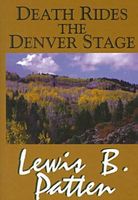
Death Rides the Denver Stage by Lewis B. Patten

I know Death Rides the Denver Stage will be a good one, since I've previously enjoyed Patten's short novel Wild Waymire. (Not to mention the numerous recommendations of his work by fellow bloggers and authors I admire.)

I also seem to have a liking for "Death does something" titles, given my enjoyment of both Death Waits at Sundown and Death Rides a Chestnut Mare (possibly my favorite title for a Western, and a damned fine read to boot).

(Patten himself wrote another called Death Rides a Black Horse, which has this fantastic review on Amazon you should read.)

Killer's Gun by Ray Hogan

Interestingly enough, in searching the electronic card catalog for newer Westerns, I came across the previously unknown name Ray Hogan. The cover to Killer's Gun intrigued me with its bold simplicity. So when Hogan was one of the names the elder gent recommended, I snatched it up with eagerness.

The book is a reprint of a 1966 novel by the prolific Hogan, who also has a good number of books available for the Kindle from Prologue Books. Luke Wade is searching for the man who killed his father. In the meantime, he gets work on a cattle drive and, against rustlers, manages to find ways to keep his "killer's gun" in good shape.
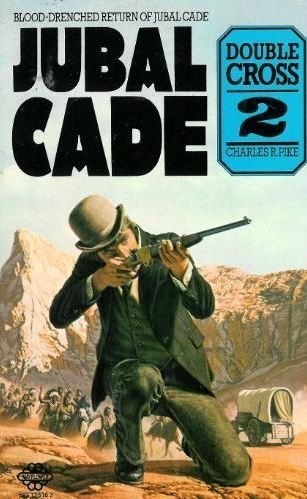
Jubal Cade #2: Double Cross by Charles R. Pike

My benefactor specifically pointed out this series as he stated that the library had all the volumes except the first. Numerous Web sources suggest that the first three books were written by author Terry Harknett, better known under another pseudonym as George G. Gilman behind the wildly popular and influential Edge and Steele series. (The Jubal Cade series was then continued to its conclusion by fellow "Piccadilly Cowboy" Angus Wells, with one intervening volume by Ken Bulmer.)

Based on the summary of this book, the first one saw poor old American doctor, trained in England, Jubal Cade losing his British wife to a killer Lee Kincaid and having to take a blind orphan boy under his care. Because of the need for money on his search for vengeance, he becomes a gun for hire. I've only read a couple of the Edge novels, but based on that, I'm excited to delve into this other series.

Thursday, November 15, 2012

Dark Thicket by Elmer Kelton (Civil War-era Western novel)

Owen Danforth is home from the American Civil War on temporary leave until his arm, deeply wounded by a Yankee saber cut earned in battle, heals well enough for his return. But Owen is not returning to a peaceful Texas: the people of his hometown are as divided here as on the battlefield. Even at home — Owen's father Andrew is a staunch Unionist though his son fights for the Confederacy.

But blood is thicker than politics, and to keep Andrew out of danger, Owen puts himself in the middle of a different kind of conflict but just as dangerous — and helping two women prisoners escape to the Dark Thicket from Phineas Shattuck and other local heel flies is just the beginning.

Elmer Kelton is one of the greats. His books have substance; they're as meaty and satisfying as a well-grilled T-bone. Buffalo Wagons was the first Western I read that made me realize the genre could offer depth along with a fast-paced read and historical authenticity. It's hardly a wonder that he has won 6 Spur Awards and was voted best Western writer of all times by his peers at the Western Writers of America.

In Dark Thicket, Kelton shows the other side of the Civil War — how it affected those back home, turning old friends into enemies (though those enemies are nonetheless eager to be friends again after the war is over). And in Phineas Shattuck, Kelton offers a villain that is both frightening in his realism and fun to hate in his over-the-top actions.

Kelton combines history with a no-nonsense writing style that expresses genuine human emotion without resorting to overt sentimentality, creating characters that are believable in their conflicted, sometimes inconsistent natures, with real feelings that linger in the reader's mind long after the book has been put back on the shelf. I feel I learned more about the actual effects of the War Between the States on individuals from Dark Thicket than from any history book.

Wednesday, November 14, 2012

Death Waits at Sundown by L. Ron Hubbard (pulp Western audiobook)

These days, L. Ron Hubbard's name is largely connected with the antics of the some of the more "outspoken" members of Scientology, overshadowing the fact that the man really knew how to tell an entertaining story. All 150 of the stories Hubbard wrote for the pulp magazines of the 1930s and '40s are being rereleased in paperback and audio under the evocative title Stories from the Golden Age.

The audiobooks are a professionally produced combination of traditional audiobooks, with narration deftly handled by actor R.F. Daley, and old-time radio, with skilled actors, genre-specific music, and sound effects.  Death Waits at Sundown contains three stories: the title tale, "Ride 'em Cowboy" and "The Boss of the Lazy B."

When a vigilante committee convicts young Frank Taylor of stage robbery, he is scheduled to hang at sundown. His brother Lynn tries to cast doubt on Frank's guilt by robbing the next coach himself -- with the help of the sheriff, whom the vigilantes ran out of office. This is an exciting listen that was first published in Street and Smith's venerable Western Story magazine in the fall of 1938.

"Ride 'em Cowboy" is easily filed under "ranch romance," so much that one would think it first appeared in the long-running pulp of the same name instead of a summer 1938 issue of Western Story. All his life "Long Tom" Branner has been developing his horsing skills in order to prove himself worthy of Vicky Steward. But Vicky is looking to prove herself, and nothing irks her more than competing and coming in second place to Long Tom. The lead actress in "Ride 'em Cowboy" is unfortunately a detriment to this audio, but the action-filled climax more than makes up for it.

All three of the stories dramatized in Death Waits at Sundown should appeal to fans of good old-fashioned Western pulp fiction, and even more so to those who have enjoyed the Western offerings of old-time radio.

Saturday, September 15, 2012

Shadows from Boot Hill by L. Ron Hubbard (western multi-cast audiobook)

On the run from the law for the hired killing of a banker, Brazos asks livery man Whisper Monahan to help him out. Brazos had to light a shuck immediately after the murder and had been unable to collect his fee: $500 in double eagles.

Scotty Brant has been poisoning lands downstream by using cyanide to get gold from iron oxide, killing entire herds of sheep and allowing Whisper to buy thousands of acres on the cheap.  Whisper offers Brazos $200 to kill Brant, giving Brazos much-needed funds and simultaneously allowing Monahan to make good on his land investment.

Trouble is, it's going to take three deaths to get one, because to get Scotty, Brazos has to get through son Swifty Brant and the family jujuman, Bilbo.  But a lack of superstition and a silver cross given by a Mexican girl are no match for a curse spat out by a dying witch doctor.

A supernatural Western originally published in June 1940 in Wild West Weekly, Shadows from Boot Hill, and its ilk were a rarity in the days of the pulps.  But author L. Ron Hubbard once again shows his talent and imagination, and this audio version, directed by Tait Ruppert with Firesign Theater alumnus Phil Proctor playing Whisper Monahan and Scotty Brant, is bound to appeal to fans of both the "weird" and the traditional.

The audio of Shadows from Boot Hill also features two more Western stories Hubbard wrote in the 1940s, "Gunman!" and "The Gunner from Gehenna", both directed by Jim Meskimen performed with equal skill by the participants, including Proctor and Meskimen himself.

Thursday, May 10, 2012

Hard Country: A Novel of the Old West by Michael McGarrity (family saga Western)

"When I first put Kevin Kerney on the page as the protagonist in my crime novels, I was already imagining his family history back several generations or more.... As the series progressed and Kerney grew and developed, I knew I would someday have to tell his family’s story generation by generation. I never once entertained the notion of simply writing the back story of Kerney’s life.... That seemed too mundane."
—author Michael McGarrity in an interview with Bookgasm

Fans of author Michael McGarrity have been waiting a long time since his last book, Dead or Alive, published back in 2008. And now that Hard Country is out, we know why. This beast of an epic Western was intended to be a single novel and ballooned into a trilogy!

McGarrity is best known for his series of southwestern mysteries featuring law enforcement officer Kevin Kerney. The only one of these I had read before Hard Country was Hermit's Peak, which was excellent, both as a mystery and as a portrait of New Mexico.

That McGarrity has been nominated for awards by both Western and mystery communities says a great deal about his ability in combining the genres. Hard Country is a deliberate departure from that series, but it retains a tie by going back into Kevin Kerney's ancestral line and telling the story of the expansion of the American West, from after the Civil War through the end of World War I, through the eyes of some of those involved.

From the opening portrait of a young wife's frustration with frontier life, I was caught up in McGarrity's characters' world. John Kerney is in west Texas to build up his Double K ranch. But, when his wife dies in childbirth, and his brother and nephew are murdered, he leaves his ranch and son behind to find the killers. Later, when Kerney decides to reclaim his son, Hard Country really starts to show its stuff. McGarrity's prose is so skilled as to be invisible, the words simply unveiling the story like truly great writing should.

It is impossible to read Hard Country and not recall some of the often-cited Western classics like Larry McMurtry's Lonesome Dove and A.B. Guthrie's The Big Sky in its sheer scope. But the book it most reminded me of was Wallace Stegner's The Big Rock Candy Mountain, especially in its portrait of a father. At nearly 700 pages, the sweep of Hard Country is breathtaking, and yet its pages zip by like a desert wind and remains accessible to even the most reluctant reader. I'm already looking forward to the sequel.

Monday, April 2, 2012

Outlaws All by Max Brand (Western novellas)

Outlaws All contains three novellas by author Max Brand. Like many of the novella collections released by Leisure Books, they are completely unrelated, except that they all originally appeared in Western Story Magazine, and two of them in 1921. Luckily, this does not matter so much, as Frederick Faust (under whatever name he wrote) was such a good writer that it is hard to go wrong with his work at any length.

"Alec the Great," a prologue to author Max Brand's novel Sixteen in Nome, was originally published in 1930 as "Two Masters." It is a "chronicle of hatred" between Massey and Calmont. The duo were inseparable friends, though almost total opposites. Then a third made them even more devoted enemies.

A girl? No indeed. It is a canine force that draws these friends apart: the titular puppy, Alexander. Confronted with this addition to their Alaskan gold-finding venture, the pair seem to completely forget their search... and their friendship.

This novella is a good example of why I enjoy Max Brand so much. In addition to his poetic yet accessible style, he writes nontraditional Westerns of other frontiers (called "North-Westerns" by some).

"Riding into Peril" saw print in November 1921 as by John Frederick. The Kid — Kestrell Irving Dangerfield — was a true presence in Jorgenville. His silky blond hair and mild blue eyes drawing the ladies to him, and his way with a gun endearing him to the townspeople due to his ending fights with transients (not starting them).

Justice Bland, even with his affection for Dangerfield, knows the Kid needs to be taken down a notch. But he has no legal recourse until Dangerfield accidentally wounds an innocent bystander — even though the Kid apologized immediately, took the victim right to the doctor, and paid his bill. Bland then tries to teach the Kid a lesson, saying he will make sure Dangerfield serves a full six years in the county jail unless he promises to forever put down his guns.

The title story, "Outlaws All," appeared in September 1921 and features Brand's popular Bull Hunter character. It was, in fact, used as the opening chapters of that character's second eponymous novel. (A total of five novellas comprise the two novels Bull Hunter and Bull Hunter's Romance.)

The main focus, however, is on the half-wolf, half-dog known as The Ghost. The first chapter is a beautifully written and self-contained tale of the Ghost's attack on a bull, and the majority of it is told from the dog's point of view. This is unusual even for Brand, who is even now remembered for taking the Western to uncommon places.

This trio of Western novellas was a treat, and both those who enjoy traditional Westerns and those looking for something a little different will find something for them in Outlaws All.

Sunday, October 23, 2011

Ten Great Western Novels (top 10 best of list)

My friend and co-editor of Living After Midnight: Hard and Heavy Stories, David T. Wilbanks, asked for recommendations of some good Western novels. Here's the list I gave him. They're in no particular order (except the order in which I thought of them).

I was rather pleased with what I came up with, so I thought I'd share it here. There will surely be contention with some of my choices, but I greatly enjoyed them all, and I think they display the genre's breadth of possibilities.

Another fantastic book, which takes place in the West in the early 1900s (and thus isn't a traditional "Western"), is The Big Rock Candy Mountain by Wallace Stegner.

Monday, June 27, 2011

Rio Loco by Robert J. Conley (Barjack series Western)

When local outlaw Owl Shit Johnson commits his latest murder, he makes the mistake of doing it right in front of the town's marshal, Barjack. Owl Shit is used to being bailed out by his brother, Chugwater, but Barjack can't be bought off. He might be prone to extreme violence and heavy drinking, but the marshal of the town of Asininity upholds the law.

Because of a promise made to their mother to take care of his little brother, Chugwater is determined to break Owl Shit out of Asininity's jail before the county judge arrives to sentence Owl Shit to be hanged. And Barjack is determined that the murderer will be face his punishment. This results in an "irresistible force"/"immovable object" fight of near-epic proportions.

Author Robert J. Conley is a three-time winner of the Spur Award from the Western Writers of America, and his character Barjack is one of the most entertaining I've encountered. He has his own way of doing things, and his code is not above using dynamite to make a point when the outlaws just don't seem to get it.

Barjack tells the story, and his voice is its primary appeal. But I was never once bored, even though Rio Loco (whose title, strangely, never appears in the text) is mainly an attack-and-defense story all the way through. Chugwater hires cowhands to do his dirty work, and Barjack deputizes a selection of trusted gunmen and -women to defend their post at the jail.

Each must try to outshoot or outwit the other to get his way, and neither is willing to give up his own, to the death. The fact that both are fighting for his own deeply held moral code — Chugwater's promise to his mother, Barjack's upholding of the law — makes it hard to feel that either is completely "wrong."

Conley peoples this mostly traditional Western with interesting characters and balances moments of shocking carnage with others of light humor, so the reader never knows what to expect. This gives Rio Loco a very modern appeal. I liked it so much that I immediately acquired a copy of the preceding volume in the series, Barjack and the Unwelcome Ghost, available in both ebook and mass-market paperback — for a limited time, I'm sure — for around a buck and a quarter.

Wednesday, April 6, 2011

Guest Blogger: Don Bendell, author of Strongheart: A Story of the Old West

Today I have the honor of welcoming author Don Bendell to the pages of Somebody Dies. Bendell wrote 10 popular Westerns in the 1990s (the Colt series), but after the fall-off of Westerns, he switched to military thrillers. A real cowboy, he longed to return to writing Westerns.

He liked the name of his hero in Detachment Delta, Charlie Strongheart, so much that when his editor asked him to return to Westerns, Bendell said the first book would be named Strongheart. The author and his wife own the Strongheart Ranch in southern Colorado and have even registered the Strongheart brand.


Strongheart is centered around the Fremont, Custer, and Saguache Counties in Colorado territory in 1873. The story begins with an action-packed stage holdup on Copper Gulch Road and a promise made to a beautiful grieving widow to get back her stolen antique wedding ring. The promise is made by the tall, handsome Joshua Strongheart, a half-white and half–Sioux Indian Pinkerton agent. There are fights, chases, and shootouts from Canon City and Florence to Hardscrabble and Villa Grove in the southern Colorado Front range area.

The plot involves Strongheart couriering a letter signed by the President from the US War Department to Major General Jefferson Davis, who has captured Captain Jack of the Modoc Tribe. Captain Jack is scheduled to be executed by firing squad. Washington does not want the popular Modoc chief, who embarrassed the army eluding capture, to become a martyr, so the missive clearly directs Davis to assure that the chief and his followers get a public and fair trial.

The story also centers around the fact that Strongheart gave his word to a beautiful widow that he would get her ring back. He lives by the creed that a man is only as good as his word, and the storyline proves it as he hunts down the gang who robbed the stage, man by man, and survives gun battles, ambushes, and even has a run-in with a large grizzly bear.

In the process of all this, Strongheart falls in love with the young widow, but it is an unrequited love, as her husband has only been dead a year. She still feels a loyalty, and the highly principled Strongheart feels honor-bound not to proclaim his growing all-out love for her. Strongheart is full of action and suspense from cover to cover, and you’ll have to read it to see how Josh and the widow come out.

Read on for an excerpt from Strongheart...

The tall warrior grabbed his bag and headed to the nearby stream to bathe, clean off his war paint, and change clothes. The Lakota or Sioux and their allies, the Cheyenne and Arapaho, were meticulous about bathing and keeping clean, and he was amused how so many racist wasicun, or white men, used expressions such as “filthy redksins.” The Lakota actually viewed many whites as being very dirty and unkempt.

Thirty minutes later, he returned to the circle of lodges from the stream. Lila Wiya Waste looked at him approaching with a great longing. She wished he was not her first cousin, but wished more he would look at her the way the other braves did. He now was dressed in his normal manner of dress and looked like a totally different person, a white man, with Lakota features.

His long, shiny, black hair was no longer braided but hung down his back in a single ponytail, and it was covered by a black cowboy hat with a wide very flat brim and rounded crown. A very wide, fancy, colorful beaded hat band went around the base of the crown.

He wore a bone hair pipe choker necklace around his sinewy neck and a piece of beaded leather thong hung down a little from the front with a large grizzly bear claw attached to it.

His soft antelope skin shirt did little to hide his bulging muscles, and the small rows of fringe which slanted in from the broad shoulders in a V shape above the large pectoral muscles and stopping at mid-chest, actually served to accentuate the muscular build and narrow waist that looked like a flesh-covered washboard like the wasicun women used.

Levi Strauss had recently patented and started making a brand new type of trousers made of blue denim which whites were calling “Levi’s.” They had brass rivets and Joshua had bought a couple pairs from a merchandiser, who bought them himself for $13.50 for each dozen pairs. They were tight, and they too did little to hide the bulging muscles of his long legs.

Around his hips, Joshua wore his prized possessions, one a gift from his late-step-father and the other a gift from his late father. On the right hip of the engraved brown gunbelt was the fancy holster, with his step-father’s Colt .45 Peacemaker in it. It had miniature marshal’s badges, like his step-father’s own, attached to both of the Mother of Pearl grips and fancy engraving along the barrel. It was a brand new single action model made especially for the army in this year, 1873, and this one was a special order by his step-father’s friend Chris Colt, who was a nephew of inventor Colonel Samuel Colt.

On his left hip was the long beaded and porcupine-quilled and fringed leather knife sheath holding the large Bowie-like knife with the elk antler handle and brass inlays. It was left to him by his father.

He wore long cowboy boots with large-roweled, jingle-bob Mexican spurs with two little bell shaped pieces of steel that hung down on the outside of each from the hubs and clinked on the spur rowels as they spun or while he walked.

Because he had always been trained to keep his weapons clean and knife sharp, Joshua pulled the large knife from the sheath and examined the blade. As usual, it was scalpel-sharp.

Lila Wiya Waste, his cousin, handed him a cup of hot coffee from the large pot he gave her months earlier. He sipped the steaming brew and thought about his childhood quest to learn about his biological father and search for blood relatives.

His biological father, Siostukala, Claw Marks, had disappeared when Joshua was young and was a total mystery to him for many years. His mother would not tell him anything about the man, and Joshua quit asking, because tears would well up in her eyes every time his name was brought up. Joshua figured he must have caused her very painful memories. Asking when family friends were trading with the Sioux, he traveled to Lakota villages every chance he got to locate him.

Finally, at 16, he met his half-brother who grew up with Siostukala . His 13-year-old half-brother named Cate Waste, meaning “Cheerful,” told him how his father died a year earlier.

Friday, March 25, 2011

The Brave by Nicholas Evans (unabridged audio book read by Michael Emerson)

Nicholas Evans, a British author with a fascination for the American West (he also wrote The Horse Whisperer), returns to his forte with The Brave. It centers on Tommy Bedford, a divorced documentary filmmaker with an estranged son, and Evans leaps back and forth in time as he covers different parts of Tommy's life.

The primary focus is on his childhood, including his time at boarding school, the dotage of his sister Diane — an aspiring, then famous, actress (then convicted murderess) — and her turbulent relationship with TV cowboy Ray Montane.

Montane is the star of Sliprock, and he's watching the coming end of the heyday of the Western — and watching his grip on Diane crumble under the weight of lies.

We also learn about Tommy's courtship of his wife Gina, which leads to marriage and the birth of their son Danny. In the present, Tommy is trying to reconnect with Danny after a long period of estrangement. Danny is an Iraq war veteran, a lance corporal currently under investigation by the Marines. Evans juggles a number of storylines without giving a single one short shrift.

All in all, The Brave is a satisfying, moving listen filled with genuine human drama. It will likely appeal to a wide variety of listeners, from fans of TV Westerns and classic Hollywood, to those who appreciate coming-of-age tales, picaresques, and mainstream literary fiction — old or young, male or female — because its main subject is families, both the ones we're born with and the ones we choose.

This isn't usually the kind of novel I seek out to read, but the Western connection intrigued me enough to begin it, and then I had to see it out to the end. Actor Michael Emerson (Ben Linus on Lost) does a fine job reading The Brave. His voices are sometimes indistinguishable, and his characters' accents seem to come and go, but his gentle narration allows the material to bloom.

Wednesday, January 26, 2011

Merkabah Rider: The Mensch with No Name by Edward M. Erdelac (weird Western novella collection)

This review is going to be pretty lame, but it has nothing to do with the quality of the book being reviewed (if such a word can be used here). It is purely due to my lack of organization. As an old-fashioned sort of fellow, I write out my reviews in longhand on a notepad, taking notes and fashioning opinions in the midst of reading the book.

Unfortunately, however, in the case of Merkabah Rider: The Mensch with No Name by author Edward M. Erdelac, after my review was written — but before I had the opportunity to transcribe it here — I lost it.

I was keeping it inside the book, as usual, and when I went to get the book and bring it to the computer, the paper wasn't there. Couldn't find it anywhere. I looked up and down for days. And, almost worse, when I attempted to recreate what I had written, I was unable.

But The Mensch with No Name deserves a review of some kind because it's quite a good read. If you enjoyed the first book in the series, the fantastic Tales of a High Planes Drifter (which made my Best of 2010 list) — and if you haven't read it, you definitely should before tackling this sequel — then you will enjoy this one.

If you're completely unfamiliar with the concept, read the review of that book for the basics, and transpose those superlatives to this one. With Merkabah Rider: The Mensch with No Name, Erdelac confirms my original impression that he has joined the ranks of Robert E. Howard (whose creation Nameless Cults is referenced, much like his "Kelly the Conjure-Man" inspired a tale in the first collection) and Joe R. Lansdale, two of my favorite authors and the kings of the weird Western. I look eagerly forward to further Rider adventures, and hopefully I'll be a little more careful with my notes next time.

Friday, January 14, 2011

Game of Chance (Diamondback #4) by Frank Roderus writing as Guy Brewer (adult series Western)

On the run from a rich Texan whose father he killed, Dexter Yancey and his best friend James are on their way to the Indian Nations. Dex is a gambler and con man. James is a former slave.

The duo are so inseparable that they even got the same education, and they both have surprises in their future — James because he's treated like nothing less than a human being, Dex because he's mistaken for a hit man. But the $3,000 fee from the fat man is too appealing to pass up.

Dex will, of course, do what he can to avoid having to actually earn that fee (and still keep it), especially when he meets the beautiful intended victim, widow Wilhelmina Stout.

Game of Chance is longer than the usual adult-series Western at 200 pages, plus it has the writing of author Frank Roderus (Charlie and the Sir) to recommend it. (Roderus wrote the entire short-lived Diamondback series under the house name Guy Brewer.)

The repartee between Dex and James sometimes feels forced, but they have genuine brotherly affection for one another. The main draw for this entry in the series, however, is that it offers up a surprising revelation about the main characters from an unexpected source.

Roderus seems to be striving for a level of character involvement here, and actually using the series format for long-term story development, something I had heretofore not seen in this genre. That, along with the talents of its author, is enough for me to recommend Game of Chance.

Monday, January 3, 2011

Cattle King for a Day by L. Ron Hubbard (unabridged multi-cast audio book)

After receiving news of his grandfather's death, Chinook Shannon heads north from Arizona to Bull Butte, Montana, to take over the Slash-S ranch. What he finds is surprising: not only in the property in debt to the tune of $26,000 but it's also been commandeered for gold mining, and a fellow named Brad Kendall doesn't want Chinook to get to the ranch. The bank is about to foreclose, and Chinook has twenty-four hours to set things right or he'll only be Cattle King for a Day.

Author L. Ron Hubbard was a master of the action Western, filling his stories of adventure with plenty of gunplay and vengeance. "Cattle King for a Day" (originally published in All Western Magazine's March 1937 issue) is enhanced by authenticity springing from Hubbard's time living in Montana, complete with details on local mining, banking, etc.

But humor is welcome here as well. One passage in particular from "Cattle King for a Day" brought a smile — where the author describes the stream of epithets and obscenities directed by Kendall toward Sheriff Taggart:

It was all unquotable. It treated Taggart's family tree from its inception, followed through several-score generations, caught up with Taggart's personal appearance, filthy habits, general demeanor, and went on to revite Taggart's posterity.

In addition, the character of Sheriff Taggart offers a sense of nostalgia for fans of the comic quartet Firesign Theater, as the actor who voices Taggart, Phil Proctor, borrows heavily from his portrayal of used-auto salesman Ralph Spoilsport, first heard on the group's classic album How Can You Be in Two Places at Once When You're Not Anywhere at All.

Also on this audio is "Come and Get It" (from the October 15, 1938, issue of Street & Smith's Western Story). Bill Norton arrives at Wolf Junction, Wyoming, as the new owner of the Bar N, met only by the station agent and a prairie dog, apparently the only residents — even "at the early hour of 11" — of this veritable ghost town.

Bill soon discovers there's actually very little waiting for him but a pair of sixguns and an unpleasant surprise: his father was murdered. But how is a tenderfooted Easterner who's never fired a gun supposed to avenge his father? With the help of a clever mind and a clever dog, and a twist ending that leaves the listener with a smile.

These two Western stories of men and their new properties, which hold surprises neither of them is prepared for, make for a good pair of listens that more than fill the two-hour running time of Cattle King for a Day. I find myself more and more on the lookout for these Galaxy Audio productions, as they are sure (with a few exceptions) to provide an engaging and exciting pulp-adventure experience.
Related Posts with Thumbnails