Showing posts with label dark fantasy. Show all posts

Monday, December 27, 2010

Living After Midnight: Hard and Heavy Stories, edited by David T. Wilbanks and Craig Clarke (hard rock and heavy metal inspired anthology of dark fantasy and horror stories)

I am very proud to say that my first book is now available — a project nearly two years in the making! See more below, beginning with Carrie Gowran's utterly awesome cover art, which perfectly encompasses the anthology's hard-rock and dark-fiction aspects.


Living After Midnight: Hard and Heavy Stories
Edited by David T. Wilbanks and Craig Clarke
—A Hard-Rockin' Horror and Dark-Fantasy Anthology—

WHAT HAPPENS WHEN HEAVY MUSIC INSPIRES DARK FICTION?


Living After Midnight: Hard and Heavy Stories consists of six horror and dark-fantasy stories inspired by some of the greatest hard-rock and heavy-metal bands in that music’s long and influential history. Each author was invited to submit a short story or novella inspired by the band of his choice.

You're sure to be impressed by the half-dozen diverse tales they came up with. The set list is as follows:

“Spooky Tooth” by Randy Chandler
“Iron Maiden” by Matthew Fryer
“Black Sabbath” by Steven L. Shrewsbury
“Judas Priest” by David T. Wilbanks
“Motorhead” by Kent Gowran
“Slayer” by L.L. Soares


An original lineup indeed. Grab a copy now for only $2.99 because you’ll not want to pass up the chance to read six of the sharpest, savviest, hardest, and heaviest stories published this year.

Reviews:

"One of the things that make having an e-reader worthwhile." — Dead in the South

"Heavy metal horror heaven." — Ginger Nuts of Horror

"A good variety pack of scary stories ... an easy read, and a satisfying one." — Patrick D'Orazio

Now available on:
Amazon
Diesel
Sony
Smashwords
.

Sunday, November 21, 2010

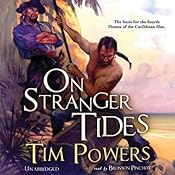
On Stranger Tides by Tim Powers (unabridged audio book read by Bronson Pinchot)

This review was originally published on SF Site.

John Chandagnac, son of a puppeteer, is still mourning his father's death when he sets out for Jamaica to get back his inheritance from the uncle who stole it. To this end, he charters the Vociferous Carmichael but gets to see another side of sea life when it is attacked by Phillip Davies, privateer and captain of the sloop Jenny.

Chandagnac gets on the wrong side of a pirate captain (by defeating him with sword techniques learned for puppet shows) and is offered the choice to either join them or die. Now christened "Jack Shandy," he discovers that the people he thought were on his side are simply out for themselves (isn't that always the way?) — including one's strange plan for the legendary Fountain of Youth, which has very different powers than usually supposed.

On Stranger Tides, the 1987 novel from author Tim Powers now available in audiobook form, is also the source material for the fourth film in the Pirates of the Caribbean series, gladdening many of Powers' fans since that will undoubtedly bring his work closer to the mass appeal they have long felt he deserved. The option apparently existed long before it was revealed, since the third film in the series most definitely foreshadows this book's Fountain of Youth plot.

For those who have not experienced his work before, Powers is a discovery. On Stranger Tides combines the mundane and the supernatural into a gripping narrative filled with high adventure. It has the potential to please readers of most forms of genre fiction, with plenty of gunfire and swordplay alongside voodoo, zombies, ghost ships, and sorcery, with numerous startling twists that never stretch the bounds of plausibility. There's adventure, revenge, romance, and intrigue all folded together into a cohesive whole as Powers never loses sight of his primary goal of telling a ripping yarn. He maintains a consistent level of tension throughout, along with a great deal of humor, toward a thoroughly satisfying conclusion.

Another discovery made through listening to On Stranger Tides is the highly advanced narrative skill of actor Bronson Pinchot. Pinchot is probably still most widely known for either his seven-year stint as the pseudo-Greek naïf Balki Bartokomous on the situation comedy Perfect Strangers or for his scene-stealing turns as Serge in two Beverly Hills Cop films. But his deft handling of unplaceable accents in those roles does not prepare one for his reading of Powers' work. The sheer number of accents Pinchot tackles is impressive, and his ability to distinguish characters while juggling various dialects within a single conversation is nothing short of astonishing, making the audio rendition a much fuller experience than the text alone could provide.

Monday, August 9, 2010

The Tilting House by Tom Llewellyn

When the real estate agent shows the Peshik family Tilton House, she is honest about the flaws: the floors tilt at a three-degree angle, and they were designed that way; the walls and floors are covered in script and drawings of a scientific and artistic nature. But the wood is gorgeous, and the price is certainly right — especially when the agent (desperately, it seems) shaves $20,000 off the asking price — so, they take it.

Then weird things start happening, and not just the kleptomaniacal leanings of the mumbling neighbor known only as Purple Door Man. I mean, weird things like the brutal murder of a Rattus rattus, resulting in the victim's father (Mr. Daga by name) getting so peeved he gives Mr. Peshik a talking-to then sells off his rare coin collection (the rat's, that is) so he can buy the house next door and relocate his remaining family.

Oh, and let's not forget the pair of undertakers who go around town, delivering their business cards, one at a time, to the person who'll die tomorrow. Author Tom Llewellyn's debut novel, The Tilting House, continues in this mostly episodic fashion, telling various stories presented as the events of the day, with the next day (or thereabouts) bringing on the next story. This not only makes it easy to find a stopping place if you need to put the book down for a spell, but it also makes the strangeness a little easier to take instead of all at one.

The Tilting House is geared toward readers in the 9-12 age group, but this much older reader found himself swept up in the linearly presented vignettes. There's a little of everything here: suspense, humor, adventure, horror, mystery, and a lot of heart. Llewellyn's story is imaginative and just weird enough to keep the reader interested, but it is also grounded in the realities (such as they are) of a family trying to get used to a new house.

What does Grandpa's leg share with their dining-room set? Why does the dimmer switch bring reporters around? What are the "deadly" consequences of the mysterious "grow powder" found inside the box in the attic? Who was the mysterious F.T. Tilton, and why did he write all over his house? The answers to these and other questions reside in The Tilting House. The result is a sort of House of Leaves for the grammar-school set. One thing is for sure: you'll never see moss the same way again.

Tuesday, July 27, 2010

Guest Bloggers: Kelley Armstrong (author of Waking the Witch) and Marjorie M. Liu (author of A Wild Light) interview each other about dead mothers in their fiction

Today I have the honor of welcoming authors Kelley Armstrong and Marjorie M. Liu to the pages of Somebody Dies. Authors of over a dozen novels each, Armstrong's most recent is Waking the Witch, the latest in her "Women of the Otherworld" series, and Liu's newest is A Wild Light, the third of her "Hunter Kiss" books.

In this exclusive exchange, Kelley Armstrong and Marjorie M. Liu discuss maternal murder, appropriate since both of their main characters have mothers who were murdered. In Armstrong’s series, Savannah Levine has dealt with that over the course of the series, but it, of course, still looms large in her character. The same holds true for Maxine Hunter, the main character in Liu’s novels.

Here the authors discuss more about how having murdered mothers have affected the main characters of their novels. Both Waking the Witch and A Wild Light are on shelves (virtual and otherwise) today.


Kelley Armstrong: When we met Savannah in the second Otherworld book (Stolen) she was twelve and her mother, Eve, had just died. Eve had been targeted by a group kidnapping powerful supernaturals. When they came for her, Savannah was at home playing sick. She's always felt, then, that if she hadn't been skipping school, her mother wouldn't have needed to protect her and could have fought off her kidnappers or escaped.

When Eve is killed trying to escape the compound, Savannah knows she was her main reason for escaping (otherwise, Eve would have waited it out). That's a lot of guilt to put on a twelve-year-old.

I always knew that when I gave Savannah her own story, she'd need to deal with that guilt. In Waking the Witch, then, I mirrored her tragedy with a similar one. She goes to a small town to investigate three murders and immediately bumps into the preadolescent daughter of a victim, who is investigating her mother's death. That takes what would have been "just a case" for Savannah and turns it into something very personal.

Marjorie M. Liu: Oh, man. I could probably write a whole book about the archetype of orphans in fiction. In Maxine's case, her mother was her entire world, the only human person she could count on as both friend, protector, and confidant. So when she was murdered — in front of Maxine, no less — it totally ripped her heart out.

It set her adrift, made her a child of the world (for lack of a better term), belonging to no one and no place except herself. Without another person to ground her, she was outside the world, observing it from a distance that was influenced by both her upbringing and broken heart.

So that's her mental state when the series begins. Which isn't to say that Maxine is moping around being depressed. She's out fighting the bad guys, doing what needs to be done. Telling herself to be strong because others need her.

But she needs people, too, and I always knew that her story would be more about her emotional and spiritual journey than the physical war between herself and the demons. That wasn't a random decision on my part. As readers will discover in A Wild Light, Maxine is power. And it's the strength of her heart — the goodness of her heart — that will determine whether the people of Earth live or die or become enslaved.

Many thanks to both authors for agreeing to interview each other for Somebody Dies. Don't forget to pick up copies of Waking the Witch and A Wild Light from your favorite bookstore.

Tuesday, March 30, 2010

Encyclopedia of Weird Westerns by Paul Green (reference/analysis)

This review originally appeared in somewhat different form on The Green Man Review. Copyright 2010. Reprinted with permission.

Traditional Westerns offer some of the best reading around, but an enthusiast also appreciates a blending of genres now and then. Westerns with crime-fiction tropes are fairly easy to find; that's just your average historical mystery with a different setting — and what Western doesn't include some sort of crime? But what about tales of the Old West that have horrific or supernatural elements? For that, you have to go to the "Weird Western."

But once you have decided to pursue more of this relatively obscure subgenre, where do you find more? Apart from coming across one accidentally, or finding the rare like-minded individuals to offer recommendations, it is hard to know where to look. Luckily, author Paul Green has solved that problem for the time being with his Encyclopedia of Weird Westerns.

From the beginning, it is clear that Green has an affection for his work. In the preface, he states that the Encyclopedia of Weird Westerns "covers the history of [the genre, dating] back over 150 years." But he also warns that the reader will not find only classics within, that the quality "ranges from top-class and innovative to repetitive and formulaic," and that he has not left out works that "might be considered in bad taste or offensive. The weird by definition attracts the weird."

Green has compiled hundreds of titles and authors of (and characters from) Weird Western stories, novels, movies, TV shows, comics, video games, and more. He covers the gamut from the only slightly weird to the truly odd, from early dime novels to current role-playing games, dividing them all into six basic categories: the Weird Western (with horror and fantasy elements), the Weird Menace Western (supernatural events with a rational explanation), the Space Western ("cowboy with a ray gun" — probably the most popular with the mainstream, it includes such favorites as Edgar Rice Burroughs's John Carter series, Star Wars, Firefly, and the recent Avatar), the Science Fiction Western (future technology, aliens, or post-apocalyptic themes — Green includes a very thorough rundown of The Wild, Wild West), the Steampunk Western (incorporating Victorian technology), and the inevitable Weird Western Romance (which is fairly self-explanatory; it seems like every genre has its "romance" offshoot).

Most surprising to this reader, all ages are represented, from the Indian in the Cupboard books and Four Feather Falls TV series for children, to the Djustine comic books for adults — a combination of the Marquis de Sade and the spaghetti Western that details the "sexually graphic adventures of the large-breasted female gunslinger and her fight with the supernatural including zombies, vampires, and Diabla, daughter of Satan." (I can hear the keyboards tapping into search engines already. That's one sure thing about Weird Western enthusiasts: the more outlandish it is, the better we like it.)

Given Green's experience as a comics artist (Marvel UK, DC Egmont, Golden Books USA) and a TV historian (A History of Television's The Virginian, 1962–1971), it's not surprising that the Encyclopedia of Weird Westerns focuses more on visual media than on more traditional stories and novels — though it could simply be a case of "weirdness" being more acceptable in visual form. Green even makes sure to include Western-centered episodes of otherwise non-Western TV shows, like Sabrina, the Teenage Witch, Highlander, and Star Trek: The Next Generation (you've got to love that holodeck!).

It is very easy to get lost in the Encyclopedia of Weird Westerns, so make sure to set aside a good deal of time when you pick it up to "just look something up." There are plenty of discoveries awaiting, and some old favorites to revisit. I'm sure some favorites have been inevitably omitted (the one I noticed was Steve Vernon's zombie buffalo novella Long Horn, Big Shaggy), but even Green is aware of this. As a supplement, he has created a weblog, called Weird Westerns, where he posts news and reviews of more recent titles. Jump on the robotic-horse-drawn stagecoach and ride into the world of the Weird Western.

Friday, March 26, 2010

Wraiths and Worlds by Darrin Charles Wilson (dark fantasy)

Six years ago, I read author Darrin Wilson's debut novel, Pine Shallow, and saw behind the unpolished writing that there was an original thinker with a talent for storytelling. Since then, Wilson's writing has improved markedly, and he's still coming up with new ideas.

Wraiths and Worlds is a formerly online serial novel now available in print with a previously unseen ending. Tired of playing publishing games, for this story Wilson went straight to the Internet. He posted the first chapters and was about to move on to his next project when he received inspiration in the form of readers from around the world wanting to know what happened next.

The story concerns Grace Tiffen, a black, 23-year-old law student who dies in a car crash and finds herself naked in the middle of an Arctic wasteland. Helped by some other local denizens, she learns that this is the afterlife but that God has left. The one person Grace really wanted to see, her father, is also absent, so she and a fellow who calls himself Deacon go off to find them both. But soon people start dying, and what kind of afterlife kills you after you get there? And what kind of afterlife does God ditch when the going gets tough?

Meanwhile, during Grace's funeral, her psychic aunt Abigail is confronted by Jonathan Sand. He's looking for a book, and he has traced it to Abigail's grandmother. When Abigail find the strange, fleshy book in her library, Sand kidnaps her and takes her on a quest through the Middle East, including a place called the Devil's Needle, where wind storms can result in death by airborne scorpion swarm. When Abigail is able to make contact with Grace, things just get weirder, like the formation of a snowy crevasse in the middle of the desert.

Wilson combines tropes from sci-fi, fantasy, adventure, mystery, and horror fiction to produce a book that has a little something for everyone. He studied and combined numerous world religions to come up with the theology he presents here. I don't usually get into books with such a high reliance on "otherworldliness" — although my appreciation for it is increasing — but Wilson's characters are so well drawn I had to know what happened. Sometimes his words get in the way of his story, but there's enough pure talent in Wraiths and Worlds to carry the reader through to the end.

Wilson was probably right to avoid traditional publishing routes with this book, since they would not know how to market it. Which genre's audience do you focus on? In any case, Wilson poses some very interesting ideas about the nature of God, and he's left plenty of room for a sequel. Wraiths and Worlds is smart fiction, that rare kind that successfully brings a new perspective to an age-old concept.

Thursday, October 1, 2009

Crimson Shadows: The Best of Robert E. Howard, Volume One (edited by Rusty Burke, illustrated by Jim and Ruth Keegan)

This review originally appeared in somewhat different form on The Green Man Review. Copyright 2009. Reprinted with permission.

Robert E. Howard wrote short stories during the heyday of the pulp era, mostly for Weird Tales, from 1924 until his death by suicide in 1936 at age 30. Howard wrote in various genres, but he is now best known for his stories popularizing the fantasy subgenre "sword and sorcery," and especially the Cimmerian hero popularly known as Conan the Barbarian. His range of talent, however, is becoming better known, as pulp-era fiction regains a modern readership. Subterranean Press and Del Rey Books are doing their part to keep Howard's name in front of book-buyers with, respectively, their limited-edition hardcover and affordable trade-paperback collections of his work. Crimson Shadows: The Best of Robert E. Howard, Volume One is the first of two "best of" retrospectives.

Compiler and editor Rusty Burke has done a great job selecting 16 stories and 12 poems that offer an idea of the range of Howard's output. Helping him in his selection was a poll of Robert E. Howard fans; 19 of the top 25 vote-getters are included. Everything from sword and sorcery to adventure to horror, from crime to boxing to Westerns, is showcased here. This does give the collection a scattered feel sometimes, but what holds them all together is the quality of the author's writing.

Both versions of Crimson Shadows are illustrated by Jim and Ruth Keegan. I find their art serviceable but too static for Howard's active prose. It probably would have been good enough had I not first read The Horror Stories of Robert E. Howard, illustrated by Greg Staples. His art in that collection is so emotionally and physically realistic, often seeming to glower or move on the page, that it makes the Keegans' work pale in comparison. Rarely do the couple choose to depict action scenes, and when they do, the positions feel posed, where Staples seems to catch his subjects in mid-motion.

For Keegan devotees, however, the Subterranean Press limited edition hardcover is a must have. It is not only signed by the artists but also has four new color plates (one of which also serves as new cover art) not included in the Del Rey trade paperback.

Opening the collection is "The Shadow Kingdom," featuring Kull from Atlantis, usurping king of Valusia. Kull meets his own attempted usurpers in the Serpent Men, a fascinating race of snake-headed individuals who deal in mesmerism and shape-shifting. Kull has to struggle with his own doubts to maintain the throne. Though similar in many ways to the later character of Conan (the first Conan story was a rewritten Kull story), I find Kull superior due to his tendency toward deeper thinking. (He appears twice more in this collection.)

"Red Shadows" introduces Howard's 17th-century Puritan hero Solomon Kane. Avenging the death of a young woman, Kane travels for years to find Le Loup ("the wolf"), meeting "good juju man" N'Longa — who later plays a larger role in Kane's life — for the first time. Howard doesn't shy away from the action here, putting Kane in peril no less than three times. Many consider this the beginning of the sword-and-sorcery genre — "The Shadow Kingdom" also has its supporters for that title — with the main difference being this one's use of a realistic setting (Kull lives around 100,000 years B.C.). I've experienced "Red Shadows" multiple times, in print and audio, and it never loses its power to entertain. Both Kane and Le Loup are indelible characters, and the action sets up Kane admirably well for his later stories. (The poem "One Black Stain," also included here, has Kane stand up to Francis Drake in the face of an execution.)

In "The Dark Man," Turlogh Dubh goes to save a girl from his family though his family no longer recognizes him. This story is a terrific adventure with a surprise that connects it to another Howard stalwart, Pict king Bran Mak Morn. "Kings of the Night" brings Bran and Kull together through an ancient lineage. A wizard conjures Kull up from the ancient past when Bran's potential fighters ask for "a king, neither Pict, Gael, nor Briton" to lead them against the invading Romans. This is truly one of the great battle stories, with realism, history, and myth blended in ideal measure.

Sailor Steve Costigan is confronted with the prospect of a dog fight involving Costigan's best pal Mike, a bull dog,in "The Fightin'est Pair." This story, one of Howard's famous boxing yarns, showcases in a surprisingly sensitive manner, without getting blubbery, the love of a man (who talks with his fists) for his dog. Those wondering if Howard had a more romantic side need only read "For the Love of Barbara Allen," a story of love across time, told in the style of a Southern folktale. I was so surprised at how moving it was, that it just may be a new favorite.

An unexpected highlight of this collection is a selection of Howard's Lovecraftian horror. H.P. Lovecraft was Howard's friend and mentor, and they corresponded by mail for years. Howard's confidence is astonishing, as he boldly makes his own additions to the Lovecraft canon (Von Junzt's Nameless Cults, poet Justin Geoffrey) that have become as much a part of the Mythos as Lovecraft's own works. But even as he adds to another author's world, he remains firmly in Robert E. Howard territory, and these tales are just as enjoyable with no prior appreciation for such "Yog-Sothothery" (what Lovecraft called the practice of Mythos-sharing, which he supported).

Having long been enthralled by tales of rare books and their supernatural effects on unassuming readers, I was deeply engaged by "The Black Stone," especially by the fact of its tangential relationship to "Worms of the Earth" (wherein Pict king Bran Mak Morn searches for the same Black Stone). Read together, they immerse the reader in a fascinating otherworld in a way that would be impossible encountering the pieces individually.

As you may surmise from the title, "Lord of the Dead" is less a mystery than an adventure tale, though it is up to oversized detective Steve Harrison to figure out why someone who died 30 years ago is trying to kill him right now. The confrontation with Erlik Khan was reminiscent of The Mask of Fu Manchu, but I'm still interested in reading more about this "big dick" (as the narration refers to him) because, unless I miss my guess, Harrison is the first detective to so deftly use an ancient axe against his enemies.

Though many Howard fans are bound to be appalled, I must state here that his most famous character, Conan the Cimmerian, is vastly overrated. I've read around half a dozen of the author's Conan stories and, apart from Howard's wonderful way with words, have found little to impress. Conan seems rather uncomplicated when compared to Solomon Kane or Bran Mak Morn, and Howard seems to run off at the pen writing of the barbarian in a way not seen in his other, more tightly written tales. (By far the longest, these two stories alone take up just under one-quarter of the book's 500 pages.) The result is I consistently found my mind wandering during "The People of the Black Circle" and "Beyond the Black River," something that never happens with his other work. Since I had not read these two before — and since they are considered the best of the best, so to speak — I was more than willing to let them convert me. But they did little but confirm my belief that Conan, while a source of great pleasure for many, is simply not for me.

But the Cimmerian has been popular from the beginning, and perhaps with good reason. Howard himself stated in a letter to Lovecraft that "his supernatural adventures aside — he is the most realistic character I ever evolved... he seemed to step full-grown into my consciousness when I wrote the first yarn of the series." So, Howard may have continued to write Conan's adventures if not for the convergence of two things: his steadily growing interest in the facts and legends of the West, and a steadily growing sum of money owed to him by Weird Tales. Both combined in such a way that Howard write primarily Westerns until his death.

"The Valley of the Worm" distinguishes itself from a plethora of sword-fighting stories by virtue of its unexpected conclusion. In most other ways, it is merely average Robert E. Howard, though any story that features the beheading of a giant snake (another mythos link?) is OK in my book. "The Grey God Passes" is the story of heroic Conn the kern and his role in the historic Battle of Clontarf. It contains a full-fledged epic story in just 30 pages.

"Hawk in the Hills" is the second of the five El Borak (Arabic for "the swift") tales published during Howard's lifetime. And the man who was born Francis X. Gordon is certainly fleet of foot, finger, and faculties, but he also talks too much, which often slows down the action in an otherwise fine story. This Texas gunfighter transplanted to the Middle East (Howard reportedly created the character when he was ten) gives the author the opportunity to write a Western character who confronts the same kind of exotic villains his other heroes did.

Breckinridge Elkins, Howard's most popular Western character by far, intends to bring a pretty schoolteacher from nearby Chawed Ear to Bear Creek by whatever means necessary in "Sharp's Gun Serenade" ("Bear Creek is goin' to have culture if I have to wade fetlock deep in gore to pervide it"). This was the last of the Elkins stories, and it is told, like the rest, in a "tall tale" style peppered with low-brow humor and Howard's deft touch with dialect.

Not only does Howard write gripping tales, but he also uses the English language with a skill I've not yet seen in genre fiction. His vocabulary range is immensely impressive, and I've never seen so many semi-colons all in one place — and used with such skill. Howard picks his words with a master's touch, making unconventional choices that still retain easy readability, like in selection from "Beyond the Black River": "A heavy chopping crunch sounded behind the leaves. The bushes were shaken violently, and simultaneously with the sound, an arrow arched erratically from among them and vanished among the trees along the trail."

Not difficult language, by any means — merely the right word for the purpose. One never gets the sense that such and such a word was "good enough," but that only the perfect one would do to set the proper mood. Yet his descriptive narrative style flows smoothly even as it speaks poetically.

Readers who tend to eschew modern poetry need not skip Howard's verse. There's a lot here to appreciate. It is written in an older style that any student of literature will find familiar. This makes it highly approachable. "The Song of a Mad Minstrel" seems to be sung by a demonic entity. It is filled with Howard's wonderfully specific word choices, like "There were crimson gulfs unplumbed, there were black wings over a sea; / There were pits where mad things drummed, and foaming blasphemy." The selection of "The Dust Dance" included is particularly effective in illustrating the epic span of man, as told by one of the first. "The Tide" has much the same effect as "For the Love of Barbara Allen." And that's just three of the dozen poems that act as palate cleansers of a sort to Crimson Shadows. Interspersed throughout, they only add to the total effect.

For the Howard completists, the editors have included an exhaustive rundown of how the versions of the pieces published in Crimson Shadows: The Best of Robert E. Howard, Volume One are different from their original sources, from the placement of commas to the cleaning up of misspellings and further. I was for some reason enthralled by this information, mostly because it shows that Burke and company are fans and scholars who want nothing more than to present Howard in the best possible light. Their choice to use en-dashes instead of em-dashes throughout is mildly irritating, but the text is otherwise nearly pristine. Other extras include a foreword from the Keegans, an introduction and a short bio of Howard from editor Burke, and Charles Hoffman's "Robert E. Howard: Twentieth Century Mythmaker."

As a final note, I would just like to mention that, before being introduced to the work of Robert E. Howard, I was under the impression that fantasy was a tired genre with nothing to offer me. Also, short stories held no appeal. These two perceptions were turned on their ears upon entering Howard's world. After only one book, The Horror Stories of Robert E. Howard, I was an instant enthusiast, and Crimson Shadows has given me all the more reason to remain that way. It confirms my opinion (formed by the Horror Stories) that Robert E. Howard was a Great Writer and one who deserves to be reevaluated by those who feel that men who do their best communicating with swords, guns, and large fists are not to be taken seriously. This collection strongly suggests otherwise.

Saturday, April 25, 2009

Bone Song and Black Blood by John Meaney (Donal Riordan series)

This review originally appeared in somewhat different form on The Green Man Review. Copyright 2008–2009. Reprinted with permission.

Bone Song is the first volume of a new series from author John Meaney, a three-time nominee for the British Science Fiction Award. Originally published in the UK in 2007, this review focuses on the 2008 US edition (Meaney gives examples of the extensive rewriting required on his weblog).

Do you feel the song? Do you hear the bones?

Quintember 6607 — Lieutenant Donal Riordan of the Tristopolis police force has just been assigned bodyguard duty by his commissioner: the protection of a true "diva," opera singer Maria daLivnova, because someone has been killing performers and stealing their bodies. (The bones of dead artists allow the possessor to see the world the way the artist did — a prospect that is both irresistible and addictive.)

Tristopolis is truly a "city of the dead." Forty-six hundred years in the future, evidence of mortality is everywhere: "Death" stands in for most common curses ("What the Death?"), with "Thanatos" handy for names taken in vain ("For Thanatos's sake!"). The city's electricity is even produced by the burning of corpses in a "necroflux reactor."

This is not surprising, given the high relative percentage of walking dead in the general population. For example, Laura Steele, the commander of a federal task force investigating an underworld collective, is a zombie who's been unusually successful with her second chance at existence (called "paralife"). Her partner, Xalia, is a wraith whose near-invisiblity hinders her struggle to be treated equally. (Riordan even begins a sexual relationship with Steele, and much is made of their difference in skin temperatures — he practically burns her with his 98.6 degrees, and she is frigid, but only literally.)

The details of Tristopolis are so engagingly described throughout that it scarcely matters that the story isn't strong enough to fill 370 pages. But Meaney keeps the pages turning with action and suspense well delivered within his varied selection of genres: Bone Song should be popular with fans of nearly every genre: from gothic and horror to science fiction and fantasy to crime and mystery. There's even a tragic romance! And he, of course, leaves some loose threads for the expected sequels.

If Meaney is trying to be everything to everyone, he's done a remarkable job. Don't count on predictability, however. Meaney also makes brave, and often surprising, choices with his characters, including one particularly startling event near the end that will likely upset some readers. Bone Song is a flawed but strong beginning to a series that I was hoping would simply get better as it went along.

Unfortunately, its sequel Black Blood (at least the part I was able to get through), was a huge disappointment. (Readers who have not yet read Bone Song should not read any further as the mere act of summarizing the sequel reveals the "particularly startling event" I just mentioned.)

Donal is on the trail of a killer — his own. Alderman Kinley Finross was responsible not only for Donal's death but that of Laura, his love, and now Laura's zombie heart beats inside Donal's chest, keeping him alive (or at least undead, since breathing is now an act of will) until he can locate Finross and get revenge.
I was very excited about Black Blood as it seems even darker than Bone Song, since that was primarily a police procedural in plot, and this one at least starts out as pure vendetta. Sadly, it took me months just to get through the first 50 pages. The combination of dark suspense and gothic horror in Meaney's highly original world was novel enough the first time around to get through the flaws in the story. But this time it felt like the author was more in love with Tristopolis than his character's pursuit. He spends pages just describing what's around his protagonist while he walks from place to place, cracking jokes and only occasionally moving forward with his goal.

Eventually, I simply lost interest — if the author's not interested in seeing justice served, why should I be? However, I did skip ahead to the ending, and those who do make it through Black Blood will be rewarded with a darkly hilarious cliffhanger ending that leads right into the third book (current working title: White Bones).

Tuesday, April 14, 2009

Cosmocopia by Paul Di Filippo and Jim Woodring

This review originally appeared in somewhat different form on The Green Man Review. Copyright 2009. Reprinted with permission.

Frank Lazorg is a legendary artist of comics, book and album covers, movie posters, and more recently his own abstract ambitions. But since his stroke, he's done nothing new. Until one day he gets "a rather exotic foreign package with — an odd smell" containing a brick of red powder in the mail from an old acquaintance. This powder inspires Lazorg to begin painting again. But when he finds that things can never be as they once were, he has a "sudden impulse" that leads him into another world.

Author Paul Di Filippo has rather transparently used the career of another legend, Frank Frazetta as his model of Lazorg's career, but the similarities stop there (I hope). The fictional Walter Paisley (A Bucket of Blood) may have been another inspiration. But even as this synopsis summarizes the first few pages of Cosmocopia, Di Filippo's new 100-page novella offered in a stunning limited edition package from Payseur and Schmidt, it is only the beginning.

The novella hits the ground running — things are already really weird by page 16 — and Lazorg goes on a journey of highs and lows that lead him toward redemption. (These paths are so surprising and brilliantly original that I want don't want to spoil them by trying to lamely describe them.) Cosmocopia, like the best speculative fiction, offers a vision of another world while making strange-looking characters seem utterly familiar, especially in their personal struggles. And Di Filippo he has done a beautiful job creating a world in so few pages that is foreign yet familiar, and managed to place a love story — and a message of hope — at the center of it. (Interestingly, the title "Cosmocopia" is mentioned in DiFilippo's story "Science Fiction" from the 2003 anthology Witpunk, so this idea has apparently been percolating in the author's mind for some time.)

This terrific limited edition also includes two wonderful examples of the work of artist Jim Woodring. The centerpiece is a 513-piece jigsaw puzzle of Woodring's black-and-white surrealist painting entitled The Artist's Eye, but also of note is an 8" by 10" full-color print of a pulp-style magazine cover mockup showing the major catalytic event of the story (Lazorg's first venture into his new style). These two disparate items quickly and sharply showcase the range of Woodring's talent, as they do not appear to have come from the same hand.

The box has a complete image of The Artist's Eye, with a wraparound band signed by both Di Filippo and Woodring. The package comes to $65 USD, but it is such a beautiful presentation, worth revisiting dozens of times (with Di Filippo's novella alone being easily rereadable at least half that much, that it's really an investment. Payseur and Schmidt seem to be one of the few small presses actually offering products that are well worth the collectors' price tag.

Friday, January 23, 2009

The Book of Lists: Horror edited by Amy Wallace, Del Howison, and Scott Bradley (introduction by Gahan Wilson)

The Book of Lists began a franchise in 1977 that has lasted over 30 years. It has resulted in a New York Times bestseller, three other general collections, and one each on the 1990s and punk rock. Now they move even further out of the mainstream with The Book of Lists: Horror.

"Trying to prod a thing as elusive, sneaky, and totally out-of-bounds as horror into an informative and highly usable book of lists would seem to be pretty much impossible," states author/illustrator Gahan Wilson (one of the first artists I learned to recognize by style) in his introduction. But it seems that editors Amy Wallace, Del Howison, and Scott Bradley have managed to somehow compile over 400 pages' worth of opinions, recommendations, and commentary into this endlessly fascinating volume. If you're a fan of the genre, The Book of Lists: Horror is a must read; if you're not, it will make you one.

Here's just a sampling of the contents, limited to lists by 15 of my favorite authors (and not necessarily my favorite lists):...and that's just scratching the surface. The Book of Lists: Horror took up every free moment I had from the day I got it until ... well, I still refer back to it now and then and expect to keep it on my reference shelf right next to another horror-list classic: Horror: 100 Best Books. In fact, my only real complaint is that there is no comprehensive index or table of contents that would allow the reader to relocate a favorite list. But there are so many terrific takes on the genre included in The Book of Lists: Horror, however, that the search will undoubtedly result in finding something else great in the process.

Wednesday, January 21, 2009

Cemetery Caterer Quote of the Day (from A Fine and Private Place by Peter S. Beagle)


"Ravens bring things to people. We're like that; it's our nature. We don't like it; we'd much rather be eagles, or swans, or even one of those moronic robins, but we're ravens and there you are. Ravens don't feel right without somebody to bring things to.... We're closer to people than any other bird, and we're bound to them all our lives, but we don't have to like them. You think we brought Elijah food because we liked him? He was an old man with a dirty beard."

— from A Fine and Private Place by Peter S. Beagle

Sunday, October 12, 2008

The Boys Are Back in Town by Christopher Golden (dark fantasy)

This review originally appeared in somewhat different form on The Green Man Review. Copyright 2008. Reprinted with permission.

Will James, reporter and critic for the Boston Tribune, has just been passed over for a promotion — on the weekend of his 10-year high school reunion — because his articles are too "eccentric." (They are primarily exposés in the style of his idol Harry Houdini on occult subjects like Wicca and vampires.) The next day, he travels to his hometown of Eastborough, Massachusetts, for the reunion.

But since this is a Christopher Golden novel, this isn't going to be just any high school reunion. Almost as soon as Will arrives, something strange happens: when he asks about his friend Mike (Mike had sent Will an e-mail saying he would attend), his other friends look at him in horror. That's not funny, they say. You know Mike died before graduation; you were at the funeral.

Even odder is the fact that Will suddenly does have a vague memory of that series of events — where there was no such memory before. Before long, other things Will thought he remembered are changed, and he begins to notice changes in the personalities of the people around him as their memories (and therefore realities) are affected. But the worst is when he watches his best friend Ashleigh transform before his eyes from the shiny girl he loves into a world-weary sufferer, all due to a single event. Someone is messing around with their pasts, and Will seems to be the only one who realizes it. To fix it, and to find out who's behind this insidious transformation, Will has to go back into his past and rediscover a talent he has long tried to forget.

The Boys Are Back in Town represents a sort of coming of age for author Christopher Golden (then known primarily for his media tie-in and young-adult series novels). Previously, his works wore their influences on their sleeves (Straight On 'Til Morning was a Peter Pan update of sorts; The Ferryman featured Styx guardian Charon) — a practice Golden continues to adopt with his modern updates of classic stories (Bloodstained Oz, etc.) — but Boys Are Back feels truly original. The premise may feel somewhat familiar but the plot framework is Golden's own.

Golden's characters, as usual, are detailed and realistic. Since a good deal of the action focuses on their time in high school, he gets to cater to his faithful young-adult audience while not alienating the adult market. The only trouble is that the adults (with a few important exceptions) aren't really all that different from their younger counterparts (but, then again, we all know people who haven't changed since high school). Threaded among the events is a nice lesson in how our memories shape the people we later become. But his greatest accomplishment is in his very moving portrait of the platonic love between Will and Ashleigh. Even if you never had a best friend you truly loved, you'll know what it feels like when you finish this book.

I've read a number of novels where problems are caused, then solved, through the use of magic (usually spelled "magick"), but The Boys Are Back in Town is the first one that didn't resort to silly, florid incantation or spells cast in an ancient language for verisimilitude. Golden accomplishes this by a simple feat: he has his characters use magic and believe in it, and so the reader does, too. This kind of matter-of-fact approach succeeds with all of the more "out there" parts of the story, like time travel (with the usual paradox omitted, allowing characters to interact with their other-time selves), letting us be swept up in Golden's murder-mystery suspense-thriller plot that pulls the best parts from The Twilight Zone and Back to the Future, among others. And he does not slight us on the ending, offering up a conclusion that is both literarily satisfying and emotionally rewarding.

It's always fascinating to watch an author develop, and The Boys Are Back in Town is a big step forward for Golden, one that shows how he was perhaps training his literary muscles for a larger task, such as the recent Veil trilogy (beginning with The Myth Hunters), in which all of his skills come to fruition. But it's also just a solid thriller, a fully involving read ideal for anyone in search of a fast-paced, character-focused novel, even if they don't generally enjoy stories with elements of fantasy, because Golden integrates them into his story so seamlessly.

Saturday, October 4, 2008

Black House by Stephen King and Peter Straub (unabridged audio book read by Frank Muller)

Authors Stephen King and Peter Straub's second collaboration is much more than just a sequel to their first, The Talisman. In fact, Black House, draws from the earlier book's mythology only in a few scenes. An older Jack Sawyer returns as the protagonist, but now he's a talented police detective called out of voluntary retirement to help solve a rash of child murders in his newly adopted home of French Landing, Wisconsin.

This makes the vast majority of Black House reminiscent of Straub's murder mysteries (like The Throat) — which is a welcome change from the King-dominated tone of The Talisman. But King fans need not think of eschewing Black House outright because the authors have a trick up their collective sleeve: they've managed to also tie this story into the Dark Tower mythos — solidly but without overdoing it.

Everything is crafted so well and flows so smoothly that "even a blind man can see" (as the eminently quotable George Rathbun would say) that Black House is the best thing either of them had written up to that point — and is a shining example of what can be achieved when a pair's talents combine to enhance each other. Straub's literary bent gives style and intelligence to King's average-guy prose, and King's skill at pacing keeps Straub's tendency toward lengthy description from slowing things down. As a result, it offers the best of both authors with very few of their flaws remaining. The quality even transcends the distracting narrative style (using first-person plural, in the manner of screenplay directions, to reflect the book's dual storyteller).

Black House also manages to turn the impossible into the believable and can be enjoyed fully by the uninitiated, though fans who have already read The Talisman and the Dark Tower series will undoubtedly be the most rewarded and have the most fun. But I'm not sure the book as written is even as good as the audiobook as read by the late Frank Muller. His legendary vocal skills enhance the storyline with unforgettable characterizations of the colorful cast. The abovementioned George Rathbun and the villainous Mr. Munshun are particularly remarkable, making this original, exciting, suspenseful and intelligent story into something even better than the words on the page. "Case closed, game over, zip up your fly."

Sunday, July 6, 2008

British Invasion edited by Christopher Golden, Tim Lebbon, and James A. Moore

This review originally appeared in somewhat different form on The Green Man Review. Copyright 2008. Reprinted with permission.

Oh, the things people get themselves into over drinks. To hear the British Invasion trio of editors Christopher Golden, Tim Lebbon, and James A. Moore tell it (in their foreword): "No one had properly chronicled [the] extraordinary number of British writers [impacting] the American horror and fantasy scene." Ten minutes later, they had sold this alcohol-inspired idea to Cemetery Dance Publications. (This quick sale actually makes a lot of sense since an anthology with this loose of a theme seems like its audience is built-in.)

In an anthology that set no restrictions on its contributors other than they be British and write horror, James Lovegrove sets himself one in the writing of "At One," the story of one man's individual hell. The restriction is unnoticeable until Lovegrove reveals it, but it gives "At One" a great deal of punch that sets it apart. (Interestingly enough, "At One" is a reprint from 2002 in an anthology that Cemetery Dance advertises as having "all new dark fiction.")

Sarah Pinborough recalls a previous British invasion (the one that changed modern music) with "The Nowhere Man," a dark fantasy (or is it?) about a boy's search for his disappeared sister. With an ending that deliberately leaves out information, Pinborough cements the unsettling effects of what preceded it. "Beth's Law" by Joel Lane is a haunting tale of how the disappearance of another young girl turns into a vendetta against outsiders.

Allen Ashley's "The Spaces in Our Lives" isn't even a horror story — unless you consider the mundanity of daily life horrific. If you do, you'll love Gary Fry's "Black Dogs," which delves deeply into a family's psychology. With "The Crazy Helmets," Paul Finch presents a "rise from the grave for revenge" story, then pulls a completely unexpected twist that changes the perception of everything involved.

Phillip Nutman's "The Misadventure of Fat Man and Little Boy, or How I Made a Monster" is by far the best. The story involves low-budget filmmakers, a naive screenwriter, a succubus, and an accidental murder. With chapters named after Warren Zevon songs, it is based on real events (Nutman is himself a low-budget filmmaker). It goes from reality to fantasy and from horror to pathos in the span of a paragraph, and contains enough actual story for a novella, making it seem deeper and wider than its mere 24 pages.

The centerpiece of British Invasion is a piece called "British Horror Weekend" by the ever-prolific Anonymous, an extraordinarily funny story of mass murder at a genre convention. It seems someone wants to kill off all the British horror writers (several contributors to this anthology make cameo appearances) and so devised to gather them all in one place. Cross-pond politics of course play a role, as does a certain amount of Anglophobia when the killer is revealed to be an "Amrk'n" tired of "imagination" in horror and eager for more "close-up detail." One imagines this to be the work of two or more of the editors, since the tone is British and the voice of the "Amrk'n" is frighteningly authentic.

Peter Crowther, whose short-story collection The Spaces Between the Lines so impressed me, does it again with "Leaves." Crowther has a fascinating ability to make the mundane terrifying (what is less frightening than a leaf?), and "Leaves" brings real chills, especially during the supposed "slow" scenes when Crowther is just setting up the situation and we're waiting for the other shoe to drop.

Late in the anthology, Mark Morris impresses with "Puppies for Sale," where a man's life is destroyed by a different kind of vampire that only operates via long-distance. And speaking of "blood-suckers," Adam L.G. Nevill knows there are few things worse than an uninvited flatmate who won't bathe — or leave! — and he expresses it with textured sensation in "Yellow Teeth."

Of the 21 stories in British Invasion, only the few above rated mention, but none of them were really turkeys; they simply were not as effective as their brethren. I'm not sure how to take the fact that the under-the-radars seemed to do a better job at scribing scares than their more famous colleagues, but it's good to know that fans of British horror have a lot to look forward to.
Related Posts with Thumbnails