Showing posts with label audiobooks. Show all posts

Saturday, June 15, 2013

Devil's Manhunt by L. Ron Hubbard (western audiobook)

With Devil's Manhunt, author L. Ron Hubbard puts his own spin on the classic "most dangerous game" yarn." The title story first appeared in Famous Western magazine in February 1950, and this audio edition also contains the stories "Johnny, the Town Tamer" and "Stranger in Town."

After eight months of hard work, Tim Beckdolt struck gold in Desperation Peak, Arizona — 175,000 dollars' worth that took him more than three more months to gather up.

A life of leisure is in his direct future, until he's found by a Virginian aristocrat named Bonnet and his Swedish henchman, Sven. They know that the only way to all that money is through Tim's corpse, and Bonnet sees it as an opportunity for a little fun.

While the actor who plays Tim is fine, the performance of Bonnet truly disturbs. R.F. Daley once again delivers a powerful narration, and the only bad apple is Phil Proctor (fantastic in Shadows from Boot Hill), who plays Sven like one of his Firesign Theater characters.

Tuesday, November 20, 2012

Best of the West, Vol. 1: Classic Stories of the American Frontier (Western audiobook anthology)

Best of the West, Vol. 1: Classic Stories of the American Frontier is a 2009 audio anthology of classic and modern classic Western stories by a wide range of authors from Matt Braun to Zane Grey, from Will Henry to Elmer Kelton. Here are some highlights:

Author Gordon D. Shirreffs (Rio Desperado) is always good for a Western filled with complex characters and situations, and "Death Hires These Guns!" is no different. Reed Emmons is in the Mexican border town of Nogalles when he gets word that his brother Rance was killed by a backshooter. Of course, he wants revenge, but he has trouble getting a bead on the killer.

First, it's Burt Whitman, marshal at the Cottonwood seat, but the evidence is circumstantial. Turns out Rance was seeing Whitman's sister Aurelia. But when Reed goes in disguise and finds Whitman had nothing to do with his brother's death, will an extra complication make him go through with his plan anyway?

In Loren D. Estleman's "The Death of Dutch Creel" (also available in his Western collection The Bandit and Others), someone who was actually at the titular event (in a way) sets the record straight after seeing a particularly sensationalist "authentic" retelling at the pictures. Arte Johnson's reading emphasizes the wry humor.

Gary McCarthy tells the story of a frontier doctor, James Stanton, who needs to learn how to "Grab, Root, and Growl" if he's going to marry the woman he loves. On the cusp of ending their relationship, he gets his chance. McCarthy portrays another kind of "true grit" here, in having Stanton show that one person's definition of "quitter" does not suit everybody.

Wednesday, November 14, 2012

Death Waits at Sundown by L. Ron Hubbard (pulp Western audiobook)

These days, L. Ron Hubbard's name is largely connected with the antics of the some of the more "outspoken" members of Scientology, overshadowing the fact that the man really knew how to tell an entertaining story. All 150 of the stories Hubbard wrote for the pulp magazines of the 1930s and '40s are being rereleased in paperback and audio under the evocative title Stories from the Golden Age.

The audiobooks are a professionally produced combination of traditional audiobooks, with narration deftly handled by actor R.F. Daley, and old-time radio, with skilled actors, genre-specific music, and sound effects.  Death Waits at Sundown contains three stories: the title tale, "Ride 'em Cowboy" and "The Boss of the Lazy B."

When a vigilante committee convicts young Frank Taylor of stage robbery, he is scheduled to hang at sundown. His brother Lynn tries to cast doubt on Frank's guilt by robbing the next coach himself -- with the help of the sheriff, whom the vigilantes ran out of office. This is an exciting listen that was first published in Street and Smith's venerable Western Story magazine in the fall of 1938.

"Ride 'em Cowboy" is easily filed under "ranch romance," so much that one would think it first appeared in the long-running pulp of the same name instead of a summer 1938 issue of Western Story. All his life "Long Tom" Branner has been developing his horsing skills in order to prove himself worthy of Vicky Steward. But Vicky is looking to prove herself, and nothing irks her more than competing and coming in second place to Long Tom. The lead actress in "Ride 'em Cowboy" is unfortunately a detriment to this audio, but the action-filled climax more than makes up for it.

All three of the stories dramatized in Death Waits at Sundown should appeal to fans of good old-fashioned Western pulp fiction, and even more so to those who have enjoyed the Western offerings of old-time radio.

Saturday, September 15, 2012

Shadows from Boot Hill by L. Ron Hubbard (western multi-cast audiobook)

On the run from the law for the hired killing of a banker, Brazos asks livery man Whisper Monahan to help him out. Brazos had to light a shuck immediately after the murder and had been unable to collect his fee: $500 in double eagles.

Scotty Brant has been poisoning lands downstream by using cyanide to get gold from iron oxide, killing entire herds of sheep and allowing Whisper to buy thousands of acres on the cheap.  Whisper offers Brazos $200 to kill Brant, giving Brazos much-needed funds and simultaneously allowing Monahan to make good on his land investment.

Trouble is, it's going to take three deaths to get one, because to get Scotty, Brazos has to get through son Swifty Brant and the family jujuman, Bilbo.  But a lack of superstition and a silver cross given by a Mexican girl are no match for a curse spat out by a dying witch doctor.

A supernatural Western originally published in June 1940 in Wild West Weekly, Shadows from Boot Hill, and its ilk were a rarity in the days of the pulps.  But author L. Ron Hubbard once again shows his talent and imagination, and this audio version, directed by Tait Ruppert with Firesign Theater alumnus Phil Proctor playing Whisper Monahan and Scotty Brant, is bound to appeal to fans of both the "weird" and the traditional.

The audio of Shadows from Boot Hill also features two more Western stories Hubbard wrote in the 1940s, "Gunman!" and "The Gunner from Gehenna", both directed by Jim Meskimen performed with equal skill by the participants, including Proctor and Meskimen himself.

Tuesday, February 28, 2012

Sky Birds Dare! by L. Ron Hubbard (aviator pulp adventure audio)

I am continually impressed at the breadth of material produced by author L. Ron Hubbard during the second half of the 1930s. He wrote everything from Westerns and suspense to adventures of the air, sea, and foreign lands. First published in the September 1936 issue of Five Novels Monthly, Sky Birds Dare!, as its title suggests, centers around aviation.

Breeze Callahan is one of the best glider pilots around. Unfortunately, that doesn't mean much in the age of motors. Though Breeze's gliders would keep a plane in the air after its motor failed — and would be able to soar into enemy territory without a sound — the Navy is more interested in the training ships of Breeze's rival, Badger O'Dowell, for the war effort.

Breeze has to prove that his gliders are good enough, and that he is good enough for the hand of Patty Donegan (his designer's daughter) — who has recently taken a shine to sailors — even if he has to crash and burn to do it.

As is fairly common in Hubbard's fiction, narration carries the day over dialogue in Sky Birds Dare!, allowing the author to display the extensive knowledge he seems to have gleaned from his time as president of the George Washington University Glider Club. (The promotional materials from Galaxy Audio often emphasize how much of Hubbard's verisimilitude came from personal experience.)

Regular narrator R.F. Daley once again puts his all into delivering the power of the words. And some of Hubbard's most effective prose is in Sky Birds Dare! — during the soar in chapter 3. Every detail is painted from the POV of the cockpit, first the exhilaration of flying, then when things start to go wrong, the fear and rush of thoughts. I felt like I was in the glider with Breeze, and that's precisely what I want from escapist fiction.

Friday, March 25, 2011

The Brave by Nicholas Evans (unabridged audio book read by Michael Emerson)

Nicholas Evans, a British author with a fascination for the American West (he also wrote The Horse Whisperer), returns to his forte with The Brave. It centers on Tommy Bedford, a divorced documentary filmmaker with an estranged son, and Evans leaps back and forth in time as he covers different parts of Tommy's life.

The primary focus is on his childhood, including his time at boarding school, the dotage of his sister Diane — an aspiring, then famous, actress (then convicted murderess) — and her turbulent relationship with TV cowboy Ray Montane.

Montane is the star of Sliprock, and he's watching the coming end of the heyday of the Western — and watching his grip on Diane crumble under the weight of lies.

We also learn about Tommy's courtship of his wife Gina, which leads to marriage and the birth of their son Danny. In the present, Tommy is trying to reconnect with Danny after a long period of estrangement. Danny is an Iraq war veteran, a lance corporal currently under investigation by the Marines. Evans juggles a number of storylines without giving a single one short shrift.

All in all, The Brave is a satisfying, moving listen filled with genuine human drama. It will likely appeal to a wide variety of listeners, from fans of TV Westerns and classic Hollywood, to those who appreciate coming-of-age tales, picaresques, and mainstream literary fiction — old or young, male or female — because its main subject is families, both the ones we're born with and the ones we choose.

This isn't usually the kind of novel I seek out to read, but the Western connection intrigued me enough to begin it, and then I had to see it out to the end. Actor Michael Emerson (Ben Linus on Lost) does a fine job reading The Brave. His voices are sometimes indistinguishable, and his characters' accents seem to come and go, but his gentle narration allows the material to bloom.

Friday, March 11, 2011

The New Adventures of Mickey Spillane's Mike Hammer, Volume 3: Encore for Murder by Max Allan Collins and Mickey Spillane

This third volume of The New Adventures of Mickey Spillane's Mike Hammer is the second to contain a "novel for radio" by Max Allan Collins (after 2010's Audie Award–nominated The Little Death). Collins continues to pore through the files of the late Mickey Spillane for gold nuggets, and this one, Encore for Murder, is expanded from a one-page outline.

Mike Hammer is hired to play bodyguard to ex-flame and former diva Rita Vance. Rita is taking a ride down nostalgia lane in the revival of her biggest success, playing George M. Cohan's wife in Mrs. Doodle Dandy.

But now she's receiving death threats, and she wants Mike and Velda to find out who is sending them. Mike's bodyguarding duties require Velda to do most of the footwork in this case, while he focuses on a more close-up investigation, so to speak. However, as always, things get a lot more complicated than they first appear.

Actor Stacy Keach once again takes the mantle and shows why he is Mike Hammer to many people. His line readings are effortless — all the right notes of righteous anger and sly humor seeming to slide out unbidden. Keach also executive produced this time around and, as he did with the previous outing, composed and performed the very noirish jazz score (with, of course, the exception of the Hammer "theme," Earle Hagen's "Harlem Nocturne") .

The terrific support from the The Little Death is back as well, with Michael Cornelison reprising his powerful turn as Pat Chambers and Franette Leibow serving up another three-dimensional Velda. Sometimes, in the novels, Velda seems a little hard to grasp, but Leibow makes you feel like you know her.

Collins himself also puts in a cameo appearance that just oozes creepiness, but it's in the writing that he really makes it count. Collins offers up some of his best work yet in Encore for Murder. On his blog, Collins noted that Stacy Keach "said I'd provided him with the best Hammer voiceover he'd ever got," and long-time fans along with new initiates will understand why: Collins really understands Hammer.

Max was a fan of Mickey's long before he was a writer, and it is this penetrating insight that gave Spillane the confidence to pass on his legacy. As Spillane reportedly told his wife Jane, "When I'm gone, there's going to be a treasure hunt around here. Take everything you find and give it to Max — he'll know what to do."

And here Collins again uses the audio format to its full potential, creating a fully realized "movie for the mind" that offers more than just simple escapism for two hours. Encore for Murder is yet one more fine addition to the Mike Hammer canon that shows not only was Max Allan Collins a good choice to carry on the legacy of Mickey Spillane, but also that no one could have done it better.

Friday, February 25, 2011

2011 Audie Award nominations announced

As a huge fan of audiobooks, we here at Somebody Dies would like to congratulate all the finalists for the 2011 Audie Awards. We'd particularly like to call attention to a couple of nominees that crossed our doorstep this year.

Nominated in the "Original Work" category:
And nominated in the "Science Fiction/Fantasy" category:
  • Feed, by Mira Grant, narrated by Paula Christensen and Jesse Bernstein, Hachette Audio

Best of luck to these two, and a big thanks to the Audio Publishers Association for sponsoring "the only awards program in the United States devoted entirely to honoring spoken word entertainment." It's a medium that is slowly growing in appreciation but that still has a long way to go.

For more information, visit the website of the Audio Publishers Association.

Tuesday, February 8, 2011

Black Hills by Dan Simmons (unabridged audio book read by Erik Davies and Michael McConnohie)

Sometimes a book is simply so good that it exceeds my ability to write about it. Everything I write sounds dumb because it's just superlative, superlative, superlative, and it all gets redundant after a while. And often the best books are hard to summarize because so much happens in them that trying to outline it with any semblance of thoroughness is likely to give away surprises.

As you've probably guessed by now, Black Hills is one of those books. Dan Simmons is one of the most interesting authors writing today. You just never know what to expect from him, and his three most recent novels show this most admirably. They display the potentials of historical fiction in a way usually unseen in the work of a single author.

The Terror was pure horror about a stranded ship and the mysterious creature that stalks it, and Drood was a thriller concerning Wilkie Collins and Charles Dickens. Both were distinctly British.

Then came the last thing I expected: a Western. But Black Hills is really only part Western, with a twist. The opening is instantly engaging. As Paha Sapa, an 11-year-old Lakota whose name means "Black Hills" (a rare event as Lakota are almost never named after sacred locations), "counts coup" on the dying George Armstrong Custer at the Battle of Little Bighorn in the summer of 1876, the ghost of the infamous commander invades the young Sioux.

Almost instantly, his head is soon filled by Custer's remembrances of his sexual dalliances with his beloved wife Libby. Custer's spirit fills Paha Sapa's nights with recitations (in the unfamiliar language of the whites) of all his memories. (If you ever wanted to hear a poetic play-by-play of Custer's dalliances with his wife, this is the book for you.) Paha Sapa will hear Custer's voice in his head for most of the rest of his life.

Black Hills jumps around in Paha Sapa's life, covering his name-change to Billy Slow Horse and Billy Slovak, his courtship with the beautiful Rain, his strife to solely destroy the three faces on Mount Rushmore before the fourth can be placed, his time in Buffalo Bill Cody's Wild West Show, and so many other events that they begin to run together.

Simmons is so interested in giving the listener the full scope of Paha Sapa's life that his writing sometimes gets in the way of his storytelling — much as his need to present all the facts often supersedes the development of his fiction. But in combining the two — in creating a wholly believable world wherein the grounded, the spiritual, and the made-up coexist seamlessly — Simmons produces in Black Hills a shining example of what historical fiction can achieve when approached with verisimilitude.

Friday, January 7, 2011

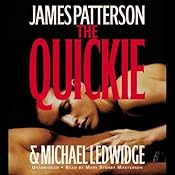
The Quickie by James Patterson and Michael Ledwidge (unabridged audio book read by Mary Stuart Masterson)

On her way to give her husband Paul a sexy surprise for lunch, Lauren Stillwell instead see him leaving his office building with a corn-fed blonde on his arm. She follows them to a hotel, and this discovery — and Paul's lying about it when confronted — turns her into a woman bent on evening the score, literally.

It was just supposed to be a quickie, but Lauren's retaliatory assignation ("Paul and I had once had a sweet sex life.... But being with Scott was life-threatening") quickly turns to murder when one of her lovers kills the other as she watches through the window into the dark, rainy night. The killer loads the victim into his car and drives off.

Once Lauren realizes he's not at any of the local hospitals, she checks out a crime scene she overhears on a cop's radio. And that's where authors James Patterson and Michael Ledwidge drop the first major surprise of The Quickie. Many more follow in this novel whose agenda is announced early on: "This is what happens when you cheat. This is what you get." But Patterson and Ledwidge have housed it in a slick thriller that is practically guaranteed to please Patterson's legion of fans.

Actress Mary Stuart Masterson (Fried Green Tomatoes, Benny & Joon) remains invisible throughout her reading of the audiobook of The Quickie, letting the characters, especially narrator Lauren, shine fully. Her portrayals are insightful and completely naturalistic with unexpected emphasis placed (in retrospect) where a real person would put it.

The Quickie is completely absorbing even as it stretches the bounds of plausibility. The final disc is a roller-coaster ride as all questions are answered and all threads tied up neatly, leaving the listener with a smile.

Monday, January 3, 2011

Cattle King for a Day by L. Ron Hubbard (unabridged multi-cast audio book)

After receiving news of his grandfather's death, Chinook Shannon heads north from Arizona to Bull Butte, Montana, to take over the Slash-S ranch. What he finds is surprising: not only in the property in debt to the tune of $26,000 but it's also been commandeered for gold mining, and a fellow named Brad Kendall doesn't want Chinook to get to the ranch. The bank is about to foreclose, and Chinook has twenty-four hours to set things right or he'll only be Cattle King for a Day.

Author L. Ron Hubbard was a master of the action Western, filling his stories of adventure with plenty of gunplay and vengeance. "Cattle King for a Day" (originally published in All Western Magazine's March 1937 issue) is enhanced by authenticity springing from Hubbard's time living in Montana, complete with details on local mining, banking, etc.

But humor is welcome here as well. One passage in particular from "Cattle King for a Day" brought a smile — where the author describes the stream of epithets and obscenities directed by Kendall toward Sheriff Taggart:

It was all unquotable. It treated Taggart's family tree from its inception, followed through several-score generations, caught up with Taggart's personal appearance, filthy habits, general demeanor, and went on to revite Taggart's posterity.

In addition, the character of Sheriff Taggart offers a sense of nostalgia for fans of the comic quartet Firesign Theater, as the actor who voices Taggart, Phil Proctor, borrows heavily from his portrayal of used-auto salesman Ralph Spoilsport, first heard on the group's classic album How Can You Be in Two Places at Once When You're Not Anywhere at All.

Also on this audio is "Come and Get It" (from the October 15, 1938, issue of Street & Smith's Western Story). Bill Norton arrives at Wolf Junction, Wyoming, as the new owner of the Bar N, met only by the station agent and a prairie dog, apparently the only residents — even "at the early hour of 11" — of this veritable ghost town.

Bill soon discovers there's actually very little waiting for him but a pair of sixguns and an unpleasant surprise: his father was murdered. But how is a tenderfooted Easterner who's never fired a gun supposed to avenge his father? With the help of a clever mind and a clever dog, and a twist ending that leaves the listener with a smile.

These two Western stories of men and their new properties, which hold surprises neither of them is prepared for, make for a good pair of listens that more than fill the two-hour running time of Cattle King for a Day. I find myself more and more on the lookout for these Galaxy Audio productions, as they are sure (with a few exceptions) to provide an engaging and exciting pulp-adventure experience.

Sunday, November 21, 2010

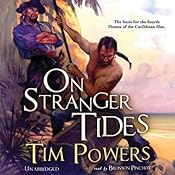
On Stranger Tides by Tim Powers (unabridged audio book read by Bronson Pinchot)

This review was originally published on SF Site.

John Chandagnac, son of a puppeteer, is still mourning his father's death when he sets out for Jamaica to get back his inheritance from the uncle who stole it. To this end, he charters the Vociferous Carmichael but gets to see another side of sea life when it is attacked by Phillip Davies, privateer and captain of the sloop Jenny.

Chandagnac gets on the wrong side of a pirate captain (by defeating him with sword techniques learned for puppet shows) and is offered the choice to either join them or die. Now christened "Jack Shandy," he discovers that the people he thought were on his side are simply out for themselves (isn't that always the way?) — including one's strange plan for the legendary Fountain of Youth, which has very different powers than usually supposed.

On Stranger Tides, the 1987 novel from author Tim Powers now available in audiobook form, is also the source material for the fourth film in the Pirates of the Caribbean series, gladdening many of Powers' fans since that will undoubtedly bring his work closer to the mass appeal they have long felt he deserved. The option apparently existed long before it was revealed, since the third film in the series most definitely foreshadows this book's Fountain of Youth plot.

For those who have not experienced his work before, Powers is a discovery. On Stranger Tides combines the mundane and the supernatural into a gripping narrative filled with high adventure. It has the potential to please readers of most forms of genre fiction, with plenty of gunfire and swordplay alongside voodoo, zombies, ghost ships, and sorcery, with numerous startling twists that never stretch the bounds of plausibility. There's adventure, revenge, romance, and intrigue all folded together into a cohesive whole as Powers never loses sight of his primary goal of telling a ripping yarn. He maintains a consistent level of tension throughout, along with a great deal of humor, toward a thoroughly satisfying conclusion.

Another discovery made through listening to On Stranger Tides is the highly advanced narrative skill of actor Bronson Pinchot. Pinchot is probably still most widely known for either his seven-year stint as the pseudo-Greek naïf Balki Bartokomous on the situation comedy Perfect Strangers or for his scene-stealing turns as Serge in two Beverly Hills Cop films. But his deft handling of unplaceable accents in those roles does not prepare one for his reading of Powers' work. The sheer number of accents Pinchot tackles is impressive, and his ability to distinguish characters while juggling various dialects within a single conversation is nothing short of astonishing, making the audio rendition a much fuller experience than the text alone could provide.

Thursday, October 28, 2010

Download the radio adaptation of Gary A. Braunbeck's "Return to Mariabronn" (from Haunted Legends edited by Ellen Datlow and Nick Mamatas)

Gary A. Braunbeck is the author of the short ghost story "Return to Mariabronn," available in the new anthology Haunted Legends, edited by Ellen Datlow and Nick Mamatas. Braunbeck has spearheaded a audio adaptation of his story, and it is available for download just in time for Halloween.

"Return to Mariabronn" was broadcast on Ohio radio stations and features the voices of the author, Braunbeck himself; his wife, author Lucy A. Snyder; and some students from Ohio State University. To download the mp3, simply visit the Ohio State University Media Manager.

Great Halloween listening!

Friday, September 17, 2010

Native Son by Richard Wright (unabridged audio book read by Peter Francis James)

A classic of African American literature — and indeed of any kind — author Richard Wright's Native Son is surprisingly accessible to the modern reader, since it is basically a crime novel with literary leanings. Bigger Thomas lives with his mother, sister, and brother in one room on the South Side of Chicago in the 1930s. They are so cramped, they have to turn away while the others dress, causing much embarrassment all around.

Bigger is not ambitious — and he actually seems a bit lazy — but a chance connection gets him a good job chauffeuring for the owner of the Thomases' apartment building, Mr. Dalton. Wright clearly shows the mixture of fear, shame, and anger that Bigger feels toward whites, and it is these conflicting yet combined emotions that cause most of his later trouble.

He is supposed to drive the Daltons' daughter, Mary, to the university his first night on the job, but she has him detour to meet up with her Communist boyfriend, Jan Erlone. The couple were previously the subject of a gossip newsreel viewed by Bigger and a friend earlier that day, a bit of a scandal since Mr. and Mrs. Dalton are most fervently not Red supporters.

Mary and Jan invite Bigger to hang out with them, whereupon they all get a little too drunk. Delivering the girl to her room late that night, Bigger nearly has his way with the barely conscious (but seemingly willing) Mary, but the blind Mrs. Dalton enters the room to check on her daughter. Bigger panics, fearing the worst if he is found in the bedroom of the white girl. He reaches for a pillow....

I don't have to tell you what happens next. And Wright doesn't shy away from any of it. Every aspect is there on the page: the fingernails scratching his hand, the glassy eyes, the realization of what he has done, his decision to cover it up and blame it on the boyfriend, his decision to simply make the body disappear, the planning, the trunk, the hatchet, the furnace ... and that's only part one of Native Son, entitled "Fear."

From there, Wright chronicles seemingly every detail of the aftermath, including Bigger's attempt to frame Jan, nearly successful through his overconfidence in the whites' underestimation of him, until his eventual slip-up in another moment of panic. Part two, "Flight," covers the manhunt as it slowly accelerates into a citywide search, resulting in another murder as Bigger tries to hide out in abandoned buildings during a snowstorm, surrounded by newspaper coverage and passionate discussions of him by both blacks and whites.

Part three, "Fate," shows the inevitable outcome: Bigger's capture, interrogation, and indictment. Wright showcases his fantastic characterization during the trial (easily as good as anything in Anatomy of a Murder) as both sides present intelligent, persuasive arguments in their favor. For this reason alone, aspiring writers should read Native Son to see how balanced presentation of the facts of the case results in gripping reading.

In fact, Native Son is probably one of the best written, plotted, peopled, and constructed novels I have ever read. (Small details presented earlier pay off later on in surprising ways.) It is most definitely one of the most powerful. Wright succeeds in presenting an indelible portrait of a time and place and the attitudes prevalent, while at the same time delivering a suspenseful narrative with a positive ending — though not necessarily a "happy" one.

Actor Peter Francis James lends gravitas to the audiobook of Native Son. His narrative voice is nicely detached, leaving Wright's words to speak for themselves. And James's characterizations are done with subtle changes. My only complaint is that Jan Erlone and lawyer Boris Max sounded very similar, and when the two were in the same room, it was hard to tell them apart, especially since their worldviews are so similar they were often reiterating what the other was saying. But his work superlative throughout, making the audio version a terrific way of introducing oneself to the work of Richard Wright and seeing why his work still resonates with readers seventy years later.

Wednesday, September 1, 2010

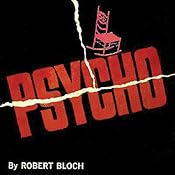
Psycho by Robert Bloch (unabridged audio book read by Paul Michael Garcia)

Nearly everyone knows the story of Psycho, of how a woman named Crane steals $40,000 from her employer and takes off to marry her boyfriend. A rainstorm causes her to make a wrong turn off the main highway, and she stops for the night at the one beacon of light on that deserted stretch, the Bates Motel, run by the unassuming mama's boy Norman Bates.

Bates himself has become an iconic figure, synonymous with the psychotic murderer and more often the source of parody than fear. So, how does one approach the original novel by author Robert Bloch with a fresh eye?

Surprisingly, it is fairly simple: one cannot. If you have seen the classic film as directed by Alfred Hitchcock, you've experienced the story in its tightest form.

Hitchcock and screenwriter Joseph Stefano delivered a very faithful adaptation, and if that is enough for you, so be it. But if you long for more depth of character, more insight into motive and history, and especially more internal monologue, then Psycho the novel is just the thing for you.

Audiobook reader Paul Michael Garcia delivers a better performance than I thought possible, inhabiting all the characters fully. This allowed me to forget that I was listening to "Psycho" and just immerse myself in Bloch's world one more time — almost, if I tried really hard, as if for the first time.

Monday, August 30, 2010

Sea Fangs by L. Ron Hubbard (unabridged audio book performed by a full cast)

Bob Sherman, one-time land owner and boat captain, had his dreams taken away by Herbert Marmion, who commandeered Sherman's property for the U.S. government's use. Trying to get to the bottom of things, Sherman hires himself out as a sailor on Marmion's ship, the Bonito. A hurricane then tosses them about, bringing forth the captain's ineptitude and Marmion's daughter Phyllis, a black-haired beauty.

The ship eventually anchors, but on the Island of Death, the headquarters of Venezuelan pirates from whom Sherman just escaped after an 18-month imprisonment. ("It would be just like the sea to bring me back where I least want to return.") It looks like Sherman is destined for recapture, but the Bonito puts up a good defense when attacked, with eight full minutes of shells and bullets making "the air ... alive with lead" on this fantastic audio adaptation of author L. Ron Hubbard's novella Sea Fangs.

Sea Fangs is a relatively early short novel from Hubbard, appearing first in the June 1934 issue of Five Novels Monthly, so it's not as skillfully crafted as works like Six-Gun Caballero and Under the Diehard Brand that were published only four years later.

The cast of Sea Fangs is, as usual for these Galaxy Audio productions, generally first-rate, with Firesign Theatre alumnus Phil Proctor tackling three relatively prominent roles and director Jim Meskimen juggling five other supporting parts. The only real fault in the production lies with the lead actress. The heroine, Phyllis, as written by Hubbard, goes through numerous emotions from devotion to grief to fear, but Kristen Proctor never gives anything more than the same flat line-readings.

Miss Proctor's performance actually detracts from the story instead of adding insight to the character. She is never once believable as the clever, strong-willed woman of action Hubbard imagined. Protagonist Bob Sherman fares considerably better, though this is due more to narrator R.F. Daley's reading of Sherman's thoughts and actions than to Shane Johnson's effort with the dialogue. That said, the audiobook of Sea Fangs is still a fine way to pass two hours, especially if you're commuting and you'd rather be on the high seas than stuck in a sea of traffic.

Friday, August 27, 2010

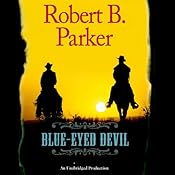
Blue-Eyed Devil by Robert B. Parker (unabridged audio book read by Titus Welliver)

Virgil Cole and Everett Hitch have quite a history together. They kept the peace as deputy U.S. marshals in a town called Appaloosa, where Virgil fell in love with a woman named Allie. Then Everett left Appaloosa (for the obvious reason) and settled in Resolution, where he kept the peace in town on a less formal basis for basically the only local businessman. Virgil came along later on (after Allie left him) to visit and help out. Eventually the duo was aided by another pair of gunmen known as Kato and Rose.

Subsequently, the pair moved on to Brimstone, after hearing that Allie's last beau hadn't worked out and she'd gotten herself involved in prostitution. There they worked as deputy sheriffs until they rescued Allie from herself, in addition to helping out a young girl, a selective mute who will only choose to talk to Virgil, much to Allie's chagrin. At the end of Brimstone, the gang is headed back to Appaloosa.

Blue-Eyed Devil, the first novel in the series not to be named after the town in which it is set, begins on their third day back in Appaloosa, when chief of police Amos Callico lets them know in no uncertain terms that he is the one in charge. But he also offers them jobs working for him. When they decline Callico, they know he'll be trouble, and he is because Callico is running a "protection" racket, and those who don't want to pay look to Cole and Hitch for help.

Author Robert B. Parker approached Westerns in the same way he did his other novels: with long strings of dialogue and short chapters. This makes them not only fast reads -- though the laconic delivery of the characters can make them seem longer -- but also highly accessible to readers who may think they don't like Westerns. Actually, Virgil and Everett have a similar friendship as Parker's mystery heroes Spenser and Hawk: Everett is the narrator and main filter for the action, the relatable one, but Virgil, like Hawk, is the more mysterious and therefore more intriguing character.

Virgil Cole's skill with a firearm is legendary, and Parker gives it a mythic spin. Always calm and relaxed, Virgil's draw looks leisurely, but it is always faster than anyone else's. But my favorite aspect of the characters is that Virgil is well-read while Everett is well-educated. (Virgil regularly refers to Everett's time at West Point.) Neither is both, which means they often share knowledge with each other, and consequently with us. From the philosophy of Rousseau to the viability of the Macedonian phalanx in modern warfare, there is a lot to learn in Parker's Westerns in addition to terrific reads.

Blue-Eyed Devil is likely the final Parker Western, and that's too bad because these four novels have been some of my favorite reads of his. They are also some of the most readable modern Westerns available, and when an author of Parker's stature publishes a Western, it gives the genre some much-needed attention. The story as told comes full circle with new beginnings and old familiarities, but I wouldn't mind seeing the series continued by other hands.

The first name that comes to mind is that of Robert J. Randisi. Parker and Randisi share a skill with dialogue that says more than it seems to, and Randisi has also written his fair share of private-eye novels. Also, they both seem to follow the popular Strunk and White dictum to "omit needless words," resulting in the abovementioned brevity of dialogue and chapter. Because of these similarities, I think Randisi would be able to take over the series with little disruption, and I hope the publisher (and the author's estate) will consider this option to continue the Cole and Hitch stories.

Blue-Eyed Devil and the other three books in the series are read on audiobook by Titus Welliver, probably best known to Western fans as "Silas Adams" on the series Deadwood. Welliver has the perfect voice for these intelligent, confident, understated men: he stays out of the way and lets Parker's hardboiled Westerns speak for themselves and shine just like they do in print. Welliver's reading reminds me of that of the prolific Scott Brick's signature dysthymic delivery (see Vendetta), and he should translate well to other genres in the same way Brick does.

Friday, July 9, 2010

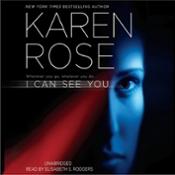
I Can See You by Karen Rose (unabridged audio book read by Elisabeth S. Rodgers)

I tested the romantic suspense waters previously with Catherine Coulter's The Maze, so when author Karen Rose's novel crossed my path, I wasn't immediately repelled in the way I would once have been. And the plot of I Can See You , involving the dangers of online predation, was very intriguing -- so much so that I entered into this 16-disc behemoth with little trepidation, despite the fact that I had just finished one nearly as long, Andrew Davidson's terrific genre-blender The Gargoyle.

Eve Wilson returns in Rose's tenth thriller. Scarred by a horrific assault in Don't Tell, Eve was also featured in Nothing to Fear. Now she's pulling her life together, bartending and studying for her M.A. in Counseling, just in time to get involved in a murder mystery.

"The hooker had awakened ... thinking she was being strangled. Then, she really was. He did love it when fantasy met reality with such perfection."

A killer with 30 years of experience at his chosen craft -- and 30 years of trophies (the victims' shoes) and a well-used lime pit to show for it -- is targeting users of an online role-playing game called Shadowland: a Second Life-like game where users pretend to be other selves.

And the list of victims of this series of half a dozen murders staged to look like suicides, with their eyes glued open, closely matches the list of participants in Eve's master's thesis experiment: studying the effects of online role-playing on real-world self-esteem. Now she must break the confidentiality of her subjects to save their lives.

Enter Minneapolis/St. Paul's famed "Hat Squad" (they wear fedoras to "dress the part" as detectives), headed by Noah Webster, coming down off a local magazine's feature article that focused on Webster's partner, handsome lothario Phelps, due to his Paul Newman looks. (Webster looks more like a film noir thug.) Never mind the fact that Webster must continually take up Phelps's slack.

Like The Maze, the weakest portions of I Can See You are those devoted to the expected romance — though these lovebirds are so sickeningly adolescent and self-defeating in the beginning that it's a wonder they get out of bed in the morning, let alone know how to pursue a mature relationship. Eve's trauma and Webster's recovering alcoholism are such obvious parts of their personalities that it seems they could agree to simply meet each other on equally flawed terms.

But Rose keeps the suspense high in I Can See You — the bulk of the story takes place during a single week — and audiobook reader Elisabeth S. Rodgers enhances the text with her immersion into the characters. Most of Rose's books tie together in some fashion due to her repeating of characters, so readers who like this one will undoubtedly want to seek out more of the author's work.

Friday, June 18, 2010

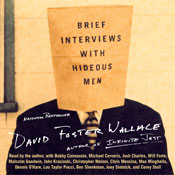
Brief Interviews with Hideous Men by David Foster Wallace (unabridged audio book read by the author and others)

This audiobook is read by Bobby Cannavale, Michael Cerveris, Josh Charles, Will Forte, Malcolm Goodwin, John Krasinski, Christopher Meloni, Chris Messina, Max Minghella, Dennis O'Hare, Lou Taylor Pucci, Ben Shenkman, Joey Slotnick, Corey Stoll, and David Foster Wallace.

The first story on the audiobook of author David Foster Wallace's short-story collection Brief Interviews with Hideous Men, "Death Is Not the End," seems to have been designed as a test to see if the listener is truly prepared for Wallace's fiction. The late author reads, but his narrative is so robotic as to be obnoxious. This is only intensified by the story's merely being a series of digressions (including the author's signature footnotes) with no real destination.

"Forever Overhead" is more successful, primarily because it covers a longer period of time: a 13-year-old's birthday spent at a public pool with his family. Wallace's incisive observations are keen, but his reading once again detracts from the piece -- or maybe it was because a glitch on my copy has caused most of track 5 on disc 1 to be a duplication of a later part of the story that shouldn't have played yet and that I therefore had to listen to twice.

Then there are the titular "Brief Interviews," in which we hear only the answers to a series of unheard questions. (These would be great for audition monologues.) There's the guy who shouts, "Victory to the forces of democratic freedom" upon orgasm; the guy whose "proclivities" originate from his father's need to be restrained from his own violence; a very personal interview with the questioner's boyfriend, who is tired of the questioner's insecurities....

Wallace's talent lies in showing everything, leaving nothing to the imagination, and punctuating it with wry humor and intensifying surprises. (Except in one special case where the final surprise is left up to the listener to figure out.)

...the pot grower who professes to know the difference between a great lover and a great lover; the guy who calls his shriveled arm "the asset"; the son of a washroom attendant; the fellow who argues that rape broadens the mind; the military brat whose supernatural masturbatory fantasies originate from a childhood fascination with Bewitched....

Wallace's fiction oozes pretensions, though Brief Interviews with Hideous Men is never unlistenable. Sometimes it's overlong and feels too much like hard work, but it's entertaining. And every so often there's a true gem, a piece so complete that it's like being rewarded for the effort of the rest. Even the title of "Suicide as a Sort of Present" adds to instead of just summarizing the experience.

...the man who loves everything about women; the duo arguing over how difficult it is to deduce what women want, given what you're working with; the guy who finds a "flake" more fascinating when he hears her rape story. The mere breadth of hideousness contained here is remarkable.

This new, unabridged edition of Brief Interviews with Hideous Men — the portions read by Wallace are taken from a previous, abridged recording — has evidently been produced to tie in with the recent film version adapted and directed by John Krasinski (best known as Jim Halpert from The Office). It includes several cast members performing their roles from the film.

Thursday, June 3, 2010

The Big Rock Candy Mountain by Wallace Stegner (unabridged audio book read by Mark Bramhall)

When her widowed father marries her best friend Sarah, Elsa Norgaard, disgusted, moves from her Minnesota home to her uncle Carl's house in Hardanger, North Dakota. There she meets Harry "Bo" Mason, and they begin a life that covers the early years of the 20th century.

Author Wallace Stegner's novel The Big Rock Candy Mountain focuses on the couple in a connected series of vignettes, broken by gaps in time but told chronologically from the characters' points of view. At first, these are primarily Bo and Elsa. Then, when they get older, their sons Chester and Bruce take the stage.

Bo is a rolling stone with an itch to make it big whatever the risk and wherever he can find "the big rock candy mountain": the "land of milk and honey" where "rivers run gold" and gambles pay off in spades and not just frustration. (The book's title comes from a song describing a hobo's idea of heaven.) To that end, he runs a series of blind pigs (places that secretly sold liquor during Prohibition) and other projects that take him and the family to different locations.

Bo tries to find the balance between security and predictability, and having the wanderlust and a fiery temper. This has both immediate and long-ranging consequences for him and his family that culminate in the fallout of a tragic event near the end of the book. Stegner reportedly based The Big Rock Candy Mountain on his own family, and long, detailed digressions from the main story into family history lend the book the feel of a saga.

At the end of the book, Bruce (Stegner's representation of himself) tries to understand the motives of his father and the actions he took, and The Big Rock Candy Mountain is a testament to his success at this. Fictionalizing the characters allows for separation that lets him get deep into the thoughts of these people and creates a novel of lasting impact.

Blackstone Audio has recently produced a selection of Stegner audiobooks. Mark Bramhall reads The Big Rock Candy Mountain. With just a slight change of voice, he manages to capture each character's individuality and brings gravity to the narration. All of this results in a literary experience that I found unexpectedly engrossing, as I could not seem to spend much time away from these people and wanted to get back to them as soon as possible.

Even now, having completed the book, I find myself thinking about its characters now and again as if I actually knew them. The fact that this was Stegner's second novel, published when he was 34 (with portions written even earlier as short stories), makes it all the more impressive.

Wallace Stegner has written a novel that will please fans of literary fiction and historical fiction (including longer Westerns). And I think it would be especially well recommended to those who enjoyed the Little House on the Prairie series but would like something a little more grown-up. The Big Rock Candy Mountain is all of that and more.
Related Posts with Thumbnails