





Since September 2009 marks the fifth anniversary of Hard Case Crime, I will be reprinting my reviews of the first 40 books from my old (and now mostly defunct) Craig's Book Club site — 2 for the first 10 days, and 1 a day for the next 20. I hope you enjoy this refresher course in the variety of crime fiction that this fascinating publisher has to offer.
Ever since he found his wife Toni with one of his operatives, all former private investigator Matt Cordell has wanted to do is crawl inside a bottle and stay there. He's been perfectly happy to wallow in his memories for the last five years, panhandling for change on the Bowery, and he doesn't want any trouble.
Enter trouble in the form of Johnny Bridges, a guy from Cordell's old neighborhood he hasn't seen in ten years. Johnny can't afford a real private detective — and he doesn't want to get the police involved for personal reasons — so he asks Matt for his help in figuring out whether his business partner, Dom Archese, is stealing from the till in their co-owned tailor shop.
Being that Cordell doesn't have a whole hell of a lot else filling his day, he says yes. This little piece of magnanimity (really just a way to get Johnny off his back) sweeps Matt into a full-fledged murder case where he encounters a shady cast of characters so full of lies that it is impossible to tell if anyone is ever telling the truth. (Not that it stops Cordell from climbing into the sack with as many of the potential femmes fatales as will let him.)
That's what you get for doing a guy a favor.
The Gutter and the Grave is a reprint of a novel originally published by Gold Medal under the title I'm Cannon — For Hire and the byline of "Curt Cannon" (the name the Cordell's character was changed to). This edition is Ed McBain's preferred text, complete with edits made just prior to his death. It is therefore a fascinating combination of the enthusiasm of a young writer (it is a little heavy on the exposition) and the restraint exercised by a seasoned pro (the violence is tight and visceral and not drawn out unnecessarily).
The Gutter and the Grave is a prime example of the fiction called noir: it's dark and it's dirty, and Matt Cordell is one depressing son of a bitch of a hero. He's full of self-pity and the smallest things set him off on a flashback.
McBain keeps his prose raw and fluid, his dialogue sizzling, and a happy ending never crosses his mind — though there is a fun Blackboard Jungle reference for those who can appreciate it (that novel was published under McBain's legal name, Evan Hunter). The Gutter and the Grave is a novel about the other side of society: the side where every day is a struggle and every relationship is just one more opportunity to take advantage of. It's the kind of potent novel that, after you get over the grungy feeling it leaves behind, makes you feel happy that you're not one of the characters — a perfect addition to the Hard Case Crime canon.
Showing posts with label Ed McBain. Show all posts
Showing posts with label Ed McBain. Show all posts
Tuesday, September 8, 2009


Thursday, February 5, 2009
Forever by Jeffery Deaver (from Transgressions edited by Ed McBain)
Over approximately the last month, I've slowly made my way through Transgressions, the 2005 anthology of crime-fiction novellas edited by the late Ed McBain. As with most anthologies (especially those composed primarily of "big names"), the results have been of mixed quality. A few stand out among the rest — among them The Ransome Women by John Farris and The Resurrection Man by Sharyn McCrumb — but only one stood high enough to be recognized as definitely the best of the bunch: Forever by Jeffery Deaver, an author I'd not previously read.
In Forever, Deaver introduces police statistician Talbot Simms. Tal in a numbers whiz who is happy to remain at his desk, crunching arithmetic means and standard deviations. But when a couple of elderly suicides present themselves as statistical "outliers" (meaning the combination of events fall far outside the norm of mathematical likelihood), Tal declares them "2124" (suspicious) and inadvertently heads toward solving his first case as a "real" police detective.
Deaver skillfully portrays Tal Simms as a novice among veterans, concurrently showing the reader all the tiny details needed to follow procedure. But Tal slowly feels his way along, with the reluctant help of Detective Greg LaTour, who develops a grudging respect for the "Einstein" of his department. Both characters are fully three-dimensional, and I would welcome a series from Deaver featuring them. Forever also features some of the most original plotting and imagination this side of classic science fiction. Odd that I put off reading it for so long, primarily from not knowing his work, because Deaver's is the name I'll come away from Transgressions most praising.
In Forever, Deaver introduces police statistician Talbot Simms. Tal in a numbers whiz who is happy to remain at his desk, crunching arithmetic means and standard deviations. But when a couple of elderly suicides present themselves as statistical "outliers" (meaning the combination of events fall far outside the norm of mathematical likelihood), Tal declares them "2124" (suspicious) and inadvertently heads toward solving his first case as a "real" police detective.
Deaver skillfully portrays Tal Simms as a novice among veterans, concurrently showing the reader all the tiny details needed to follow procedure. But Tal slowly feels his way along, with the reluctant help of Detective Greg LaTour, who develops a grudging respect for the "Einstein" of his department. Both characters are fully three-dimensional, and I would welcome a series from Deaver featuring them. Forever also features some of the most original plotting and imagination this side of classic science fiction. Odd that I put off reading it for so long, primarily from not knowing his work, because Deaver's is the name I'll come away from Transgressions most praising.
Sunday, February 1, 2009
Five Disappointing Reads from 2008
This is a different kind of list. This one consists of those books that I had great expectations for going in, and really fell short in one way or another.
- Richard Laymon, The Lake (2004) — One of the three posthumous Laymon novels, this one was the farthest from being ready for publication.
- Jack Ketchum, Weed Species (2006) — Ketchum is known for his extreme character portraits, but this one fails from a lack of an interesting story.
- Ed McBain, The Frumious Bandersnatch (2003) — McBain's 87th Precinct series is always readable, but the author's obvious lack of knowledge about modern music makes this one a struggle.
- Sara Gruen, Water for Elephants (2006) — An interesting story about quirky characters is hampered by a completely unbelievable protagonist's inability to ground the odd occurrences in reality.
- ...but the biggest disappointment of 2008 was the nine-book Star Wars: Legacy of the Force series by Aaron Allston, Karen Traviss, and Troy Denning (2006–2008). Nine books over a two-year period conclude with an ending telegraphed from the beginning and completely predictable even by Star Wars standards? There were some high points, notably Traviss's work in Bloodlines and Sacrifice, but I'll not again invest in the anticipation game. Any more series are going to have to be finished before I start them.
Monday, January 26, 2009
Ten More Great Reads from 2008
This is my second Best Books I Read in 2008 list. (The first one is here.) This one consists of those books that were not first published in 2008. These should not in any way be taken as lesser selections — in fact the best book I read all year is on this list — I just wanted to keep them separate.
So, here they are, in the order I finished them, along with their year of publication. Any links go to the more detailed reviews I wrote when I first read them. Others have short summaries and capsule reviews. You can research more about those yourself (and then tell your friends that you discovered them).
So, here they are, in the order I finished them, along with their year of publication. Any links go to the more detailed reviews I wrote when I first read them. Others have short summaries and capsule reviews. You can research more about those yourself (and then tell your friends that you discovered them).
- Douglas Preston, The Codex (2004) —Three brothers compete to find the inheritance their puzzle-happy father left them ... buried along with him somewhere in the Honduran rainforest. Preston flies solo in this globe-trotting adventure that is a little long but still immensely entertaining.
- John Burnham Schwartz, Reservation Road (1998)
- Lois Lowry, The Giver (1993)
- Budd Schulberg, What Makes Sammy Run? (1941) — The story of Sammy Glick, a copy boy who schemes his way through the ranks of Hollywood. Schulberg makes a despicable character sympathetic by filtering through the eyes of his only friend. Sammy was originally meant to be outrageous, but soon became a "how-to" manual for those on the move.
- David Robbins writing as Ralph Compton, Rio Largo (2006)
- Ed McBain, Ten Plus One (1964)
- John D. MacDonald, Cry Hard, Cry Fast (1955) — The author most famous for his Travis McGee novels paints intricate portraits of every person involved in a multiple-car crash; terrific characterization.
- Stephen King and Peter Straub, Black House (2001)
- John Irving, A Widow for One Year (1998)
- Charles Portis, True Grit (1968) — (A repeat from last year's list: I liked it so much, I read it again and loved it almost as much!)
Thursday, June 5, 2008
Books I Read in May 2008
Trailin'! by Max Brand
The First Quarry by Max Allan Collins
The Max by Ken Bruen and Jason Starr
Doubt by John Patrick Shanley
"The Frigid Flame" (novella from American Pulp) by Richard Matheson
Ten Plus One by Ed McBain
British Invasion edited by Christopher Golden, Tim Lebbon, and James A. Moore
Shooting Star / Spiderweb by Robert Bloch
Lemur by Tom Bradley
Rio Largo: a Ralph Compton novel by David Robbins
The First Quarry by Max Allan Collins
The Max by Ken Bruen and Jason Starr
Doubt by John Patrick Shanley
"The Frigid Flame" (novella from American Pulp) by Richard Matheson
Ten Plus One by Ed McBain
British Invasion edited by Christopher Golden, Tim Lebbon, and James A. Moore
Shooting Star / Spiderweb by Robert Bloch
Lemur by Tom Bradley
Rio Largo: a Ralph Compton novel by David Robbins
Friday, May 30, 2008
Ten Plus One by Ed McBain (87th Precinct)
The classic 87th Precinct novels are my favorites because of books like Ten Plus One, the fifteenth in the series. From the beginning, it contains some of McBain's best writing. And I'm talking about descriptive, sometimes philosophical prose — something rare in crime novels, anyway. But when an author begins a novel (about a sniper picking off citizens) with a tongue-in-cheek section on how it's illegal to die in the springtime (autumn is much more appropriate), you've got something special.
And Ten Plus One continues to impress! Each victim gets a full rundown of the events, thoughts, and feelings leading up to their final moments, making each a real person before becoming a corpse.
(Chapter 10, detailing the tragedy of Frankie Pierce, a victim of a different sort, is worth singling out as an example of bad police work, and also as a cautionary tale. Parents should read it to their kids as a reason why you should never get on the wrong side of the law because it labels you forever.)
The plot, the motive, the backstory detailing the connections of the victims to each other, and the solution are all very original — and even groundbreaking by implication, especially where past events are concerned, making Ten Plus One an absolute necessity for Ed McBain fans.
And Ten Plus One continues to impress! Each victim gets a full rundown of the events, thoughts, and feelings leading up to their final moments, making each a real person before becoming a corpse.
(Chapter 10, detailing the tragedy of Frankie Pierce, a victim of a different sort, is worth singling out as an example of bad police work, and also as a cautionary tale. Parents should read it to their kids as a reason why you should never get on the wrong side of the law because it labels you forever.)
The plot, the motive, the backstory detailing the connections of the victims to each other, and the solution are all very original — and even groundbreaking by implication, especially where past events are concerned, making Ten Plus One an absolute necessity for Ed McBain fans.
Tuesday, February 19, 2008
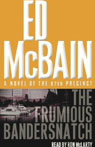
The Frumious Bandersnatch by Ed McBain (audio book read by Ron McLarty)
What Ed McBain didn't know about modern pop music is written all over The Frumious Bandersnatch , the 53rd in his ever-popular 87th Precinct series. McBain was obviously not a fan of modern music, but his writing (at least at the beginning) suggests that his research consisted entirely of reading gossip magazines (his description of the music video delves into every modern cliche).
 I almost didn't finish the novel for that reason. Then I realized I don't seek out McBain's work for social commentary, but because his work is the best at presenting a realistic look at the daily grind of America's big-city police officers. Luckily, that makes up the majority of The Frumious Bandersnatch.
Carella and company are back when new singing sensation, Tamar Valparaiso, is kidnapped during the launch of her debut CD, Bandersnatch. (The title song, and first single, is simply Lewis Carroll's "Jabberwocky" set to music.) Meanwhile, Ollie Weeks (from the 88th precinct) is given his own subplot once again, this time pursuing his romance with fellow police officer Patricia Gomez (who, to me, seems rather dim, but that could only be the way her dialogue is written).
The Frumious Bandersnatch is a weaker entry in the series (the early, more tightly written books are definitely my favorites), but McBain's easygoing skill with words (and Ron McLarty's reading of the audiobook) makes it enjoyable nevertheless, especially during the actual investigation scenes.
Carella and company are back when new singing sensation, Tamar Valparaiso, is kidnapped during the launch of her debut CD, Bandersnatch. (The title song, and first single, is simply Lewis Carroll's "Jabberwocky" set to music.) Meanwhile, Ollie Weeks (from the 88th precinct) is given his own subplot once again, this time pursuing his romance with fellow police officer Patricia Gomez (who, to me, seems rather dim, but that could only be the way her dialogue is written).
The Frumious Bandersnatch
Subscribe to:
Posts (Atom)
