Showing posts with label Ralph Compton. Show all posts

Saturday, October 3, 2015

The Law and the Lawless: A Ralph Compton Novel by David Robbins (Western)

Cestus Calloway leads a gang of bank and stagecoach robbers. To keep in the public's good graces, he throws some of the ill-gotten gains into the crowd during the getaway, giving him the moniker "the Robin Hood of the Rockies." And his main rule is no killings: "There's nothin' that stirs folks up more than a killin'. They send out bigger posses and hardly ever give up.... We want them on our side, not scourin' the countryside to string us up."

Boyd Cooper is the town marshal of Alpine, an otherwise quiet settlement. But the law is the law, and Cooper gathers a posse including his deputy and a local scout to chase the Calloway gang. Trouble comes when one of the gang stays behind to use the posse's horses for a little target practice and hits a man instead.

Retribution is quick — gang: 1, posse: 1 — and the hunt is on. From here on, hotter heads will rule and the stakes rise until neither side is willing to put aside honor or revenge for a peaceful outcome.

Author David Robbins (riding once again for the Ralph Compton brand) combines traditional Western writing with individuated characters in The Law and the Lawless.

Robbins strikes the ideal balance between exciting action scenes and quieter character moments — including a touching middle-age romance that hits all the right spots — with enough of the former to keep the pages turning and enough of the latter to ensure we care about who lives or dies. This makes The Law and the Lawless the best Western I've read in a while and the best from the Ralph Compton camp since The Man from Nowhere.

Friday, March 15, 2013

New on My Shelves

You've got to love used book stores and all the treasures they offer.

And a happy Ides of March, everyone.

Monday, April 19, 2010

Death of a Hangman, a Ralph Compton novel by Joseph A. West (Western)

Since his debut, Me and Johnny Blue in 2000, author Joseph A. West has produced over two dozen Western novels, most recently under the Ralph Compton banner. Though West has stated that "I can’t write in Ralph’s style, nor do I try," he's producing some of the best work published in the interest of continuing the late Compton's legacy.

(If you're not familiar with this, a handful of new novels a year are published under the author "Ralph Compton" but with "a Ralph Compton novel by [author]" at the bottom of the cover and on the title page. This is one of the more respectful work-for-hire situations going, since most books published under "house names" don't credit the original author at all.)

When I first started reading new Compton Westerns, I encountered West's more "traditional" takes on the genre, Doomsday Rider and Vengeance Rider, and was not overly impressed. But there must have been something about those books because last summer, I gave him another try with The Man from Nowhere and was bowled over by its originality. This led to my choosing it for my Favorite Reads of 2009 list and to my recent purchase of the novel on shelves now, April 2010's Death of a Hangman.

When they fought together for the Confederacy, Brigadier General Henry J. Dryden saved the life of Major Charles Pike. Now Judge Dryden (known as "Hangin' Hank" for his particular brand of justice) is dying of cancer and wants to go from New Mexico Territory to his home in Texas to be buried there. He asks Pike to escort him, sort of calling in an owed favor.

The problem is that Dryden sent outlaw Clem Dredge's brother to the gallows. Dredge wants revenge, and he's offered a $500 reward for Dryden — dead or alive. It's up to Pike to get Dryden (and his whore, Loretta) safely to Texas while being pursued by bounty hunters of every stripe: professional and otherwise.

Author Joseph A. West offers up another original Western with Death of a Hangman. It is filled with terrific characterizations and West's usual cast of flawed characters. Always interested in entertaining the reader, he doesn't give Pike any chance to rest, even confronting him with one Ephraim Satin ("half Apache, half wildcat, an' all son of a bitch") on his way to the judge.

Before they get to Texas, they'll hold an impromptu trial, Pike will find out what kind of man the judge really is, and he'll go through more hell (with less to show for it) than any God-fearing man should be allowed. But, of course, all this conflict is highly entertaining and is what makes Death of a Hangman such a solid, page-turning read full of plot twists and surprising directions from West, who seems to improve his craft with each passing book.

Monday, October 5, 2009

Outlaw's Reckoning: a Ralph Compton novel by Marcus Galloway (Western)

Gus McCord and Doyle Hill are engaged in one of their favorite pastimes, robbing a stagecoach, when a man named Mason gets especially protective of his black case. Their interest piqued, the duo soon find it contains a woman's clothes covered in blood.

The woman is Abigail Swann, and her father is a very powerful man. Mason is part of the crew involved in the kidnapping. Surprising his partner, the one-eyed Gus decides to do the noble thing and rescue Miss Swann, and Doyle goes along. ("[He's] my conscience," Doyle says at one point.)

I've enjoyed the Westerns of Ralph Compton — whether by the man himself (The Goodnight Trail) or, more recently, by others writing under his name (Joseph A. West's The Man from Nowhere) — for a couple of years now. They manage to combine traditional Western tropes like trail drives, stagecoach robberies, and gunfights with more modern approaches like personal redemption, strong female characters, and the occasional serial killer (David Robbins's Rio Largo).

The writer behind Outlaw's Reckoning is Marcus Galloway. Galloway has written two previous Compton novels, The Bloody Trail and Death of a Bad Man. He is also the author of two prominent Western series of his own: The Accomplice featuring Doc Holliday and The Man from Boot Hill, which chronicles the adventures of professional mourner Nick Graves. (He has also ghostwritten for a couple of monthly Western series, and he writes the Skinners series of werewolf-hunter horror novels under his birth name Marcus Pelegrimas.)

Marcus Galloway has a easily flowing prose style that allows the reader to get straight into the story with no obstacles of language. And, though I can respect a word craftsman, most often all I want is some simple escapism. All of the author's characters are strongly drawn; they come easily to the mind's eye and are distinctive through their dialogue.

Galloway also leavens the suspense of Outlaw's Reckoning with a great deal of humor, primarily coming from the interactions of Gus and Doyle with their conflicting quirks, grudging respect, and antagonistic friendship, there's obviously also a love there. Gus and Doyle are one of the great mismatched teams. They continually get on each other's nerves, but each also fully respects the other's skills because they complement each other so well.

I had hoped for further adventures of the duo, but Galloway has unfortunately slammed the door tight on any possibilities for a sequel to Outlaw's Reckoning. Nevertheless, I'll keep an eye open for any future Ralph Compton novels by this author, in addition to seeking out his other work. (I'm especially curious about those werewolf novels.)

Tuesday, August 4, 2009

The Man from Nowhere: a Ralph Compton novel by Joseph A. West (Western)

Eddie Oates has always been a drunk, good for little else than humiliating entertainment given in exchange for a drink. When the Apaches surround Alma, New Mexico Territory, its citizens cut the fat to save supplies. This includes hanging the stage-robbing Hart brothers ahead of their sentenced date and banishing Eddie, three whores, and "simple boy" Sam Tatum.

Left to his own devices, Eddie continues to show off his faults. But he soon finds the better part of himself through dealing with people he meets along his travels — especially a young Lipan Apache who says she's his wife.

Author Joseph A. West wrote the first two "Ralph Compton" novels I read: Doomsday Rider and Vengeance Rider. Those two introduced me to the style, and at first it didn't seem like anything special. But I've read other Comptons in the meantime (Rio Largo by David Robbins and The Goodnight Trail by Compton himself) and have since come to appreciate the particular tone and blend of action with characterization that it typifies. Now I'm continually on the lookout for them, and "Ralph Compton" (whoever is actually doing the writing) is one of my favorite Western authors.

So, when I saw The Man from Nowhere, I decided to give West another try. He pleasantly surprised me. Eddie Oates, along with all the other characters that people the novel, are fully realized portraits of individuals under some form of duress or another — none more than Oates himself, who continually fights his desire for alcohol and eventually redeems himself and even becomes a hero of sorts.

The story is mainly Eddie's, but West makes sure to give each character in The Man from Nowhere his or her time in the spotlight and offers up not just one but two memorable villains in the process. He also ties things up with a feel-good ending that doesn't forget the seriousness of what came before. West has truly impressed me with this latest offering, and I'll definitely look for his name in the future.

Nitpicker's Note: When a character has a pet phrase that is repeated several times throughout a novel, it sticks in the memory. At the same time, it's understandable when a mistake on the last page of said novel slips past even the best copyeditor's eye. Even so, when Nellie calls her friend Lorraine "Darlene" in the midst of that pet phrase, you'd think somebody would have noticed.

Tuesday, April 7, 2009

The Goodnight Trail by Ralph Compton (audio book read by Jim Gough) (Trail Drive series)

It took me a while to warm to the "Ralph Compton" style. When I first listened to the audiobook of Doomsday Rider, it seemed too much like the Western cliché for me to really realize what a good read it was, even though I had no trouble finishing it and instantly acquired its sequel, Vengeance Rider (which was even better). Compton's name stayed in my mind afterward, however, and when I was looking for another similar book to fill my commute, I picked up Rio Largo, and that was so terrific I was hooked.

The books carrying on Compton's "brand name" were enjoyable enough on their own, but it seemed time to try out the works of the man himself. Not long after, I came across a copy of The Goodnight Trail, the first in Compton's popular, long-running Trail Drive series. It was also Compton's debut novel and an auspicious one it seems.

June 1865 — Not long after the end of the Civil War, three men — Benton McCaleb, Brazos Gifford, and Will Elliot — hatch a plan to "make the gather" — herd the cattle that had gone maverick while the Civil War was being fought — and drive them up a new trail being blazed by Charles Goodnight and Oliver Loving in what would eventually become known as the Goodnight-Loving Trail. (Goodnight invented that staple of the trail drive, the chuck wagon — not named after himself, as some people think, but because trail food was called chuck.)

But even herding cattle is action-packed for this crew under Compton's pen: they get involved in a family feud (Rebecca and Monte Nash against their father) and side with a Spanish-speaking Apache Indian named Goose in a continuing battle against "bloodthirsty Comanches". This adds three more to their team and offers Compton the chance to show his skill at mixing characters.

Not all of the characters become truly individual, because in general they aren't all that different from one another. They operate by the same code, and tend to react similarly to situations, but they have strong personalities if not necessarily separate ones. The most memorable ones are McCaleb, Rebecca Nash, and Goose. Compton inserts a few real people for variety, too. Charles Goodnight and Oliver Loving play a fairly large role (not surprising, given the title), Judge Roy Bean even makes an appearance to dole out his particular brand of frontier justice.

The Goodnight Trail is a slice of life on the trail, and that's all it pretends to be. Don't expect any character arcs, or any real plot to speak of, and you'll be quite satisfied by this constantly moving combination of history and myth. Compton has an action-oriented style more than somewhat influenced by the pulps, and he makes time to throw in a little bit of a roughneck romance. I also enjoyed his insertion of useful tips on the trail. You will learn (among other things) how cauterize an arrow wound and the many alternate uses for grain alcohol.

If you have the chance, find a copy of the audiobook of The Goodnight Trail (with music and sound effects) read by Jim Gough. His authentic Texas drawl makes the story sound as if it was being told around a campfire, with coffee brewing and bacon frying. (If Gough had read my copy of Lonesome Dove, I may have actually been able to finish it.)

The Trail Drive series was originally conceived as a trilogy (and The Goodnight Trail leads right into the sequel, The Western Trail). But the series has grown (with help from modern writers) to around 20 books, contesting to the popularity of this subgenre. As of this writing, they are as follows.

By Ralph Compton:
1. The Goodnight Trail
2. The Western Trail
3. The Chisholm Trail
4. The Bandera Trail
5. The California Trail
6. The Shawnee Trail
7. The Virginia City Trail
8. The Dodge City Trail
9. The Oregon Trail
10. The Santa Fe Trail
11. The Old Spanish Trail
12. The Deadwood Trail
13. The Green River Trail

By modern authors:
14. The Dakota Trail by Robert Vaughan
15. The Alamosa Trail by Robert Vaughan
16. The Bozeman Trail by Robert Vaughan
17. The Abilene Trail by Dusty Richards
18. The Trail to Fort Smith by Dusty Richards
19. The Ogallala Trail by Dusty Richards
20. The Palo Duro Trail by Jory Sherman
21. The Ellsworth Trail by Jory Sherman
22. The Tenderfoot Trail by Joseph A. West
23. Trail to Cottonwood Falls by Dusty Richards

Monday, January 26, 2009

Ten More Great Reads from 2008

This is my second Best Books I Read in 2008 list. (The first one is here.) This one consists of those books that were not first published in 2008. These should not in any way be taken as lesser selections — in fact the best book I read all year is on this list — I just wanted to keep them separate.

So, here they are, in the order I finished them, along with their year of publication. Any links go to the more detailed reviews I wrote when I first read them. Others have short summaries and capsule reviews. You can research more about those yourself (and then tell your friends that you discovered them).

  1. Douglas Preston, The Codex (2004) —Three brothers compete to find the inheritance their puzzle-happy father left them ... buried along with him somewhere in the Honduran rainforest. Preston flies solo in this globe-trotting adventure that is a little long but still immensely entertaining.
  2. John Burnham Schwartz, Reservation Road (1998)
  3. Lois Lowry, The Giver (1993)
  4. Budd Schulberg, What Makes Sammy Run? (1941) — The story of Sammy Glick, a copy boy who schemes his way through the ranks of Hollywood. Schulberg makes a despicable character sympathetic by filtering through the eyes of his only friend. Sammy was originally meant to be outrageous, but soon became a "how-to" manual for those on the move.
  5. David Robbins writing as Ralph Compton, Rio Largo (2006)
  6. Ed McBain, Ten Plus One (1964)
  7. John D. MacDonald, Cry Hard, Cry Fast (1955) — The author most famous for his Travis McGee novels paints intricate portraits of every person involved in a multiple-car crash; terrific characterization.
  8. Stephen King and Peter Straub, Black House (2001)
  9. John Irving, A Widow for One Year (1998)
  10. Charles Portis, True Grit (1968) — (A repeat from last year's list: I liked it so much, I read it again and loved it almost as much!)

Thursday, June 5, 2008

Books I Read in May 2008

Trailin'! by Max Brand
The First Quarry by Max Allan Collins
The Max by Ken Bruen and Jason Starr
Doubt by John Patrick Shanley
"The Frigid Flame" (novella from American Pulp) by Richard Matheson
Ten Plus One by Ed McBain
British Invasion edited by Christopher Golden, Tim Lebbon, and James A. Moore
Shooting Star / Spiderweb by Robert Bloch
Lemur by Tom Bradley
Rio Largo: a Ralph Compton novel by David Robbins

Thursday, May 29, 2008

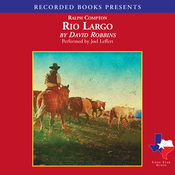
Rio Largo: a Ralph Compton novel by David Robbins (audio book read by Joel Leffert)

Kent Tovey and Dar Pierce run the "Circle T" and "D.P." ranches, respectively, on opposite sides of the Río Largo ("long river"). Technically, they're competitors, but since there is enough land for each to run his ranch successfully, they often help each other out and have become friends. Workers for each ranch are told to be polite to the other ranch's workers, and to only go for cattle that have crossed over once the other ranchers have been notified, to avoid any suspicion of rustling.

But an impulsive act leads to a murder, which leads to more, with each side accusing the other without searching for evidence. When one of the ranch owners is found with his face half–shot off, it's war.

Author David Robbins's tough and forceful prose was the first thing I liked about Rio Largo. Later, I was impressed by how the author laces his old-style storytelling with modern sensibilities.

Any ranch worth its salt is going to have a high percentage of cowboys and vaqueros who are experienced gunhands. But Tovey and Pierce seem to have hired more than their fair share of hardened killers. The newest hire, Hijino, is a breed to himself, however — the closest thing to a serial killer I've encountered in a tale of the Old West.

Robbins is also an expert at creating suspense, as his characters find out information and — as they try to piece together who is behind the sabotage — quickly realize that no one is safe. (Robbins also doesn't shy away from chronicling the effects of the bloodshed on loved ones.)

Entirely despicable, Hijino is also the most purely entertaining character in Rio Largo, simply due to his unpredictability. While the other denizens of the Circle T and D.P. are mostly loyal to their employers, there is underlying racism among a selection of the cowhands. Also, some of the Pierce children (half-Mexican by Dar's wife Juanita) just know that the "gringos" are behind it. But Hijino schemes entirely for his own purposes, and you just never know what he'll do next. One thing is for sure: he'll let no one get in his way.

Reader Joel Leffert's performance deserves a great deal of the credit for how much I enjoyed this book. From the youngest woman to the oldest man, his voices are individual and authentic. But this only enhanced the experience wrought by Robbins himself. Despite being published under the "Ralph Compton" mantle, this is no throwaway series novel but a possible contender for the mantle of modern classic. "Fill your hand" with a copy of Rio Largo.

Saturday, December 8, 2007

Vengeance Rider: a Ralph Compton novel by Joseph A. West (audiobook read by Terry Evans)

Author Joseph A. West's second novel under the Ralph Compton name, Vengeance Rider, is a vast improvement over his first, Doomsday Rider. The plot takes place ten years after the previous book. Buck Fletcher is now retired and married, with a daughter who has a terminal illness. Only a trip overseas can possibly save her life, but Fletcher doesn't have the money. The only chance he has is to take his best horse to a race in another part of the country; if he wins, he get the $10,000 he needs.

But the plot's not the part of Vengeance Rider I liked. It's the characterizations. Fletcher is more mature and grounded this time around, and he meets up with Doc Holliday on his way to the horse race.

West's portrait of Holliday is fantastic and filled with the things that make this mythic figure so popular — though few authors have been able to make him quite so interesting. It's one of the few times I've seen the old dentist practically "leap off the page," so to speak. Figuratively speaking, I often felt while listening to Vengeance Rider (again read with skill by Terry Evans) that Doc Holliday was riding in the seat next to me. I commend Joseph A. West for taking this necessary step up in quality. Now, I will be much more likely to pick up other books by him.

Wednesday, December 5, 2007

Doomsday Rider: a Ralph Compton novel by Joseph A. West (audiobook read by Terry Evans)

When people bad-mouth Westerns, this is the type of Western they mean: the kind that seems to be just be telling an often-told story over again, with very little plot (except for the typical revenge motif) and characters who speak and think in cliches. Here's the summary from the audiobook version of Doomsday Rider:

Framed for a murder that he did not commit, Buck Fletcher is given the chance to redeem his reputation by rescuing a senator's disgraced daughter from a war-torn region of Arizona, braving a band of renegade Apaches, the senator's minions, and a determined bounty hunter along the way.

Pretty straightforward, wouldn't you say? People in this world are either good or bad, and author Joseph A. West is perfectly willing to keep things that way.

I'm usually more interested in Westerns that try to stretch the genre in one way or another, but that is not to say that Doomsday Rider is not a pleasant read. After all, readers looking for their idea of the "typical" Western will likely be pleased by West's second tale featuring Buck Fletcher (author Ralph Compton is deceased; various authors are continuing his legacy in a series of novels that retain his name on the cover).

I found it satisfying as an audiobook. Reader Terry Evans's range of voices gets increasingly more surprising as the book continues. At one point, the text calls for a "fine, high tenor" to sing a song with new lyrics to the tune of "John Brown's Body," and Evans gives it his all, showing that he is more than up to the challenge. Evans's reading, in fact, was good enough to make it easier to overlook Doomsday Rider's other flaws. But for a much better example of a well-written Western, pick up Vengeance Rider (this book's sequel), also read by Evans, or Rio Largo, another Ralph Compton novel written by David Robbins.
Related Posts with Thumbnails