





- Antiques Disposal: A Trash 'n' Treasures Mystery by Max Allan Collins and Barbara Collins writing as Barbara Allan
- Best of the West, Vol. 1: Classic Stories of the American Frontier
- The Boar by Joe R. Lansdale
- Dark Side of the Morgue by Raymond Benson
- Death Waits at Sundown by L. Ron Hubbard
- Flesh Worn Stone by John A. Burks, Jr.
- Gates of Fire: An Epic Novel of the Battle of Thermopylae by Steven Pressfield
- Hard Country: A Novel of the Old West by Michael McGarrity
- Outlaws All: A Western Trio by Max Brand
- Shadows from Boot Hill by L. Ron Hubbard
- Sky Birds Dare! by L. Ron Hubbard
- Stolen Away by Max Allan Collins
- Too Poor for Texas by Joe Donn Martin
- Torture Garden directed by Freddie Francis and written by Robert Bloch
- The Words by Douglas Clegg
Monday, December 31, 2012
2012: The Year in Review(s)
Thursday, December 20, 2012
Christmas Crime: Antiques Flee Market: a Trash 'n' Treasures Mystery by Barbara Allan (Barbara Collins and Max Allan Collins)
Following her divorce, Brandy Borne moved back in with her mother, Vivian, in her hometown of Serenity. Much to her chagrin, the first thing they did together was attend a mother-daughter meeting of the local Red Hat Club. (Mystery readers all, the local branch has been named The Red-Hatted League.) Vivian couldn't go with Brandy's much-older sister Peggy Sue (they were both named after popular songs of their day) because Peggy Sue was already a member.
Before her arrival, Peg informed Brandy that Vivian sold off most of her prized possessions to an antique dealer while on a "drug holiday" from her bipolar meds. When the antique dealer was found dead — and both Brandy and Vivian admitted to running over the body in their car — it was up to the Borne girls to sift through the other suspects (the dealer was known for taking advantage of citizens) and find the real killer. This story was told in the first "Trash 'n' Treasures" book, Antiques Roadkill.
Since then, they've become amateur sleuths of a sort, investigating murders in their formerly quiet little Midwestern hometown and generally causing havoc of one sort or another while getting in the way of genuine police investigation. The second book in the series, Antiques Maul, is Halloween-themed. It concerns Brandy's trying to keep Vivian out of trouble by opening a booth at the local antiques mall, then finding a woman dead, presumably by her pit bull.
The third book in the series is Antiques Flee Market. Now it's Christmastime, and a former "conquest" of Vivian's (a "mercy mission" during wartime) has been found dead in his nursing-home bed.
Along for the search this time is the victim's British, Goth granddaughter, Chaz, an ex-con with less than savory friends and a delightfully Cockney way of speaking. Meanwhile, Brandy is troubled by an anonymous note that suggests Vivian is not her real mother, and Vivian is excited by news that she is no longer bipolar but merely schizo-affective (which is actually bipolar with psychotic tendencies).
Antiques Flee Market shows a marked improvement over the first book in the series, which I was actually unable to finish (I skipped the followup). The prose here is smoother, with very little sign of one author taking over for the other. The Collinses work well together as "Barbara Allan," and even the humor — which definitely felt inserted into Antiques Roadkill — is much more seamlessly integrated, making for a genuinely funny read (as opposed to simply a joke-filled one).
Fans of co-author Max Allan Collins will appreciate a couple of touches that must have come from him: namely a Mike Hammer reference and the fact that the antique this time around is a rare edition of Tarzan by Edgar Rice Burroughs (the "sleuth" Collins used for his Disaster series book The Pearl Harbor Murders). But all in all, "Barbara Allan" is really coming into her own, and the Trash 'n' Treasures series has to be the quirkiest cozy series on the market.
In fact, in many ways, the Collinses seem to be turning the classic tropes of the cozy subgenre on their ear. After all, the Bornes aren't independently wealthy; their dog is diabetic, blind, and named after raw fish; they're highly dependent on psychiatric medications just for their daily functioning (with disastrously funny results if, for example, they get their pill boxes confused); and their antiques are solely low-rent, flea-market fare (Mother is not averse to Dumpster diving) that clearly falls under the heading of the series' inspiration, the adage "One man's trash is another man's treasure."
In short, unlike most escapist fiction protagonists, the Bornes do not have a life to which it is likely the reader will aspire (except perhaps for those readers who should be, but aren't already, on psych meds). It more closely resembles horror fiction in that the events make you feel better about your own life.
Of course, I could be off on my facts a bit there, given that I wouldn't even have heard of this series if it weren't co-written by one of my favorite authors. But Antiques Flee Market actually turned out to be quite a fun read. Each chapter ends with an (often tongue-in-cheek) antique-buying tip, and the couple have a delightfully wicked sense of humor (dig that soap-opera-derived cliffhanger ending!). I'm already looking forward to reading the fourth book in the series, Antiques Bizarre.
Wednesday, December 19, 2012
Christmas Crime: Damon Runyon, Douglas Lindsay, and Tom Piccirilli
If you're at all like me, when a holiday season rolls around, you like to gear your genre-fiction reading toward material with that theme. Where horror dominates Halloween, the Christmas season seems to focus on crime.
 I first came across this seemingly ironic pairing in an anthology entitled Murder for Christmas, which still graces my bookshelf, waiting patiently through the other eleven months for me to pay it due attention each December. This book also has the special honor of having introduced me to Damon Runyon via "Dancing Dan's Christmas," which is not only an excellent example of Runyon's style and sense of humor but also holds up to annual rereading.
"Dancing Dan's Christmas" is a yarn (and Runyon's stories often feel like yarns) of getting one up on the coppers. It's a nice little holiday tale filled with Runyon's wonderful humor, sly references to crimes "not" committed by the narrator, and quite a good deal of the Christmas spirit. When a story contains a drunk in a Santa suit and still has an O. Henry–style happy ending, you know you're in the hands of a skilled writer. Murder for Christmas is out of print, but "Dancing Dan's Christmas" is currently available in the Penguin Classics edition of Guys and Dolls and Other Writings.
 From upstart publisher Blasted Heath comes Douglas Lindsay's latest in his series of Barney Thomson, the "renegage barbershop legend," The End of Days, a novella set during December 2009. Carnage seems to follow Thomson wherever he goes, though Thomson directly causes none of it.
In The End of Days, at the same time Britain's Prime Minister hires Barney to do his hair ("He did Blair's hair at the last election. And he did the First Minister in Scotland a while back. He has form. Get him down here") — despite a warning that "death, murder, slaughter, blood, horror, mutilation and genocidal abomination are sure to follow" — someone starts killing off members of Parliament at an alarming rate.
As the PM is more concerned with how his hair looks at each speech he gives — "I want a haircut that transcends hair. That's what Gandhi had. He had a haircut that didn't even need hair. I want something like that, but a haircut that doesn't need hair but has hair anyway" — Thomson becomes his advisor during one of the worst times in Britain's history, culminating in a planned invasion of the United States! This combination of serial killer and political satire makes for great reading.
 Where The End of Days ends on Christmas Day, author Tom Piccirilli's "noirella" You'd Better Watch Out begins there, as the narrator watches his father brutally murder his mother on that holiday. (Piccirilli's time working in the horror genre comes in handy here.)
Soon, he begins working for mobster Johnny Booze, who trains the kid to be a torpedo (hitman) of the highest order, while the kid readies himself for the day his father is released. The tension Piccirilli weaves throughout the story is sometimes nearly unbearable, showing how he's one of today's top noir-fiction writers.
Piccirilli uses the Christmas theme well, as nearly every important event occurs on or around that day as the years pass. You'd Better Watch Out is certainly not a feel-good read — though there is a genuine soft spot at its center — and it is perfect for those not looking for some relief from the usual tidings of comfort and joy.
(And after you've read all three of these stories, be sure to add The Thin Man to your annual slate of holiday viewing, even if only for the scene where Nick Charles tests out his new air rifle — on the Christmas tree ornaments.)
Happy holidays!
I first came across this seemingly ironic pairing in an anthology entitled Murder for Christmas, which still graces my bookshelf, waiting patiently through the other eleven months for me to pay it due attention each December. This book also has the special honor of having introduced me to Damon Runyon via "Dancing Dan's Christmas," which is not only an excellent example of Runyon's style and sense of humor but also holds up to annual rereading. "Dancing Dan's Christmas" is a yarn (and Runyon's stories often feel like yarns) of getting one up on the coppers. It's a nice little holiday tale filled with Runyon's wonderful humor, sly references to crimes "not" committed by the narrator, and quite a good deal of the Christmas spirit. When a story contains a drunk in a Santa suit and still has an O. Henry–style happy ending, you know you're in the hands of a skilled writer. Murder for Christmas is out of print, but "Dancing Dan's Christmas" is currently available in the Penguin Classics edition of Guys and Dolls and Other Writings.
From upstart publisher Blasted Heath comes Douglas Lindsay's latest in his series of Barney Thomson, the "renegage barbershop legend," The End of Days, a novella set during December 2009. Carnage seems to follow Thomson wherever he goes, though Thomson directly causes none of it. In The End of Days, at the same time Britain's Prime Minister hires Barney to do his hair ("He did Blair's hair at the last election. And he did the First Minister in Scotland a while back. He has form. Get him down here") — despite a warning that "death, murder, slaughter, blood, horror, mutilation and genocidal abomination are sure to follow" — someone starts killing off members of Parliament at an alarming rate.
As the PM is more concerned with how his hair looks at each speech he gives — "I want a haircut that transcends hair. That's what Gandhi had. He had a haircut that didn't even need hair. I want something like that, but a haircut that doesn't need hair but has hair anyway" — Thomson becomes his advisor during one of the worst times in Britain's history, culminating in a planned invasion of the United States! This combination of serial killer and political satire makes for great reading.
Where The End of Days ends on Christmas Day, author Tom Piccirilli's "noirella" You'd Better Watch Out begins there, as the narrator watches his father brutally murder his mother on that holiday. (Piccirilli's time working in the horror genre comes in handy here.) Soon, he begins working for mobster Johnny Booze, who trains the kid to be a torpedo (hitman) of the highest order, while the kid readies himself for the day his father is released. The tension Piccirilli weaves throughout the story is sometimes nearly unbearable, showing how he's one of today's top noir-fiction writers.
Piccirilli uses the Christmas theme well, as nearly every important event occurs on or around that day as the years pass. You'd Better Watch Out is certainly not a feel-good read — though there is a genuine soft spot at its center — and it is perfect for those not looking for some relief from the usual tidings of comfort and joy.
(And after you've read all three of these stories, be sure to add The Thin Man to your annual slate of holiday viewing, even if only for the scene where Nick Charles tests out his new air rifle — on the Christmas tree ornaments.)
Happy holidays!
Sunday, November 25, 2012
Re-Kindling Interest: Serpent Girl by Ray Garton (horror novella)
This is one of a series of reviews focusing on out-of-print works that have become available again via a variety of e-book formats.
Newly retired from his well-paying job, Steven Benedetti decides to celebrate with a visit to the carnival. There he meets Elise, the Serpent Girl (she dances with snakes), herself newly unemployed due to a fight with her boss/lover. Elise (whose real name is Carmen Mattox) and Benedetti subsequently hit the road together, spending the night in a roadside motel where they share their bodies and their histories — but not their secrets. That comes later; pieces slowly reveal themselves as the couple have a lot of sex and begin to think they're perfect for each other.
 Author Ray Garton is probably best known as a writer of horror fiction (The New Neighbor, Live Girls), but Serpent Girl, originally one of his long line of books from Cemetery Dance Publications, seems to display the influence of the hardboiled crime novels and films of the 1940s and '50s: to wit, the beautiful woman whom trouble seems to follow and the world-weary man who is so attracted to her that he doesn't realize what he's gotten into until very late in the game. Steven and Elise fit their roles well, but each has a little secret in store for the other.
This blend of sex, horror, and crime fiction (I like to call it "erotic noirror," but your mileage may vary) plays to Garton's strengths: creative plots and the rare ability to know when to paint with broad strokes and when to be more detailed. Serpent Girl certainly has its flaws (conversations that border on the tedious, two-dimensional characters, and an abrupt ending), but they don't keep this novella from pulling the reader through to the somewhat unexpected conclusion. Its menacing foreshadowing alone would guarantee that, even if Garton didn't have a couple of surprises up his sleeve.
Garton's longtime fans will definitely be satisfied by Serpent Girl, and those concerned that he might be devoting himself to crime fiction entirely can be assuaged by his recent werewolf novel Ravenous (and its sequel, Bestial). Those, however, wanting more of this direction of the author's work should seek out his two books originally published under the pseudonym Arthur Darknell and now out under his own: Loveless and Murder Was My Alibi.
This review is an updated and revised version of the one that originally appeared in The Green Man Review in 2008. Reprinted with permission.
Newly retired from his well-paying job, Steven Benedetti decides to celebrate with a visit to the carnival. There he meets Elise, the Serpent Girl (she dances with snakes), herself newly unemployed due to a fight with her boss/lover. Elise (whose real name is Carmen Mattox) and Benedetti subsequently hit the road together, spending the night in a roadside motel where they share their bodies and their histories — but not their secrets. That comes later; pieces slowly reveal themselves as the couple have a lot of sex and begin to think they're perfect for each other.
Author Ray Garton is probably best known as a writer of horror fiction (The New Neighbor, Live Girls), but Serpent Girl, originally one of his long line of books from Cemetery Dance Publications, seems to display the influence of the hardboiled crime novels and films of the 1940s and '50s: to wit, the beautiful woman whom trouble seems to follow and the world-weary man who is so attracted to her that he doesn't realize what he's gotten into until very late in the game. Steven and Elise fit their roles well, but each has a little secret in store for the other.This blend of sex, horror, and crime fiction (I like to call it "erotic noirror," but your mileage may vary) plays to Garton's strengths: creative plots and the rare ability to know when to paint with broad strokes and when to be more detailed. Serpent Girl certainly has its flaws (conversations that border on the tedious, two-dimensional characters, and an abrupt ending), but they don't keep this novella from pulling the reader through to the somewhat unexpected conclusion. Its menacing foreshadowing alone would guarantee that, even if Garton didn't have a couple of surprises up his sleeve.
Garton's longtime fans will definitely be satisfied by Serpent Girl, and those concerned that he might be devoting himself to crime fiction entirely can be assuaged by his recent werewolf novel Ravenous (and its sequel, Bestial). Those, however, wanting more of this direction of the author's work should seek out his two books originally published under the pseudonym Arthur Darknell and now out under his own: Loveless and Murder Was My Alibi.
This review is an updated and revised version of the one that originally appeared in The Green Man Review in 2008. Reprinted with permission.
0
observations

 Labels:
Cemetery Dance,
crime,
film noir,
hit men,
horror,
novellas,
Ray Garton,
serial killers
Labels:
Cemetery Dance,
crime,
film noir,
hit men,
horror,
novellas,
Ray Garton,
serial killers
Tuesday, November 20, 2012
Best of the West, Vol. 1: Classic Stories of the American Frontier (Western audiobook anthology)
Best of the West, Vol. 1: Classic Stories of the American Frontier is a 2009 audio anthology of classic and modern classic Western stories by a wide range of authors from Matt Braun to Zane Grey, from Will Henry to Elmer Kelton. Here are some highlights:
 Author Gordon D. Shirreffs (Rio Desperado) is always good for a Western filled with complex characters and situations, and "Death Hires These Guns!" is no different. Reed Emmons is in the Mexican border town of Nogalles when he gets word that his brother Rance was killed by a backshooter. Of course, he wants revenge, but he has trouble getting a bead on the killer.
First, it's Burt Whitman, marshal at the Cottonwood seat, but the evidence is circumstantial. Turns out Rance was seeing Whitman's sister Aurelia. But when Reed goes in disguise and finds Whitman had nothing to do with his brother's death, will an extra complication make him go through with his plan anyway?
In Loren D. Estleman's "The Death of Dutch Creel" (also available in his Western collection The Bandit and Others), someone who was actually at the titular event (in a way) sets the record straight after seeing a particularly sensationalist "authentic" retelling at the pictures. Arte Johnson's reading emphasizes the wry humor.
Gary McCarthy tells the story of a frontier doctor, James Stanton, who needs to learn how to "Grab, Root, and Growl" if he's going to marry the woman he loves. On the cusp of ending their relationship, he gets his chance. McCarthy portrays another kind of "true grit" here, in having Stanton show that one person's definition of "quitter" does not suit everybody.
Author Gordon D. Shirreffs (Rio Desperado) is always good for a Western filled with complex characters and situations, and "Death Hires These Guns!" is no different. Reed Emmons is in the Mexican border town of Nogalles when he gets word that his brother Rance was killed by a backshooter. Of course, he wants revenge, but he has trouble getting a bead on the killer.First, it's Burt Whitman, marshal at the Cottonwood seat, but the evidence is circumstantial. Turns out Rance was seeing Whitman's sister Aurelia. But when Reed goes in disguise and finds Whitman had nothing to do with his brother's death, will an extra complication make him go through with his plan anyway?
In Loren D. Estleman's "The Death of Dutch Creel" (also available in his Western collection The Bandit and Others), someone who was actually at the titular event (in a way) sets the record straight after seeing a particularly sensationalist "authentic" retelling at the pictures. Arte Johnson's reading emphasizes the wry humor.
Gary McCarthy tells the story of a frontier doctor, James Stanton, who needs to learn how to "Grab, Root, and Growl" if he's going to marry the woman he loves. On the cusp of ending their relationship, he gets his chance. McCarthy portrays another kind of "true grit" here, in having Stanton show that one person's definition of "quitter" does not suit everybody.
Westerns from the Library
I went to the library in the next town over the other day. (If you have a library card in my state, you can borrow from any library in the state's network.) This was primarily because they have a much wider selection of Westerns than the library in my town.
However, as the librarians have mentioned, these Westerns are kept mostly to satisfy a handful of enthusiastic older gentlemen who stop in every so often. As such, I would guess that around 90 percent of them are large-print books. This is not my preference when it comes to reading material, but I'm just happy that the books are there at all.
Usually when I visit, there are numerous folks filing through the various stacks but I am alone in the Western section. Today, however, one of these spoken-of gentlemen was there, too.
We had a short conversation where he mentioned that he got the books for himself and his wife, who has macular degeneration, so he gets the large-print books, though "I have 20/20 vision." (It's little loving deeds like this that make for happy marriages, gents. Remember that.)
I also took the opportunity to ask him for recommendations. After letting me know that his favorite author was Johnstone, and saying that he didn't much care for Max Brand (too much description), he took a few moments to show me some specific books. Though these initial comments led me to believe our tastes might actually be diametrically opposed, I listened appreciatively and with an open mind. (After all, I won't really know until I've tried them, right?) The four I checked out are below.
The Man Who Believed in the Code of the West by George L. Voss
I found this one myself. The title and premise interested me, as did the portion of the author's bio that states on the back flap of this first edition hardcover (which, incidentally, cost $6.95 new) that "Like James Fenimore Cooper, George L. Voss began writing late in life because he was dissatisfied with what he was reading."
It's about a Harvard graduate who goes out West, and the promotional material calls the character "a combination of Destry and The Man Who Shot Liberty Valance." And if those three classic-Western references don't seem like overkill yet, it continues, "but he has more charm, more wit, and yes, more true grit."
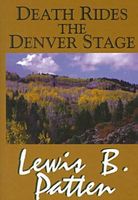 Death Rides the Denver Stage by Lewis B. Patten
I know Death Rides the Denver Stage will be a good one, since I've previously enjoyed Patten's short novel Wild Waymire. (Not to mention the numerous recommendations of his work by fellow bloggers and authors I admire.)
I also seem to have a liking for "Death does something" titles, given my enjoyment of both Death Waits at Sundown and Death Rides a Chestnut Mare (possibly my favorite title for a Western, and a damned fine read to boot).
(Patten himself wrote another called Death Rides a Black Horse, which has this fantastic review on Amazon you should read.)
 Killer's Gun by Ray Hogan
Interestingly enough, in searching the electronic card catalog for newer Westerns, I came across the previously unknown name Ray Hogan. The cover to Killer's Gun intrigued me with its bold simplicity. So when Hogan was one of the names the elder gent recommended, I snatched it up with eagerness.
The book is a reprint of a 1966 novel by the prolific Hogan, who also has a good number of books available for the Kindle from Prologue Books. Luke Wade is searching for the man who killed his father. In the meantime, he gets work on a cattle drive and, against rustlers, manages to find ways to keep his "killer's gun" in good shape.
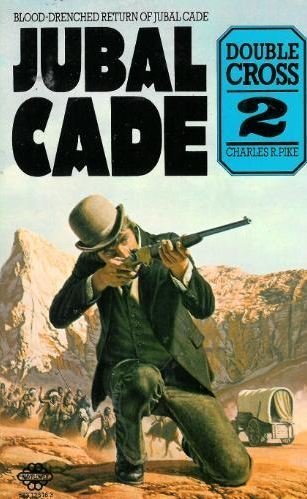 Jubal Cade #2: Double Cross by Charles R. Pike
My benefactor specifically pointed out this series as he stated that the library had all the volumes except the first. Numerous Web sources suggest that the first three books were written by author Terry Harknett, better known under another pseudonym as George G. Gilman behind the wildly popular and influential Edge and Steele series. (The Jubal Cade series was then continued to its conclusion by fellow "Piccadilly Cowboy" Angus Wells, with one intervening volume by Ken Bulmer.)
Based on the summary of this book, the first one saw poor old American doctor, trained in England, Jubal Cade losing his British wife to a killer Lee Kincaid and having to take a blind orphan boy under his care. Because of the need for money on his search for vengeance, he becomes a gun for hire. I've only read a couple of the Edge novels, but based on that, I'm excited to delve into this other series.
However, as the librarians have mentioned, these Westerns are kept mostly to satisfy a handful of enthusiastic older gentlemen who stop in every so often. As such, I would guess that around 90 percent of them are large-print books. This is not my preference when it comes to reading material, but I'm just happy that the books are there at all.
Usually when I visit, there are numerous folks filing through the various stacks but I am alone in the Western section. Today, however, one of these spoken-of gentlemen was there, too.
We had a short conversation where he mentioned that he got the books for himself and his wife, who has macular degeneration, so he gets the large-print books, though "I have 20/20 vision." (It's little loving deeds like this that make for happy marriages, gents. Remember that.)
I also took the opportunity to ask him for recommendations. After letting me know that his favorite author was Johnstone, and saying that he didn't much care for Max Brand (too much description), he took a few moments to show me some specific books. Though these initial comments led me to believe our tastes might actually be diametrically opposed, I listened appreciatively and with an open mind. (After all, I won't really know until I've tried them, right?) The four I checked out are below.
The Man Who Believed in the Code of the West by George L. Voss
I found this one myself. The title and premise interested me, as did the portion of the author's bio that states on the back flap of this first edition hardcover (which, incidentally, cost $6.95 new) that "Like James Fenimore Cooper, George L. Voss began writing late in life because he was dissatisfied with what he was reading."
It's about a Harvard graduate who goes out West, and the promotional material calls the character "a combination of Destry and The Man Who Shot Liberty Valance." And if those three classic-Western references don't seem like overkill yet, it continues, "but he has more charm, more wit, and yes, more true grit."
Death Rides the Denver Stage by Lewis B. Patten
I know Death Rides the Denver Stage will be a good one, since I've previously enjoyed Patten's short novel Wild Waymire. (Not to mention the numerous recommendations of his work by fellow bloggers and authors I admire.)
I also seem to have a liking for "Death does something" titles, given my enjoyment of both Death Waits at Sundown and Death Rides a Chestnut Mare (possibly my favorite title for a Western, and a damned fine read to boot).
(Patten himself wrote another called Death Rides a Black Horse, which has this fantastic review on Amazon you should read.)
Killer's Gun by Ray Hogan
Interestingly enough, in searching the electronic card catalog for newer Westerns, I came across the previously unknown name Ray Hogan. The cover to Killer's Gun intrigued me with its bold simplicity. So when Hogan was one of the names the elder gent recommended, I snatched it up with eagerness.
The book is a reprint of a 1966 novel by the prolific Hogan, who also has a good number of books available for the Kindle from Prologue Books. Luke Wade is searching for the man who killed his father. In the meantime, he gets work on a cattle drive and, against rustlers, manages to find ways to keep his "killer's gun" in good shape.
Jubal Cade #2: Double Cross by Charles R. Pike
My benefactor specifically pointed out this series as he stated that the library had all the volumes except the first. Numerous Web sources suggest that the first three books were written by author Terry Harknett, better known under another pseudonym as George G. Gilman behind the wildly popular and influential Edge and Steele series. (The Jubal Cade series was then continued to its conclusion by fellow "Piccadilly Cowboy" Angus Wells, with one intervening volume by Ken Bulmer.)
Based on the summary of this book, the first one saw poor old American doctor, trained in England, Jubal Cade losing his British wife to a killer Lee Kincaid and having to take a blind orphan boy under his care. Because of the need for money on his search for vengeance, he becomes a gun for hire. I've only read a couple of the Edge novels, but based on that, I'm excited to delve into this other series.
Subscribe to:
Posts (Atom)
