Showing posts with label investigation. Show all posts

Saturday, May 4, 2013

Mortal Lock by Andrew Vachss (collection of 20 short stories and a screenplay)

Crime author Andrew Vachss is well known as a modern master of the hardboiled tale, and the twenty-one works in his latest collection, Mortal Lock, only serve to further that reputation.

Vachss is an attorney who only represents clients under 18, but his doppelganger shows up in "Veil's Visit" (co-written with friend and fellow Texan Joe R. Lansdale) to defend Hap Collins's best friend, serial crack-house arsonist Leonard Pine.

Veil's defense is as funny as it is clever, and Lansdale and Vachss blend their styles seamlessly. It is a treat for Lansdale fans and a welcome source of laughs in the midst of the surrounding darkness.

Because the stories in Mortal Lock are dark, no doubt about it. Vachss seems to specialize in portraying the worst sides of humanity, with only occasional dashes of hope included.

Lucky for the reader, what makes society poorer makes for gripping fiction. From beginning to end, the works in Mortal Lock — I would say "stories," but the final third is devoted to a screenplay adapting the "Underground" stories from Born Bad — are utterly engrossing.

And the characters are originals. Take the narrator of "Ghostwriter," one of two previously unpublished stories. He will do anything to be recognized for his writing, as long as it's for its quality. He doesn't care about the money; he still needs to realize his true ambition, no matter who gets in the way.

"Bloodlines" (source of the title phrase) is the other original in Mortal Lock. To fit in while he waits for his target to come along, a hit man learns the ins and outs of racing "trotters." The story and dialogue were reminiscent of some of the best work of Damon Runyon (a favorite of mine), and I loved learning about an unfamiliar topic while being entertained by two really great characters.

Other memorable characters that come to mind are the cagey old prisoner from "Seeding the Ground," and Rhino and Princess from "Profile" — which features series character Cross, protagonist of Blackjack and numerous short stories. "As the Crow Flies" stars the protagonists of Vachss's latest series, beginning with the novel Aftershock. The story starts out relatively low key, but that allows the ending to hit that much harder.

The writing in Mortal Lock, while it may seem sensational on the surface, is actually quite subtle. This comes out best in the several short-shorts scattered throughout. There are stories like "They're All Alike," "Corazón," "Savior," and "Dead Reliable" that save their gut punch to the end. And tales like "Sure Thing," "Passage to Paradise, and "Pig" may not deliver their full effect until the reader has left them for a while. Their power comes from what is not on the page, but in the final picture those words create in the mind.

Tuesday, March 5, 2013

One Night Stands and Lost Weekends: Early Stories by Lawrence Block (short stories and novellas)

May you, Dear Reader, like the tomcat who had the affair with the skunk, enjoy these stories as much as you can stand.
—Lawrence Block, from the introduction
In 1999, publisher Crippen & Landru released limited hardcover editions of the early short fiction of author Lawrence Block.  The short-story volume was entitled One Night Stands, and the novella collection was called The Lost Cases of Ed London.

Now, these two volumes have been combined into a single trade paperback with the provocative title One Night Stands and Lost Weekends. The title describes the average time it took to write the short stories and novellas, respectively.

Block begins One Night Stands and Lost Weekends with a self-deprecatingly humorous introduction where he tells why he changed his mind regarding his original decision — set down in the introduction (also included) to the preceding limited collectors' edition — to only release the stories to a limited audience. Basically that, upon reading the stories, no one called "rip off," so why not make a little more money off them?

While these stories obviously aren't to the level of Block's later work (a point he emphasizes in both introductions, practically going so far as to warn the reader away from them), they will still appeal to the author's fans.  His voice is already clear, and the humor and imagination glosses over any imperfections in craft.

Con man Dick Barron runs across an amateur playing "The Badger Game" — badly — and decides to go along with it and turn the tables, though he's a little too arrogant for his own good. Before reading this story, I had not heard of this con, and now references to it seem to keep popping up. Apparently it was a popular plot device during the period. The story is definitely of its time — the narrator speaks of "expensive" thirty-dollar shoes — but Block's skill at character makes this one of special appeal to fans of confidence tales like his The Girl with the Long Green Heart.

"The Bad Night" is a simple and unsurprising standoff between two young killers and their much older potential victim. The use of setting and dialogue goes a long way toward saving this one. "Bargain in Blood," originally published under the "Sheldon Lord" byline, has a simple message: the next time your other half wants you to prove your love, just hope she's not Rita. Block manages to put off the surprise nearly to the end here.

"Bride of Violence" is a very well executed piece of pure crime fiction with a twist that, if hard to condone, is completely the result of the actions of the story. "The Burning Fury" is another one of those stories of people who can't leave well enough alone.  Block's characterization is stunning, giving all the right information and still holding back a surprise.

Characterization is everything in "The Dope," since there's very little in the way of plot.  "A Fire in the Night" is an internal monologue of sorts with a twist that negates several factual statements from the story.  "Frozen Stiff" owes a debt to Roald Dahl, as the irony flows. (A nod to the master is given in the form of a leg of lamb.)  Another Sheldon Lord, "Just Window Shopping," shows remarkable insight into the mind of a voyeur who gets a surprise opportunity.

A quote usually misattributed to Confucius says that if rape is inevitable, just "Lie Back and Enjoy It." But then the tables are turned a little too cutely in this tale from 1958. (Read it online.)  "Look Death in the Eye" is reminiscent of Robert Bloch with its darkly funny and humorously gruesome Tales from the Crypt–style ending.  In "Man of Passion," a photographer on the run picks the wrong town to hide out in.

"Nor Iron Bars a Cage" is one of those tales where you just know there's going to be a twist that the whole story was conceived around, but still Block manages to surprise with his only attempt at science fiction. "Package Deal" concerns town tamer Lou Baron, Joe Milani, Albert Hallander, Mike Ross, Arlington Ohio, and a hit man with his own agenda.

A particular highlight is "Pseudo Identity." It is the tragic tale of a double life that goes awry when the two overlap in an unexpected way.  Block pulls us along a surprising route that ends in a karmic twist.  This is one of his best all around.

"Ride the White Horse" is a very dark tale of how one man's life changes for the better — and then for the worse — when his routine is disrupted. A little naive in its drug knowledge but very astute in drawing the primary relationship.  The overblown ending is the only real detriment.

Even after having so many twists and turns thrown at me, Block still managed to get another one right past me in "The Way to Power," a tale of a mob gunman who finally begins to think for himself.  Lenny Blake (not his real name), the protagonist of "You Can't Lose," offers advice for smart guys who don't like to work but like to stay flush with cash--as long as they're not into luxury.

The "Lost Weekends" portion contains three novellas featuring Block's first series P.I., Ed London.  The introduction to this volume is similar to the other.  In "The Naked and the Deadly," London meets his client's blackmailer, and on the way to do business the extortionist is mowed down by a Tommy gun.

Ed then fills us in on the backstory: he was hired by a secretive woman, a lawyer is looking for the woman, a cop is looking for the lawyer, and things go from there.  The novella gives London (and Block) the chance to ramble on a bit and impress us with his esoteric knowledge.

In "Stag Party Girl," the title character jumps out of a cake at a bachelor dinner and gets shot for her trouble. She'd been intimate with most of the attendees and was potentially blackmailing one or more.  This is an improvement on "The Naked and the Deadly," with London seeming to take his job more seriously.

Finally, in "Twin Call Girls," Ed gets an urgent call from a frightened woman.  But when he gets to the meeting he finds her dead.  When the girl subsequently turns up alive at his office, it's not hard to figure out what's going on.  (The title gives it away.) This is the darkest of the three, with Block delving into some of the seediest aspects of humanity, but always with enough heart to make it palatable.

Reading these solid detective novelettes, it's easy to see how Block would progress to his later detective series.  And readers hungry for more Ed London can find him in Coward's Kiss.

Readers seeking classic Block should keep searching. But I heartily recommend that readers of Block's Hard Case Crime reprints get a copy of One Night Stands and Lost Weekends.

Friday, January 25, 2013

Seduction of the Innocent by Max Allan Collins (Hard Case Crime; Jack and Maggie Starr)

Manhattan, 1954—Comics are on trial, both in the court and in the media. Dr. Werner Frederick's best-selling book Ravage the Lambs offers a warning against — or, for some, a guide to — the "worst" of the full-color, graphic (both meanings apply here) publications allegedly warping the minds of America's youth.

A good deal of participants in the comics industry would like to see Dr. Frederick done away with. When he is subsequently murdered by strangulation, is his theory being proven correct?

Seduction of the Innocent is the third in the Jack and Maggie Starr trilogy of historical mysteries by author Max Allan Collins. The previous volumes, A Killing in Comics and Strip for Murder appeared in 2007 and 2008, respectively, but then the publisher chose not to continue with the series.

Lucky for us, Hard Case Crime saw fit to rectify that oversight, and now readers can once again follow the exploits of the Starrs, complete with brand-new art, including fourteen pages of illustrations from Terry Beatty (Ms. Tree) and a suitably lurid cover painting from Glen Orbik.

Maggie Starr runs the Starr Newspaper Syndication Company. Her stepson Jack is a private investigator whose only client is the Starr Syndicate. Jack's father, known primarily as "the major," willed the syndicate to his young wife upon his death, which Jack repeatedly says doesn't bother him. (Maggie is also a former ecdysiast only 10 years Jack's senior, a situation that is a source of Oedipal-incest jokes at Jack's expense.)

Like its predecessors, Seduction of the Innocent has some basis in history, but author Max Allan Collins emphasizes that truth was only the inspiration. He plays around with the facts here more than in, say, his Nathan Heller series. The Heller novels hew closely to the facts with just a fictional character or two thrown in for the sake of the story.

A primary difference between Seduction of the Innocent and history is that Fredric Wertham, the real-life counterpart of Dr. Werner Frederick (and the author of the original best-selling anti-comics screed from which this novel takes its name), died of old age, so Collins even had to invent a murder to solve.

This explains why the main participants' names are fictionalized right along with the timeline of events and the characters' relationships. Collins gives them names that aren't obvious caricatures, but realistic names in the style of the real ones.

Collins himself states that he "invite[s] readers — particularly comics fans — to enjoy the roman à clef aspects," but that Seduction of the Innocent "is a mystery in the Rex Stout or Ellery Queen tradition, with a dollop of Mickey Spillane." But readers who are interested in the period will quickly realize that Collins's usual in-depth research is still strongly at play here, as the surrounding events (including death threats that didn't happen) are all based on fact.

So, it's an interesting mix, and there were times that I was torn by whether to read Seduction of the Innocent as a slice of history or simply as a golden-age mystery. It's fun either way.

Wednesday, January 16, 2013

Glock: The Rise of America's Gun by Paul Barrett (modern history)

Author Paul Barrett has been writing about the gun industry for 15 years at BusinessWeek. Given this breadth of experience, he seems unequivocably qualified to write this history.

Glock: The Rise of America's Gun tells the story of the firearm that rose from humble beginnings to eventually supplant the revolver as the United States's preferred Roscoe. This unassuming plastic piece was designed by Gaston Glock, an Austrian engineer with no experience in gun design, and this proved to be what was needed to bring his gun above the fray.

The Glock seems to have an equal-opportunity appeal, drawing everyone from police officers to gangbangers, from drug dealers to hobbyists, and seemingly every other gun enthusiast in between. Not being one of those myself, I was astonished at how drawn in I was by the tale of the Glock. Barrett's prose is smooth, and the story he tells is surprisingly involved and entertaining.

Thursday, December 20, 2012

Christmas Crime: Antiques Flee Market: a Trash 'n' Treasures Mystery by Barbara Allan (Barbara Collins and Max Allan Collins)

Following her divorce, Brandy Borne moved back in with her mother, Vivian, in her hometown of Serenity. Much to her chagrin, the first thing they did together was attend a mother-daughter meeting of the local Red Hat Club. (Mystery readers all, the local branch has been named The Red-Hatted League.) Vivian couldn't go with Brandy's much-older sister Peggy Sue (they were both named after popular songs of their day) because Peggy Sue was already a member.

Before her arrival, Peg informed Brandy that Vivian sold off most of her prized possessions to an antique dealer while on a "drug holiday" from her bipolar meds. When the antique dealer was found dead — and both Brandy and Vivian admitted to running over the body in their car — it was up to the Borne girls to sift through the other suspects (the dealer was known for taking advantage of citizens) and find the real killer. This story was told in the first "Trash 'n' Treasures" book, Antiques Roadkill.

Since then, they've become amateur sleuths of a sort, investigating murders in their formerly quiet little Midwestern hometown and generally causing havoc of one sort or another while getting in the way of genuine police investigation. The second book in the series, Antiques Maul, is Halloween-themed. It concerns Brandy's trying to keep Vivian out of trouble by opening a booth at the local antiques mall, then finding a woman dead, presumably by her pit bull.

The third book in the series is Antiques Flee Market. Now it's Christmastime, and a former "conquest" of Vivian's (a "mercy mission" during wartime) has been found dead in his nursing-home bed.

Along for the search this time is the victim's British, Goth granddaughter, Chaz, an ex-con with less than savory friends and a delightfully Cockney way of speaking. Meanwhile, Brandy is troubled by an anonymous note that suggests Vivian is not her real mother, and Vivian is excited by news that she is no longer bipolar but merely schizo-affective (which is actually bipolar with psychotic tendencies).

Antiques Flee Market shows a marked improvement over the first book in the series, which I was actually unable to finish (I skipped the followup). The prose here is smoother, with very little sign of one author taking over for the other. The Collinses work well together as "Barbara Allan," and even the humor — which definitely felt inserted into Antiques Roadkill — is much more seamlessly integrated, making for a genuinely funny read (as opposed to simply a joke-filled one).

Fans of co-author Max Allan Collins will appreciate a couple of touches that must have come from him: namely a Mike Hammer reference and the fact that the antique this time around is a rare edition of Tarzan by Edgar Rice Burroughs (the "sleuth" Collins used for his Disaster series book The Pearl Harbor Murders). But all in all, "Barbara Allan" is really coming into her own, and the Trash 'n' Treasures series has to be the quirkiest cozy series on the market.

In fact, in many ways, the Collinses seem to be turning the classic tropes of the cozy subgenre on their ear. After all, the Bornes aren't independently wealthy; their dog is diabetic, blind, and named after raw fish; they're highly dependent on psychiatric medications just for their daily functioning (with disastrously funny results if, for example, they get their pill boxes confused); and their antiques are solely low-rent, flea-market fare (Mother is not averse to Dumpster diving) that clearly falls under the heading of the series' inspiration, the adage "One man's trash is another man's treasure."

In short, unlike most escapist fiction protagonists, the Bornes do not have a life to which it is likely the reader will aspire (except perhaps for those readers who should be, but aren't already, on psych meds). It more closely resembles horror fiction in that the events make you feel better about your own life.

Of course, I could be off on my facts a bit there, given that I wouldn't even have heard of this series if it weren't co-written by one of my favorite authors. But Antiques Flee Market actually turned out to be quite a fun read. Each chapter ends with an (often tongue-in-cheek) antique-buying tip, and the couple have a delightfully wicked sense of humor (dig that soap-opera-derived cliffhanger ending!). I'm already looking forward to reading the fourth book in the series, Antiques Bizarre.

Saturday, August 11, 2012

Stolen Away by Max Allan Collins (Nathan Heller historical mystery series #5)

The fifth novel in Max Allan Collins's Nathan Heller series of historically accurate private-eye mysteries not only won the Shamus Award for best private-eye novel (the second in the series to win after True Detective), but is also, at 600 pages, the longest private-eye novel ever written.

But there's a lot of story to cover in Stolen Away, which focuses on the kidnapping of the "Lindbergh baby," 20-month-old Charles Lindbergh, Jr., son of the famous pilot ("Lucky Lindy"), who flew The Spirit of St. Louis across the Atlantic and was the first person to do it solo.

The story begins, however, with Heller, at this point still a cop on the Chicago force, following a suspicious-looking blonde, baby in tow, through the local train station. The Lindbergh kidnapping is only a few days old, and Heller thinks he might be on the trail to solving it, which would do wonderful things for his career.

He tails the woman all the way home, only to discover he's stumbled onto another kidnapping entirely. But this case catches the attention of Charles Lindbergh ("Slim" to his friends), who requests Heller's assistance in the investigation of his own child's disappearance.

Since Heller is still a cop throughout most of the book, Stolen Away walks the line of being a true private-eye novel. It is only Heller's distance from his normal jurisdiction that, in the long run, makes it feasible -- that and its part in the already established series. Heller works alone, and I guess that's what counts.

Having an elderly Heller writing his "memoirs" from his retirement complex in Coral Springs is a nice touch. It lends a realism that an actual person is recounting these events from memory (though he must have Archie Goodwin's memory for dialogue to be able to remember conversations as clearly as he does).

Collins' solution to the kidnapping is a little too clean for my taste, but Stolen Away as a whole is quite a gripping read with a surprisingly emotional conclusion. Fans of the series will tear through this, but I would especially recommend it to those interested in the Lindbergh kidnapping as history, given that Collins's usual exhaustive research is in high gear here. All the characters, except Heller, are either real people, "have real-life counterparts," or are composites of real people, and their actions and motives are taken from various articles and books about the case, mostly written by the participants.

That it all fits together so well is a testament to author Max Allan Collins's skill, especially since, in his "I Owe Them One" afterword (where he lists his sources), he cites the "conflicting source material" and the fact that "none of the books contemporary to the Lindbergh case proved entirely reliable." Nevertheless, Stolen Away is by far my favorite Heller mystery, and Collins is always my go-to guy whenever I want to indulge my taste for a great historical whodunit.

Thursday, April 26, 2012

Antiques Disposal: a Trash 'n' Treasures Mystery by Barbara Allan (Barbara Collins and Max Allan Collins)

Fans of Storage Wars, take note. Antiques Disposal, the sixth entry in the Trash 'n' Treasures cozy mystery series from author Barbara Allan (actually spouses Barbara Collins and Max Allan Collins) has heroines (or anti-heroines, depending on your take) Brandy and Vivian Borne bidding on a storage unit to stock their antique shop. There they discover both a cornet (that may have belonged to Bix Beiderbecke) and a corpse (that definitely belongs to Big Jim Bob, owner of the storage area and ex-flame of Vivian's).

If you're new to the antics of the mother-daughter dueling duo (as well as the authors' prevalent parenthetical asides — apparently the subject of much debate), you may wish to start with the first novel in the series, Antiques Roadkill, though the authors will catch you up satisfactorily in Antiques Disposal

Just be aware that facts presumed here were used as revelations in previous entries, so reading a later book may spoil the impact of earlier ones.  (The authors tackle this with admirable wit within the text.)

The Collinses as "Barbara Allan" produce another wacky, lightweight romp perfect for an evening's escapism, despite the Bornes' increasingly complex family tree.  This series is just pure fun, and the humor, though readers of more "hard-boiled" fiction might call it silly, is a treat. 

However breezy the novel feels, writing funny is actually quite difficult to pull off while keeping a tight rein on a murder-mystery plot.  The fact that this pair (the Collinses, not the Bornes) keep managing to pull this off while remaining happily married is a credit to them. 

(For those thinking that the authors are merely cashing in on a popular fad, looking into the history on Max Allan Collins's blog reveals that the first chapter and synopsis of Antiques Disposal were sent to the editor in June 2010, and Storage Wars debuted in December of that year.)

Wednesday, January 25, 2012

Re-Kindling Interest: Dark Side of the Morgue by Raymond Benson (The Rock 'n' Roll Detective's Greatest Hits)

This is one of a series of reviews focusing on out-of-print works that have become available again via a variety of e-book formats.

A blonde wearing sunglasses and a big, floppy hat has been killing members of Chicago's prog-rock scene (known locally as "Chicagoprog"), and Zach Garriott (guitarist and vocalist for the seminal bands North Side and Red Skyez, but gone solo since 1980) wants Spike Berenger's help finding the suspect — he's on the list. The trouble is, the main suspect is Sylvia Favero, and she's been dead since 1970.

Dark Side of the Morgue is author Raymond Benson's second Spike Berenger novel. This Kindle edition (called The Rock 'n' Roll Detective's Greatest Hits) contains it and the other two, A Hard Day's Death and On the Threshold of a Death for less than the price of one of the original paperback editions.

P.I. Spike Berenger used to be in a progressive rock band called The Fixers, but they didn't last long (though they still have some devoted fans). Now Berenger and his partner Rudy Bishop run Rockin' Security, a service for the music industry. Berenger also has his private investigator's license because it sometimes helps with business. Suzanne Prescott, a former Goth devotee now into Transcendental Meditation (T.M.) and martial arts, is his investigation partner.

Berenger, a little bored with his current caseload involving Iggy Pop's dogs and Debbie Harry's landlord, decides to take the case, partly because he's friends and former colleagues with many of the participants. Here, Benson's knowledge of the prog-rock industry serves him well (he wrote The Pocket Guide to Jethro Tull and is himself a composer and songwriter).

After a long exposition introducing character relationships and band histories, Benson's feel for the high points brings authenticity to the story and never feels just like some guy trying to write a rock novel. (A Chicagoprog "family tree" at the front of the book is great for reference, and the table of contents is actually a "track listing" of song titles.)

Dark Side of the Morgue is funny, disturbing, and filled with deep knowledge of the music industry and abnormal psychology, all combined to make a really terrific read that I wanted to pick up whenever I had a free moment. It is assembled from P.I./thriller tropes we've seen many times before, but Benson has put them together in a way that feels fresh and original, and results in the reader responding to them as if they were brand new.

My only real complaint is that protagonist Spike Berenger is the least interesting person in the book. But Berenger's transparency allows the supporting characters to truly shine (for example, in how Prescott's T.M. skills actually figure into the plot instead of being just an interesting character quirk). Benson obviously spent a great deal of time developing his musicians' relationships and histories, and the hard work pays off as Dark Side of the Morgue is an engrossing read that is as much for rock fans as it is for fans of conventional P.I. novels.

Tuesday, November 8, 2011

Top MFA Programs for Genre Writers (from guest blogger Emily Matthews)

Today I have the pleasure of welcoming writer Emily Matthews to the pages of Somebody Dies. An MFA applicant herself, she has offered to share some of her knowledge with other genre-fiction writers.

For all the arguments for and against obtaining a Master of Fine Arts in Creative Writing, one of the greatest concerns among authors is choosing the right program. This concern goes beyond simply choosing between a program that is geared toward fiction or poetry.

In the past, creative writers who wanted to explore the depths of certain genres such as mystery and thriller novels had every right to be skeptical about the value of MFA programs. There was a prevalent notion that MFA fiction programs shunned genre writing in favor of highbrow literary drama and writing for the performing arts. What’s a genre fiction writer to do when you’re searching for a master's degree program to practice your craft? Don’t give up hope.

While it’s true that masters of literature such as Kazuo Ishiguro and Ian McEwan, as well as acclaimed screenwriters such as Darren Starr and David Benioff, graduated from MFA programs, authors of thrillers and mysteries can definitely find a program geared towards their chosen genre. Authors of mysteries and thrillers who are looking to create suspense will find that there is an MFA program waiting for them.

The MFA program at the University of Southern Maine has an option for popular fiction writing. The school not only welcomes burgeoning writers of mystery and thriller novels, it actually encourages them to market their work.

Science fiction and techno-thriller authors are gladly accepted at the University of Kansas and its esteemed James Gunn Center for the Study of Science Fiction. Genre fiction is actually a graduate course for writers attending the North Carolina State University MFA program.

Taking a critical look at the professors teaching at specific MFA schools can shed light on their inclination towards genre writers. At Florida International University, Les Standiford has been at the helm of the creative writing program for decades. He is well known for his crime and suspense novels based in Miami, and he even gave Raymond Carver his first writing gig. Adam Baron, who teaches at the prestigious Kingston University London, is a thriller and crime writer whose work has been serialized for BBC Radio.

Writers of mystery and thriller novels do not have to jump from one workshop to sharpen their skills and become masters of their craft. In terms of cultural standing, the MFA programs above recognize that mysteries and thrillers have an important place in the world's literature. Entering the right MFA program is a great opportunity for authors to become the next Michael Crichton or John Grisham.

Emily Matthews is currently applying to master's degree programs across the U.S., and loves to read about new research into health care, gender issues, and literature. She lives and writes in Seattle, Washington.

Saturday, October 1, 2011

Re-Kindling Interest: True Detective, True Crime, and The Million-Dollar Wound by Max Allan Collins (Nathan Heller series of historical private eye novels)

This is one of a series of reviews focusing on out-of-print novels that have become available again via a variety of e-book formats.

Though they've been out of print for most of the last decade, I was happy to learn that Amazon's new mystery imprint, Thomas & Mercer (named for the cross streets where the offices are located) would be reprinting all of author Max Allan Collins's Nathan Heller novels. Now they're available in trade paperback and e-book formats.

Recently, the first book in the series, the Shamus Award–winning True Detective, was promotionally priced at $0.99 and shot to #1 on the Kindle charts. As of this writing, it's still at the reasonable $1.99: an easy impulse buy.

True Detective is a stunning mix of fact and fiction. The setting is 1930s Chicago, and Collins paints the city of that time with a bold brush. Nathan Heller is a city cop who gets roped into a messy situation by his fellow officers. When he ends up killing a man with the same gun Heller's father used to commit suicide, Nathan's own, that's the last straw that leads to Heller's quitting the force, despite the efforts of the higher-ups to get him to reconsider.

But working as the president of your own detective agency (called "A-1" so it will appear first in the telephone directory) is by no means boring — not when your best friend is Eliot Ness and you have connections to Frank Nitti, Al Capone, mayor Anton Cermak, Walter Winchell, George Raft, and a young future actor who goes by the name "Dutch" Reagan. (Gangster John Looney, whom Collins would feature in Road to Perdition fifteen years later, even shows up.)

Collins took five years to research the place and time, and this, combined with his immense storytelling skill, make True Detective an immersive experience. The World's Fair comes alive in his hands, as do the characters, who have never seemed so real (even in The Untouchables) as when they are dealing with the fictional Nathan Heller.

The Nate Heller series continues with True Crime, also the second book in the "Frank Nitti Trilogy." Taking place just months after the events in its predecessor, True Crime centers around the famous killing of gangster John Dillinger in front of Chicago's Biograph Theater. (Manhattan Melodrama was the picture that he, a girlfriend, and the famous "Lady in Red" had just seen.)

Nate has just begun a relationship with renowned feather/bubble dancer, Sally Rand, when a man comes into his office asking Heller to find his wife. How this connects with Dillinger, and how Heller then gets mixed up with Pretty Boy Floyd, Baby Face Nelson, Ma Barker and her boys, and J. Edgar Hoover is a narrative of historic proportions.

True Crime was originally meant to be part of True Detective, but Collins realized that what was supposed to be a novel was slowly turning into an epic, and that cutting the entire Dillinger plot was what was needed. So, when the editor who bought the first asked if Collins had ideas for a sequel, he had an instant answer.

The accuracy of Collins' details and the amount of research done to get the facts right (sources are named in the back) are an example of the dedication Collins has to his craft. That he is able to whip up a plot that uses these facts, but does not rely on them for a crutch, while inserting a fictional character into the midst of the fracas, is nothing short of remarkable.

Collins sends Heller off to war in The Million-Dollar Wound, the third in the series to be nominated for a Shamus Award. (Note: The title refers to a war wound that gets a soldier sent home, but doesn't kill him.)

A little male pride, some misplaced patriotism, and a few drinks too many land Heller, too old for the draft, in the Marine enlistment office in 1942, right alongside best friend and ex-boxer Barney Ross. Far too soon after, they find themselves smack dab in the middle of Guadalcanal Island, surrounded by "Japs" and fighting death in both its projectile and contagious forms.

An especially bad case of malaria finds an amnesiac Heller back in the States with a fuzzy memory but a thriving investigation practice, and a request to testify against Frank Nitti, now in control of the territory left vacant by Al Capone's prison sentence. The story quickly flashes back to 1939. Those used to the linear narratives of the first two novels in the series, and their relative chronological proximity to each other, may be thrown by The Million-Dollar Wound, which takes place nine, then six, then ten years after the events in True Crime.

The Million-Dollar Wound was Max Allan Collins's most complex novel, both emotionally and narratively, up to that point. The weight of the combat experience weighs heavily on Heller's mind throughout the remainder of the novel, especially the bad dreams he has involving a fellow Marine's death by "friendly fire." Did Heller fire the fatal shot? He can't remember. This lends a gravity to this third entry that only enhances the reading, offering a deeper sense of character through Heller's reaction to the truth.

This Frank Nitti trilogy is only the first three novels of this long-running series of "memoirs," which includes the most recent novel, Bye Bye, Baby, wherein Nate Heller investigates the death of Marilyn Monroe. Also upcoming are two collections. Chicago Lightning contains all the Heller short stories produced throughout the last 30 years, previously collected and uncollected. Triple Play contains three Heller novellas written to date: “Dying in the Postwar World,” “Kisses of Death,” and “Strike Zone.”

Saturday, May 14, 2011

Kiss Her Goodbye by Mickey Spillane and Max Allan Collins (Mike Hammer series)

Only a telephone call from his best friend, police captain Pat Chambers, could bring Mike Hammer back to New York. There was simply nothing for him there anymore. And his health's not so great, either, after that firefight that ended in the death of Sal Bonetti and left Hammer with numerous pains, in particular a "hot spot" behind his ribs. So, he's been relaxing and recuperating in Florida and not missing the city a bit.

When Pat tells Mike that their pal Inspector Bill Doolan killed himself, Mike is on his way. After the funeral, though, something nags at Hammer, and he begins to have doubts. Sure, Doolan had cancer, and maybe he would want to do away with himself before the disease made his every living moment hell, but it's just not Doolan's style. And yet maybe it could have been his wish, given how he was living his final years as a playboy, to go out in a flash.

But when the corpse of Ginnie Mathes turns up and Dulcie Thorpe is hit-and-run'd right beside Mike, Hammer knows that, as unofficial as he wanted this visit to be, he'll have to break out the .45 and the porkpie and do what he does best. Only this time without his girl Friday, Velda.

Kiss Her Goodbye is the third Mike Hammer novel finished by author Max Allan Collins from documents in the late Mickey Spillane's files. The first two were The Goliath Bone and The Big Bang (with the non-Hammer Dead Street before that).

Collins has really hit his stride with this one. He captures the disco era skillfully, yet assures that it doesn't feel old or out-of-date to modern readers — though that didn't keep a Bowery Boys reference from eliciting a grin. Kiss Her Goodbye also serves up a superlative mystery that kept me guessing, sometimes even more after a question was answered than before, delivering a couple of really great twists.

There are several more unfinished novels and other works remaining in the Spillane archives, but Kiss Her Goodbye is at this writing the last Hammer contracted for. I for one am glad to see Hammer in brand new adventures, and I know many of you are, too. So let's keep him there. What this means is that, if you want to see more, you need to speak up with your almighty dollars. Accolades and passionate discussion are all well and good, but the only way the publisher knows that these books are in demand is if they sell.

Friday, March 11, 2011

The New Adventures of Mickey Spillane's Mike Hammer, Volume 3: Encore for Murder by Max Allan Collins and Mickey Spillane

This third volume of The New Adventures of Mickey Spillane's Mike Hammer is the second to contain a "novel for radio" by Max Allan Collins (after 2010's Audie Award–nominated The Little Death). Collins continues to pore through the files of the late Mickey Spillane for gold nuggets, and this one, Encore for Murder, is expanded from a one-page outline.

Mike Hammer is hired to play bodyguard to ex-flame and former diva Rita Vance. Rita is taking a ride down nostalgia lane in the revival of her biggest success, playing George M. Cohan's wife in Mrs. Doodle Dandy.

But now she's receiving death threats, and she wants Mike and Velda to find out who is sending them. Mike's bodyguarding duties require Velda to do most of the footwork in this case, while he focuses on a more close-up investigation, so to speak. However, as always, things get a lot more complicated than they first appear.

Actor Stacy Keach once again takes the mantle and shows why he is Mike Hammer to many people. His line readings are effortless — all the right notes of righteous anger and sly humor seeming to slide out unbidden. Keach also executive produced this time around and, as he did with the previous outing, composed and performed the very noirish jazz score (with, of course, the exception of the Hammer "theme," Earle Hagen's "Harlem Nocturne") .

The terrific support from the The Little Death is back as well, with Michael Cornelison reprising his powerful turn as Pat Chambers and Franette Leibow serving up another three-dimensional Velda. Sometimes, in the novels, Velda seems a little hard to grasp, but Leibow makes you feel like you know her.

Collins himself also puts in a cameo appearance that just oozes creepiness, but it's in the writing that he really makes it count. Collins offers up some of his best work yet in Encore for Murder. On his blog, Collins noted that Stacy Keach "said I'd provided him with the best Hammer voiceover he'd ever got," and long-time fans along with new initiates will understand why: Collins really understands Hammer.

Max was a fan of Mickey's long before he was a writer, and it is this penetrating insight that gave Spillane the confidence to pass on his legacy. As Spillane reportedly told his wife Jane, "When I'm gone, there's going to be a treasure hunt around here. Take everything you find and give it to Max — he'll know what to do."

And here Collins again uses the audio format to its full potential, creating a fully realized "movie for the mind" that offers more than just simple escapism for two hours. Encore for Murder is yet one more fine addition to the Mike Hammer canon that shows not only was Max Allan Collins a good choice to carry on the legacy of Mickey Spillane, but also that no one could have done it better.

Saturday, February 26, 2011

Shaken by J.A. Konrath (Jacqueline "Jack" Daniels mystery series)

Author J.A. Konrath has become quite well known of late as a vocal proponent of self-publishing in the electronic age, having sold multi-thousands of e-books for the Amazon Kindle (among other formats) with what seems like very little effort. His most famous works are his series of novels starring Jacqueline "Jack" Daniels, of which Shaken is the seventh.

Many opinions have been posed of the reasons for his terrific success, but reading this novel has given me the truth: Konrath writes a damned good mainstream thriller. Shaken covers four periods in the life of Daniels, all landmark events presented concurrently in alternating chapters.

This method makes things a little messy at first as each period gels in the mind. But once that happens, it's quite easy and effective to hop back and forth as the suspense builds in different eras.

The present period finds Jack bound and gagged in a self-storage facility as she realizes she's the latest captive of the infamous Mr. K., a serial killer she's been tracking for over 20 years. Konrath skillfully keeps his time periods connected with some overlapping events and keeps the pages turning — literally this time, as Shaken is being released in a print edition by AmazonEncore — with cliffhanger endings.

He combines mystery, horror, suspense, and humor in an engagingly dark carnival ride that can be enjoyed piece by piece or all at once. The ending of Shaken opens the door for the proposed sequel (Stirred, co-authored with Blake Crouch) while tying up all its own loose ends. Sometimes it seems like people become popular from little merit, but Konrath's success is one bandwagon it's safe to jump on.

Sunday, February 13, 2011

No One Will Hear You by Max Allan Collins and Matthew Clemens (serial killer thriller)

This second in the new series from authors Max Allan Collins and Matthew Clemens starts much better than the first, which I wasn't all that impressed with. Nevertheless, I held out hope for the follow-up since other Collins series have only improved as they went along.

No One Will Hear You delivers on that promise with a fantastic opener that delivers thrills and introduces a killer's motives: reality show stardom. He's filming his kills so they'll be broadcast on J.C. Harrow's hit show, Crime Seen. Harrow's family was murdered the night he saved the President from assassination, and he subsequently launched Crime Seen to catch other criminals.

But now that his family's killer has been taken down — with the help of Harrow's hand-picked Killer TV crew — what is left? Even as he helps conquer a money-laundering meth lab, Harrow notes his lack of personal satisfaction — and that his team is not sure they want to go forward into a third season. Meanwhile, they're on the search of a serial killer the cops dubbed "Billy Shears" (a pun on the sharp instruments used to emasculate the male victims) even before the first victim has been identified.

No One Will Hear You is a considerable improvement over its predecessor, You Can't Stop Me, with more of what's expected from a serial-killer novel: the serial killer — either two sharing an M.O. of sharp implements and Rohypnol, or a single, bisexual murderer perpetrating both series of murders.

The truth turns out to be far more interesting in this fascinating new side to Max Allan Collins that will hopefully gain him even more new readers. No One Will Hear You contains instantly memorable chapters from a killer's point of view that are comparable to classic serial-killer novels like Shane Stevens's By Reason of Insanity, Thomas Harris's Red Dragon, and Michael Slade's Headhunter.

Early on, I was able to pause and savor both the style and substance of the book, but as events headed toward the unguessable conclusion, I grabbed every available moment to turn even just one more page in the excitement of the journey. Far exceeding my expectations, Collins and Clemens expand on the potential of their first J.C. Harrow book and produce what may become a classic of the serial-killer genre, continuing plot threads begun in You Can't Stop Me while solidly standing on alone in its cleverness and originality.

Collins has really been showing his range lately, from the light cozy series with his wife as Barbara Allan to finishing the posthumous works of Mickey Spillane in true hardboiled mode to touching on horror with the Harrow books written with longtime collaborator Matthew Clemens.

These co-writers allow Collins to produce even more work than usual, making 2011, the 40th anniversary of his first sale, a bang-up year with no less than 8 new books seeing publication (including the postponed Quarry's Ex). I'm really looking forward to it.

Friday, January 7, 2011

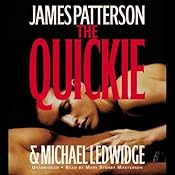
The Quickie by James Patterson and Michael Ledwidge (unabridged audio book read by Mary Stuart Masterson)

On her way to give her husband Paul a sexy surprise for lunch, Lauren Stillwell instead see him leaving his office building with a corn-fed blonde on his arm. She follows them to a hotel, and this discovery — and Paul's lying about it when confronted — turns her into a woman bent on evening the score, literally.

It was just supposed to be a quickie, but Lauren's retaliatory assignation ("Paul and I had once had a sweet sex life.... But being with Scott was life-threatening") quickly turns to murder when one of her lovers kills the other as she watches through the window into the dark, rainy night. The killer loads the victim into his car and drives off.

Once Lauren realizes he's not at any of the local hospitals, she checks out a crime scene she overhears on a cop's radio. And that's where authors James Patterson and Michael Ledwidge drop the first major surprise of The Quickie. Many more follow in this novel whose agenda is announced early on: "This is what happens when you cheat. This is what you get." But Patterson and Ledwidge have housed it in a slick thriller that is practically guaranteed to please Patterson's legion of fans.

Actress Mary Stuart Masterson (Fried Green Tomatoes, Benny & Joon) remains invisible throughout her reading of the audiobook of The Quickie, letting the characters, especially narrator Lauren, shine fully. Her portrayals are insightful and completely naturalistic with unexpected emphasis placed (in retrospect) where a real person would put it.

The Quickie is completely absorbing even as it stretches the bounds of plausibility. The final disc is a roller-coaster ride as all questions are answered and all threads tied up neatly, leaving the listener with a smile.

Friday, September 17, 2010

Native Son by Richard Wright (unabridged audio book read by Peter Francis James)

A classic of African American literature — and indeed of any kind — author Richard Wright's Native Son is surprisingly accessible to the modern reader, since it is basically a crime novel with literary leanings. Bigger Thomas lives with his mother, sister, and brother in one room on the South Side of Chicago in the 1930s. They are so cramped, they have to turn away while the others dress, causing much embarrassment all around.

Bigger is not ambitious — and he actually seems a bit lazy — but a chance connection gets him a good job chauffeuring for the owner of the Thomases' apartment building, Mr. Dalton. Wright clearly shows the mixture of fear, shame, and anger that Bigger feels toward whites, and it is these conflicting yet combined emotions that cause most of his later trouble.

He is supposed to drive the Daltons' daughter, Mary, to the university his first night on the job, but she has him detour to meet up with her Communist boyfriend, Jan Erlone. The couple were previously the subject of a gossip newsreel viewed by Bigger and a friend earlier that day, a bit of a scandal since Mr. and Mrs. Dalton are most fervently not Red supporters.

Mary and Jan invite Bigger to hang out with them, whereupon they all get a little too drunk. Delivering the girl to her room late that night, Bigger nearly has his way with the barely conscious (but seemingly willing) Mary, but the blind Mrs. Dalton enters the room to check on her daughter. Bigger panics, fearing the worst if he is found in the bedroom of the white girl. He reaches for a pillow....

I don't have to tell you what happens next. And Wright doesn't shy away from any of it. Every aspect is there on the page: the fingernails scratching his hand, the glassy eyes, the realization of what he has done, his decision to cover it up and blame it on the boyfriend, his decision to simply make the body disappear, the planning, the trunk, the hatchet, the furnace ... and that's only part one of Native Son, entitled "Fear."

From there, Wright chronicles seemingly every detail of the aftermath, including Bigger's attempt to frame Jan, nearly successful through his overconfidence in the whites' underestimation of him, until his eventual slip-up in another moment of panic. Part two, "Flight," covers the manhunt as it slowly accelerates into a citywide search, resulting in another murder as Bigger tries to hide out in abandoned buildings during a snowstorm, surrounded by newspaper coverage and passionate discussions of him by both blacks and whites.

Part three, "Fate," shows the inevitable outcome: Bigger's capture, interrogation, and indictment. Wright showcases his fantastic characterization during the trial (easily as good as anything in Anatomy of a Murder) as both sides present intelligent, persuasive arguments in their favor. For this reason alone, aspiring writers should read Native Son to see how balanced presentation of the facts of the case results in gripping reading.

In fact, Native Son is probably one of the best written, plotted, peopled, and constructed novels I have ever read. (Small details presented earlier pay off later on in surprising ways.) It is most definitely one of the most powerful. Wright succeeds in presenting an indelible portrait of a time and place and the attitudes prevalent, while at the same time delivering a suspenseful narrative with a positive ending — though not necessarily a "happy" one.

Actor Peter Francis James lends gravitas to the audiobook of Native Son. His narrative voice is nicely detached, leaving Wright's words to speak for themselves. And James's characterizations are done with subtle changes. My only complaint is that Jan Erlone and lawyer Boris Max sounded very similar, and when the two were in the same room, it was hard to tell them apart, especially since their worldviews are so similar they were often reiterating what the other was saying. But his work superlative throughout, making the audio version a terrific way of introducing oneself to the work of Richard Wright and seeing why his work still resonates with readers seventy years later.

Wednesday, July 7, 2010

Demons of the Night and Other Early Tales by Seabury Quinn, edited by Gene Christie (Black Dog Books)

Author Seabury Quinn is probably best known to modern readers for his series of short stories featuring occult detective Jules de Grandin, as well as for his marked influence on the works of fellow author Robert E. Howard. But Quinn's career spanned sixty years: from 1917, the year "The Law of Movies" (a nonfiction article included as an appendix to this collection) saw print, to 1977, when his novel Alien Flesh was published, with at least 150 other works in the intervening years.

Demons of the Night and Other Early Tales, edited and with an introduction and bibliography by Gene Christie and published by Black Dog Books, collects Quinn's earliest known fiction along with other rarities, including the aforementioned "Law of the Movies." It is a humorous and insightful look at the way legal matters are presented on film that is just as applicable today as it was in 1917, even though its examples consist entirely of obscure silent films (none of which appear to be available on video).

The title story, "Demons of the Night," is just the kind of derivative tale — familiar but with a twist — that many an author has used as his entry to published genre fiction, and it is wholly entertaining if taken in that spirit. (The ending especially is that of an oft-told campfire story.)

"Was She Mad?" is reminiscent of classic Poe with genuine horror contained in it. Though many authors have tackled the "possessed artifact" tale, Quinn's "The Stone Image" manages to be surprisingly effective at chilling the spine, even though its tropes are all too familiar.

"Painted Gold" is one of a few surprises found by editor Gene Christie in his searches. Neither it or "Romance Unawares" have been reprinted since their publication in Young's Magazine in 1919 and 1920, respectively. In the former, Lt. Rathburn Thomas has little appreciation for the feminine form until the continuous company of men in the service puts him on the prowl. Quinn warns us with his trademark erudite humor: "When a perfectly nice young man begins to act in this way, there is danter ahead, particularly for him; for it is from such that the victims of the Strange Woman are recruited."

But despite this protest, "Painted Gold" is an unexpectedly sweet romantic tale of a fellow who meets a beautiful woman but is put off by her rouge and lipstick, since that was only worn by the cheap girls back home. "Romance Unawares" is another truly sweet story of two life-long friends whom the whole town expect to be married and who find out (of course) that they really cannot do without each other. These stories show a different side of Seabury Quinn than the other early tales in Demons of the Night, but it's one I wouldn't mind seeing more of.

"The Cloth of Madness" is most famous for its appearance in Weird Tales, but it was actually first printed in Young's, too. It's a classic tale of the cuckold getting revenge in one of the most original ways I've read. The fiction of Demons of the Night closes with two of Quinn's Major Sturdevant stories, "Ravished Shrines" and "Out of the Land of Egypt" — neither of which impressed me, though Loomis is an engaging narrator — and two from his Professor Forrester series, "In the Fog" and "The Black Widow."

It is in the Professor Forrester tales, especially "In the Fog," that I found the most direct antecedent to the style of Robert E. Howard, both in the constant action and in the varied, poetic vocabulary. "In the Fog" finds Forrester locking himself inadvertently into a "house of mysteries" that is like a trip to the Orient, and that will require all of his myriad (and mildly implausible though wildly entertaining) talents to escape alive.

I especially admired how Quinn uses the house to allow the reader to experience a globe-trotting adventure without his hero's having to leave Washington. "In the Fog" is the first of the series that appeared in Read Detective Tales throughout 1927 and 1928, and explains the origin of the woman who would later be his ward. "The Black Widow" is equally engaging, though more a mystery than an adventure.

Editor and compiler Christie brings Demons of the Night and Other Early Tales to a satisfying conclusion by offering the reader the breadth of Quinn's published work with an extensive bibliography — as full as is currently known, anyway. Given the organic nature of the discovery process, Christie considers the bibliography a work in progress and gives contact information in the introductory paragraph, welcoming any new information the reader can offer.

Tuesday, June 15, 2010

Rio Desperado by Gordon D. Shirreffs (Western novella)

Burke Dane had to cut down his lynched younger half-brother Charley Mayo. Not he's on the hunt for the sidewinder that did it. The only thing Burke has to go on is the braided rawhide rope that Charley was hanged with.

Looking for more evidence, he comes across a fellow in danger and saves his life. His name is Jesse Lester, and he and Burke become tenuous friends. At least until Burke finds out that Jesse was in his predicament because he was looking for something: "a damned good rawhide reata" borrowed by an amigo who lost it.

Author Gordon D. Shirreffs is a little-remembered name now, but he was once a Western powerhouse, producing over 70 novels during his 40-year career, including the classic Quint Kershaw trilogy of mountain-man novels, The Untamed Breed, Bold Legend, and Glorieta Pass. Modern Western writers like Robert J. Randisi, James Reasoner, Jory Sherman, Mike Linaker, and Peter Brandvold list him as a major influence in their interviews on Western Fiction Review.

Those who like a mystery in their Westerns will enjoy Rio Desperado as Burke goes "undercover" to find the one(s) responsible for Charley's death — and find the $5,000 he was last seen with, to deliver it to Charley's wife and children. The book shows how there are some things that can't be done alone, and deals that must be made and followed through on.

The edition of Rio Desperado I read was packaged as a novel, but at 120 pages of relatively large print, it is little more than a novella. I was not surprised to learn that it was originally published as one half of an Ace Double, along with Voice of the Gun, also by Shirreffs.

But genre-fiction readers know that the novella is often the peak of storytelling. I often prefer novels, but the novella lets the story set its own length and pace, without concession to sales potential. Of course, once complete, its only usual option is to be collection in a book with others of its kind, unless, like Shirreffs' was even in 1988, your name is draw enough to sell one on its own.

Rio Desperado is fast-paced but does not stint on character. Dane is nicely complex, and Shirreffs keeps the mysterious nature in most of the supporting cast until it is their time. Shirreffs also doesn't shy away from the honesty of life in the Old West, like how Lester's sister "likes nice things" but hasn't "got a dime," so she uses what she does have. ("'I've got some stock-in-trade.' She looked down at her lovely body. 'Something Clete Hinch is mighty interested in.... I'm free, white and over twenty-one. You do your type of mankilling and I'll do mine, Jesse.')"

Tuesday, May 18, 2010

Gun Work: The Further Exploits of Hayden Tilden by J. Lee Butts (Western novel)

Former Deputy U.S. Marshal Hayden Tilden reminisces about his time working for "Hangin'" Judge Isaac Parker from the confines of the Rolling Hills Home for the Aged in Little Rock, Arkansas. It is the 1940s, and Tilden is 90 years old, but his memory is as good as ever. Gun Work begins with a transcribed interview taken by Tilden's biographer, Franklin J. Lightfoot Jr., reporter for the Arkansas Gazette.

With his fellow deputy marshals Carlton J. Cecil and Nate Swords in the Brotherhood of Blood, Tilden hunts down the worst of the worst as Judge Parker's "personal manhunter," and it's OK if he doesn't follow Frank Buck's famous motto "bring 'em back alive." In fact he's rather infamous for the opposite. As outlaw C.W. Jemson points out, "Heard 'bout the way you catch folks, Tilden. Not many as you go out lookin' for come back breathin'."

The main story of Gun Work is told by Tilden to his rest-home sweetheart Martha Frances Harrison ("she likes me to call her Martye") after the announcement that tonight's movie is to be about Wyatt Earp. Tilden allows that his West was not so romantic, and Martye urges him to tell her his story of "obsession, murder, blood, and betrayal."

This time, the assignment, delivered as always by Judge Parker's go-between George Wilton, is to hunt down Jesse and Leroy Coltrane, suspected of slaughtering the Cassidy family with their captured brother Benny, and to retrieve the surviving daughter, Daisy, from Fort Worth. But things are never quite that easy, especially since it seems there are always outlaws ready to challenge the notorious Marshal Tilden.

Author J. Lee Butts writes an exciting Western in Gun Work, with plenty of bullets and bravado. Modern Western writers aren't afraid to get down and dirty in their descriptions of the consequences of gun work, and J. Lee Butts offers up a level of bloodshed that even a horror fan can appreciate, including one highly memorable comment from a witness regarding a shot-off piece of skull: "Lord, Lord. Glob of goo still has the hair growin' out'n it."

That's also an example of the terrific, colorful language to be found in Gun Work. Butts comes armed with an arsenal of similes to describe everything from a falling body to a quiet room. And over 200 pages, he seems to never repeat a single one. The dialogue and repartee between Tilden, Cecil, and Swords is also a treat. Keep a special eye out for the conversation early on between Tilden and Swords regarding Swords' predilection for uncommon eats. ("Fry up some coconuts along with an armadiller, and you've got yourself one helluva meal, my friend.")

I was just looking for some newer work by a Western writer I hadn't read before, and I made quite a discovery in J. Lee Butts. Gun Work is entertaining on many levels, and I recommend it highly to those looking for something that combines humor and grit in a tight, action-filled package.

The Adventures/Exploits of Hayden Tilden, novels by J. Lee Butts:
1. Lawdog (2001)
2. Hell in the Nations (2002)
3. Brotherhood of Blood (2004)
4. Ambushed (2006)
5. Written in Blood (2009)
6. Gun Work (2010)

Friday, May 7, 2010

The Big Bang by Mickey Spillane and Max Allan Collins (Mike Hammer)

Mike Hammer went to Florida to recover from a stab wound from one of Junior Evello's boys — Junior is the nephew of Carl Evello from Kiss Me, Deadly — "that had opened my side like somebody wanted to slip in there and hide." On his first day back in Manhattan, he chances across hospital messenger Billy Blue being jumped by drug dealers who think he can get them easy access to the hospital's drug stash, and Hammer quickly dispatches the assailants with his signature brand of street justice.

It looks like Evello might be involved, but Hammer assures Homicide captain (and long-time friend) Pat Chambers that he has no interest in the case. Of course, when somebody tried to kill Mike, he gets interested fast. Now it's on.

The Big Bang is one of the handful of unfinished manuscripts Mickey Spillane entrusted to Max Allan Collins upon his death in 2006. Two others have been published previously: the non-Hammer Dead Street and the "last" Hammer novel chronologically, The Goliath Bone.

In addition to being about one-third complete, The Big Bang was also fully outlined and included the ending, which was one of Spillane's favorites. When the deadline for this book was approaching and it did not look like he could finish it, Spillane took the previously shelved "second" Hammer novel For Whom the Gods Would Destroy (he had written it after I, the Jury but quickly pounded out My Gun Is Quick as a followup instead), updated it with references to more recent cases, and sent that one in. It would be published under the title The Twisted Thing.

Spillane's and Collins's styles mesh well throughout The Big Bang, since Collins expanded Spillane's original one-third out to about one-half and then completed what was missing. Collins has somehow managed to produce a novel that is firmly grounded in the 1960s but does not feel dated. This is not an artifact, but a fully vital modern novel.

Collins stays mostly in the background, preferring to let his friend and mentor shine from beyond. Those who have followed Hammer through numerous adventures will appreciate it most, but The Big Bang can be enjoyed even by those relatively new to the detective.

One definite highlight is the climax, when Hammer unwittingly drops acid and sees his potential final moments with all the clarity of a warped record. ("Shotgun" by Junior Walker and the All-Stars gets a prominent role in the melee.)

But the ending of The Big Bang is just stunning, related to a huge shipment of heroin coming into the city (the "big bang" of the title — sorry physics fans, no beginning-of-the-universe theories discussed in these pages1). It may in fact be one of the best of the series. Just don't try to skip ahead and read it because you won't understand its significance unless you've read the rest of the book. The whole thing is well orchestrated for maximum impact. It's a keeper and one that will likely go down as one of the more memorable.

At least one more of these Spillane/Collins collaborations (Kiss Her Goodbye) is already scheduled to be published. There are at least three more substantial manuscripts that could be completed: Complex 90 (a sequel to The Girl Hunters), Lady Go Die!, and King of the Weeds. However, whether these see their way into print depends, like all things in publishing, on how well these sell, so support them however you can (preferably with your wallet) and help Spillane's legacy continue well into the future.


1Try What's Next?: Dispatches from the Future of Science for that — specifically Sean Carroll's "Our Place in an Unnatural Universe."
Related Posts with Thumbnails