Showing posts with label Robert Bloch. Show all posts

Saturday, October 20, 2012

Torture Garden directed by Freddie Francis (starring Peter Cushing, Burgess Meredith, Jack Palance)

Torture Garden (1967). Screenplay by Robert Bloch, based on his short stories "Enoch," "Terror Over Hollywood," "Mr. Steinway," and "The Man Who Collected Poe."

Horror and carnivals: how long have these two been connected?  In any case, Torture Garden — a horror anthology film based on short stories written by Robert Bloch (who also wrote the screenplay, adding the wraparound story that ties them all together) — begins with a barker inviting us into the show.  

"You'll shriek, you'll shudder, you'll shiver," he promises.  "But it's all in fun and no harm done."

We pay our half-crown and enter the realm of Dr. Diabolo (Burgess Meredith, looking reminiscent of his turn as the Penguin on TV's Batman).  His private exhibit offers patrons a look at their potential future, and the possible manner of their death if they give in to their inner evil.

The first story, loosely based on Bloch's 1946 Weird Tales story "Enoch," involves a man's search for his uncle's gold stash.  What he uncovers instead is a devil cat with a hunger for human heads.  Michael Bryant is somehow believable as a man under feline mind control, and the closeups of the cat's eyes help it along.

Next comes an adaptation of "Terror Over Hollywood" from Fantastic Universe in 1957, centering on an actress (Beverly Adams) who sabotages her roommate's date with a Hollywood bigwig to take advantage of it herself ... and gets in way over her head when she sticks her nose where it doesn't belong.  Adams is good as an overly ambitious starlet, but the story derails when it veers off into science-fiction territory.

The starlet's best friend (Barbara Ewing) is up next as a reporter who interviews a concert pianist (John Standing) then falls in love with him — much to the consternation of his piano, a jealous embodiment of the musical goddess Euterpe.  This silly conceit (originated in "Mr. Steinway," Bloch's feature in the April 1954 issue of Fantastic) is not helped by the predictable narrative, though the piano is suitably menacing.  ("She" also gives the best performance in this section.)

Finally, after standing around with a pipe in his teeth for over an hour, Jack Palance utters his first words as Ronald Wyatt, an Edgar Allan Poe fanatic who gets very excited when he finds that the collection of fellow Poe aficionado Lancelot Canning (Peter Cushing) also includes the famous author himself. 

Author Bloch was a huge Poe fan in his own right — he was the first to complete the one known incomplete work, "The Lighthouse" — and this knowledge adds to the verisimilitude of the story, based on "The Man Who Collected Poe" from Famous Fantastic Mysteries in 1951.  Also a plus is Palance, who is cast against type as an anxious, bookish type.

Much like Bloch's novels from the era, the stories in Torture Garden combine his talent for eerieness with a tongue-in-cheek approach that is not afraid to court the ridiculous in the name of a well-told story.  Those not familiar with Bloch's work may use Tales from the Crypt as a comparison (also directed by Freddie Francis and featuring Peter Cushing), though it came out five years later.

In addition to the stories mentioned above, the movie also features the goddess Atropos and her shears.  She (Clytie Jessop) appears in a different manifestation in each tale (really the only thing other than the wraparound that ties them together), and even the wraparound has a twist.  Torture Garden is by no means a classic, but it is definitely a good, fun time for those who enjoy horror anthology films.

Wednesday, September 1, 2010

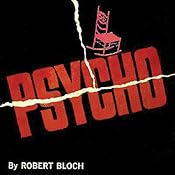
Psycho by Robert Bloch (unabridged audio book read by Paul Michael Garcia)

Nearly everyone knows the story of Psycho, of how a woman named Crane steals $40,000 from her employer and takes off to marry her boyfriend. A rainstorm causes her to make a wrong turn off the main highway, and she stops for the night at the one beacon of light on that deserted stretch, the Bates Motel, run by the unassuming mama's boy Norman Bates.

Bates himself has become an iconic figure, synonymous with the psychotic murderer and more often the source of parody than fear. So, how does one approach the original novel by author Robert Bloch with a fresh eye?

Surprisingly, it is fairly simple: one cannot. If you have seen the classic film as directed by Alfred Hitchcock, you've experienced the story in its tightest form.

Hitchcock and screenwriter Joseph Stefano delivered a very faithful adaptation, and if that is enough for you, so be it. But if you long for more depth of character, more insight into motive and history, and especially more internal monologue, then Psycho the novel is just the thing for you.

Audiobook reader Paul Michael Garcia delivers a better performance than I thought possible, inhabiting all the characters fully. This allowed me to forget that I was listening to "Psycho" and just immerse myself in Bloch's world one more time — almost, if I tried really hard, as if for the first time.

Thursday, December 3, 2009

The Cabinet of Curiosities by Douglas Preston and Lincoln Child (audio book read by Rene Auberjonois)

During work at a Catherine Street construction site in lower Manhattan, a charnel of bones is discovered: 36 bodies, all told, buried around 100 years before. FBI Special Agent Pendergast takes one skull to archeologist Nora Kelly, who places that victim's age at 13. When Pendergast gets Kelly access to the site, she learns that the victims were nearly all teens, primarily boys, and that they all appear to have had similar injuries to the lumbar spine.

While Nora gets in trouble for her work with Pendergast, her on-and-off boyfriend, reporter William Smithback, Jr., of The New York Times is working so hard to get a scoop that he's ruining his relationship with Nora. Later, Smithback gets himself into hot water when he discovers an address before Pendergast and Nora do and goes to check out the location.

The discovery of a sheaf of letters leads to the identity of the perpetrator of the century-old murders — a scientist searching for the secret of longer life — but that turns out to be only the beginning of the mystery when the body of a 27-year-old woman is found with the same portion of the spinal cord (the cauda equina, or horse's tail) removed. This grotesque surgery was likely done while the woman was alive, and was thus the cause of death.

Is a copycat killer at large, or did the scientist actually find what he was looking for and has chosen to recommence his spree? Or is something even more sinister and mysterious going on? Pendergast is sure that "The solution to the new murders lies in the old." One thing is for sure: with authors Douglas Preston and Lincoln Child, it will be something other than the mundane and will be somehow connected to "the Cabinet of Curiosities."

In this first Preston/Child collaboration to feature Pendergast as the protagonist, we learn that a streak of insanity runs in his family when he asks advice of his great-aunt Cordelia about other family members. An odd duck anyway, Pendergast see an attack on him as a "positive development" since it means he's getting close to a solution.

The Cabinet of Curiosities is altogether a fascinating read, commingling old and new science with the tropes of horror fiction. Preston and Child don't shy away from the horror of having a deranged surgeon perform his signature surgery without anesthesia (and fully awake) on a major character.

One particular highlight was highly unexpected. From his hospital bed (following the aforementioned "positive development") — in a supernatural twist on The Daughter of Time — Pendergast travels through time and puts himself back into late-19th-century New York (on a fact-finding expedition) using only his mind.

For a novel so otherwise grounded in reality, however strange and obscure that reality may sometimes be, it takes a definite leap of faith to follow Pendergast along on his flight of fancy. But it is simultaneously a very rewarding trip into the period and takes The Cabinet of Curiosities another notch above the fray.

Other authors would have simply had their characters find old documents or the like. This choice, though unorthodox, is an imaginative improvement, especially since the authors work hard to make it believable. (Though Pendergast is inscrutable enough to make it plausible that he would spend his time developing this skill.)

Actor René Auberjonois — probably best known for his television work on Benson (for which he was Emmy-nominated), Star Trek: Deep Space Nine, and Boston Legal, as well as in the film version of M*A*S*H — shows off his impressive vocal range in the audiobook of The Cabinet of Curiosities. Auberjonois makes each character different while retaining a familiar thread throughout (though he doesn't quite achieve the "mellifluous" tone frequently attributed to Pendergast).

The Cabinet of Curiosities has a wonderful sense of atmosphere that will particularly delight fans of the novels of Robert Bloch. (Enoch Leng is an especially Blochian character.) The authors' highly descriptive style immerses the reader in a richly drawn, though unfamiliar, world. And their intelligent approach appeals to more literate readers while their plot operates solidly within the confines of the genre.

Friday, May 16, 2008

Shooting Star / Spiderweb by Robert Bloch (Hard Case Crime double)

It's at first a little surprising that Hard Case Crime would reprint a Robert Bloch novel, let alone two, since he is best known for writing the novel that inspired Alfred Hitchcock's classic film Psycho. Though Bloch then became known as a horror writer, that book was just one of 20 he wrote throughout his career, covering other genres like science-fiction and, the appropriate one here, crime.

Shooting Star appears in this volume along with Spiderweb, packaged together in a form reminiscent of the old Ace Doubles — two complete novels printed back-to-back and head-to-tail with a separate cover for each one. You read one novel, then flip the book over to read the other. Each one has its own copyright page and cover art. It's a gimmick, to be sure, but a great one.

This presentation is perfect when you consider that Shooting Star and Spiderweb actually both first appeared as part of the Ace Double line (each runs just over 150 pages). Not together, though: they were published in 1958 and 1954, respectively. (Spiderweb was backed by a David Alexander novel, and Shooting Star was backed with a collection of Bloch's short stories.)

When an old friend asks him to solve an old murder, a one-eyed, down-on-his-luck literary agent becomes a one-eyed, down-on-his-luck private eye. After Mark Clayburn had the accident that lost him an eye (and gained him a patch), no one came to visit him — not even Harry Bannock, though they were pretty close at the time.

Now Bannock wants a favor: for Clayburn to solve the murder of Dick Ryan (Clayburn has a PI license and gun permit to help with research on true-detective yarns) so Bannock can cash in on a TV deal for Ryan's series of 39 Lucky Larry movies. (Ryan was found with "reefer butts" at the time, and the TV people are wary of closing the deal due to the scandal.) Clayburn only agrees because he could use the money. But the threats begin right away, and the police are less than helpful.

I often enjoy novels set in old Hollywood. In fact, just before beginning Shooting Star, I had just read two others — What Makes Sammy Run? and Rude Mechanicals — and I thought my brain was primed for the experience. But, as one might expect, Bloch shows a different side of Hollywood. No bright lights here, expect for the occasional muzzle flash. Clayburn can't trust anyone, not even the people he has to depend on most.

What I didn't expect was conventionality. Though few of them are genuine classics, all the other Bloch novels I've read were nonetheless intriguing in their pursuit of original ideas. But, apart from a couple of interesting details — namely, the one-eyed protagonist and the antidrug message (with repeated talk of "reefer addicts") — Shooting Star is like a lot of other private eye novels. Plus, the solution is so predictable that it's practically given away before the book begins.

Even Spiderweb offers a very typical noir-fiction plot: greed gets a guy in over his head with some shady dealings, and he has to find a way out. Eddie Haines had a promising career in Iowa. The star of the senior play, they all said, "You oughta be in pictures." When he got a crackerjack idea for a TV series, he headed for Hollywood. Two months and $300 to an agent later, after not a single bite, Eddie is standing in front of his bathroom mirror with a straight razor in his hand and shaving the farthest thing from his mind when a Peter Lorre lookalike knocks on his door with $100 and the opportunity to become someone else.

The only different between this and any other typical crime novel is Bloch's use of psychology as a theme. Fortunately, that difference goes a long way toward making Spiderweb the more entertaining of the two. My guess is that it was the novel actually selected to be reprinted but that it was too short by itself and Shooting Star was picked to fill out the page count. Either way, I still hope Hard Case Crime produces more dual volumes like this one and the one they published early on, collecting Max Allan Collins's first two novels — I have to admit I like getting "two for the money."
Related Posts with Thumbnails