Showing posts with label Hachette Audio. Show all posts

Friday, March 25, 2011

The Brave by Nicholas Evans (unabridged audio book read by Michael Emerson)

Nicholas Evans, a British author with a fascination for the American West (he also wrote The Horse Whisperer), returns to his forte with The Brave. It centers on Tommy Bedford, a divorced documentary filmmaker with an estranged son, and Evans leaps back and forth in time as he covers different parts of Tommy's life.

The primary focus is on his childhood, including his time at boarding school, the dotage of his sister Diane — an aspiring, then famous, actress (then convicted murderess) — and her turbulent relationship with TV cowboy Ray Montane.

Montane is the star of Sliprock, and he's watching the coming end of the heyday of the Western — and watching his grip on Diane crumble under the weight of lies.

We also learn about Tommy's courtship of his wife Gina, which leads to marriage and the birth of their son Danny. In the present, Tommy is trying to reconnect with Danny after a long period of estrangement. Danny is an Iraq war veteran, a lance corporal currently under investigation by the Marines. Evans juggles a number of storylines without giving a single one short shrift.

All in all, The Brave is a satisfying, moving listen filled with genuine human drama. It will likely appeal to a wide variety of listeners, from fans of TV Westerns and classic Hollywood, to those who appreciate coming-of-age tales, picaresques, and mainstream literary fiction — old or young, male or female — because its main subject is families, both the ones we're born with and the ones we choose.

This isn't usually the kind of novel I seek out to read, but the Western connection intrigued me enough to begin it, and then I had to see it out to the end. Actor Michael Emerson (Ben Linus on Lost) does a fine job reading The Brave. His voices are sometimes indistinguishable, and his characters' accents seem to come and go, but his gentle narration allows the material to bloom.

Tuesday, February 8, 2011

Black Hills by Dan Simmons (unabridged audio book read by Erik Davies and Michael McConnohie)

Sometimes a book is simply so good that it exceeds my ability to write about it. Everything I write sounds dumb because it's just superlative, superlative, superlative, and it all gets redundant after a while. And often the best books are hard to summarize because so much happens in them that trying to outline it with any semblance of thoroughness is likely to give away surprises.

As you've probably guessed by now, Black Hills is one of those books. Dan Simmons is one of the most interesting authors writing today. You just never know what to expect from him, and his three most recent novels show this most admirably. They display the potentials of historical fiction in a way usually unseen in the work of a single author.

The Terror was pure horror about a stranded ship and the mysterious creature that stalks it, and Drood was a thriller concerning Wilkie Collins and Charles Dickens. Both were distinctly British.

Then came the last thing I expected: a Western. But Black Hills is really only part Western, with a twist. The opening is instantly engaging. As Paha Sapa, an 11-year-old Lakota whose name means "Black Hills" (a rare event as Lakota are almost never named after sacred locations), "counts coup" on the dying George Armstrong Custer at the Battle of Little Bighorn in the summer of 1876, the ghost of the infamous commander invades the young Sioux.

Almost instantly, his head is soon filled by Custer's remembrances of his sexual dalliances with his beloved wife Libby. Custer's spirit fills Paha Sapa's nights with recitations (in the unfamiliar language of the whites) of all his memories. (If you ever wanted to hear a poetic play-by-play of Custer's dalliances with his wife, this is the book for you.) Paha Sapa will hear Custer's voice in his head for most of the rest of his life.

Black Hills jumps around in Paha Sapa's life, covering his name-change to Billy Slow Horse and Billy Slovak, his courtship with the beautiful Rain, his strife to solely destroy the three faces on Mount Rushmore before the fourth can be placed, his time in Buffalo Bill Cody's Wild West Show, and so many other events that they begin to run together.

Simmons is so interested in giving the listener the full scope of Paha Sapa's life that his writing sometimes gets in the way of his storytelling — much as his need to present all the facts often supersedes the development of his fiction. But in combining the two — in creating a wholly believable world wherein the grounded, the spiritual, and the made-up coexist seamlessly — Simmons produces in Black Hills a shining example of what historical fiction can achieve when approached with verisimilitude.

Friday, January 7, 2011

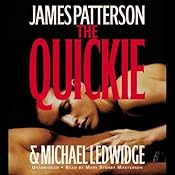
The Quickie by James Patterson and Michael Ledwidge (unabridged audio book read by Mary Stuart Masterson)

On her way to give her husband Paul a sexy surprise for lunch, Lauren Stillwell instead see him leaving his office building with a corn-fed blonde on his arm. She follows them to a hotel, and this discovery — and Paul's lying about it when confronted — turns her into a woman bent on evening the score, literally.

It was just supposed to be a quickie, but Lauren's retaliatory assignation ("Paul and I had once had a sweet sex life.... But being with Scott was life-threatening") quickly turns to murder when one of her lovers kills the other as she watches through the window into the dark, rainy night. The killer loads the victim into his car and drives off.

Once Lauren realizes he's not at any of the local hospitals, she checks out a crime scene she overhears on a cop's radio. And that's where authors James Patterson and Michael Ledwidge drop the first major surprise of The Quickie. Many more follow in this novel whose agenda is announced early on: "This is what happens when you cheat. This is what you get." But Patterson and Ledwidge have housed it in a slick thriller that is practically guaranteed to please Patterson's legion of fans.

Actress Mary Stuart Masterson (Fried Green Tomatoes, Benny & Joon) remains invisible throughout her reading of the audiobook of The Quickie, letting the characters, especially narrator Lauren, shine fully. Her portrayals are insightful and completely naturalistic with unexpected emphasis placed (in retrospect) where a real person would put it.

The Quickie is completely absorbing even as it stretches the bounds of plausibility. The final disc is a roller-coaster ride as all questions are answered and all threads tied up neatly, leaving the listener with a smile.

Friday, July 9, 2010

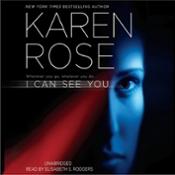
I Can See You by Karen Rose (unabridged audio book read by Elisabeth S. Rodgers)

I tested the romantic suspense waters previously with Catherine Coulter's The Maze, so when author Karen Rose's novel crossed my path, I wasn't immediately repelled in the way I would once have been. And the plot of I Can See You , involving the dangers of online predation, was very intriguing -- so much so that I entered into this 16-disc behemoth with little trepidation, despite the fact that I had just finished one nearly as long, Andrew Davidson's terrific genre-blender The Gargoyle.

Eve Wilson returns in Rose's tenth thriller. Scarred by a horrific assault in Don't Tell, Eve was also featured in Nothing to Fear. Now she's pulling her life together, bartending and studying for her M.A. in Counseling, just in time to get involved in a murder mystery.

"The hooker had awakened ... thinking she was being strangled. Then, she really was. He did love it when fantasy met reality with such perfection."

A killer with 30 years of experience at his chosen craft -- and 30 years of trophies (the victims' shoes) and a well-used lime pit to show for it -- is targeting users of an online role-playing game called Shadowland: a Second Life-like game where users pretend to be other selves.

And the list of victims of this series of half a dozen murders staged to look like suicides, with their eyes glued open, closely matches the list of participants in Eve's master's thesis experiment: studying the effects of online role-playing on real-world self-esteem. Now she must break the confidentiality of her subjects to save their lives.

Enter Minneapolis/St. Paul's famed "Hat Squad" (they wear fedoras to "dress the part" as detectives), headed by Noah Webster, coming down off a local magazine's feature article that focused on Webster's partner, handsome lothario Phelps, due to his Paul Newman looks. (Webster looks more like a film noir thug.) Never mind the fact that Webster must continually take up Phelps's slack.

Like The Maze, the weakest portions of I Can See You are those devoted to the expected romance — though these lovebirds are so sickeningly adolescent and self-defeating in the beginning that it's a wonder they get out of bed in the morning, let alone know how to pursue a mature relationship. Eve's trauma and Webster's recovering alcoholism are such obvious parts of their personalities that it seems they could agree to simply meet each other on equally flawed terms.

But Rose keeps the suspense high in I Can See You — the bulk of the story takes place during a single week — and audiobook reader Elisabeth S. Rodgers enhances the text with her immersion into the characters. Most of Rose's books tie together in some fashion due to her repeating of characters, so readers who like this one will undoubtedly want to seek out more of the author's work.

Friday, June 18, 2010

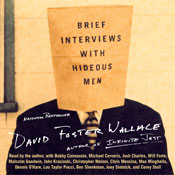
Brief Interviews with Hideous Men by David Foster Wallace (unabridged audio book read by the author and others)

This audiobook is read by Bobby Cannavale, Michael Cerveris, Josh Charles, Will Forte, Malcolm Goodwin, John Krasinski, Christopher Meloni, Chris Messina, Max Minghella, Dennis O'Hare, Lou Taylor Pucci, Ben Shenkman, Joey Slotnick, Corey Stoll, and David Foster Wallace.

The first story on the audiobook of author David Foster Wallace's short-story collection Brief Interviews with Hideous Men, "Death Is Not the End," seems to have been designed as a test to see if the listener is truly prepared for Wallace's fiction. The late author reads, but his narrative is so robotic as to be obnoxious. This is only intensified by the story's merely being a series of digressions (including the author's signature footnotes) with no real destination.

"Forever Overhead" is more successful, primarily because it covers a longer period of time: a 13-year-old's birthday spent at a public pool with his family. Wallace's incisive observations are keen, but his reading once again detracts from the piece -- or maybe it was because a glitch on my copy has caused most of track 5 on disc 1 to be a duplication of a later part of the story that shouldn't have played yet and that I therefore had to listen to twice.

Then there are the titular "Brief Interviews," in which we hear only the answers to a series of unheard questions. (These would be great for audition monologues.) There's the guy who shouts, "Victory to the forces of democratic freedom" upon orgasm; the guy whose "proclivities" originate from his father's need to be restrained from his own violence; a very personal interview with the questioner's boyfriend, who is tired of the questioner's insecurities....

Wallace's talent lies in showing everything, leaving nothing to the imagination, and punctuating it with wry humor and intensifying surprises. (Except in one special case where the final surprise is left up to the listener to figure out.)

...the pot grower who professes to know the difference between a great lover and a great lover; the guy who calls his shriveled arm "the asset"; the son of a washroom attendant; the fellow who argues that rape broadens the mind; the military brat whose supernatural masturbatory fantasies originate from a childhood fascination with Bewitched....

Wallace's fiction oozes pretensions, though Brief Interviews with Hideous Men is never unlistenable. Sometimes it's overlong and feels too much like hard work, but it's entertaining. And every so often there's a true gem, a piece so complete that it's like being rewarded for the effort of the rest. Even the title of "Suicide as a Sort of Present" adds to instead of just summarizing the experience.

...the man who loves everything about women; the duo arguing over how difficult it is to deduce what women want, given what you're working with; the guy who finds a "flake" more fascinating when he hears her rape story. The mere breadth of hideousness contained here is remarkable.

This new, unabridged edition of Brief Interviews with Hideous Men — the portions read by Wallace are taken from a previous, abridged recording — has evidently been produced to tie in with the recent film version adapted and directed by John Krasinski (best known as Jim Halpert from The Office). It includes several cast members performing their roles from the film.

Monday, May 24, 2010

Alibi by Teri Woods (unabridged audio book read by Paula Jai Parker-Martin)

Author Teri Woods is one of the shining stars of modern urban fiction, also known as "street lit." She follows in the literary footsteps of such influential street-lit writers as Iceberg Slim, Donald Goines, Chester Himes, and Sister Souljah, while blazing a trail of her own by the sheer extent of her popularity.

Woods began by self-publishing her first novel, True to the Game, and selling copies out of her car trunk while working as a paralegal. Then she founded Teri Woods Publishing and further increased her readership while also allowing newer authors a home for their work.

Now she sees her debut on audiobook, Alibi, after signing with a major New York publisher, namely the vast Hachette conglomerate, hoping to further spread her vision via their wide distribution model. (Alibi is also Woods's debut in hardcover.) Paula Jai Parker-Martin (The Proud Family) performs the characters with such skill that she is practically invisible, allowing the writing to shine.

1986, North Philadelphia — Lance and Jeremy are a couple of low-rent dealers who think they've found their golden ticket: an open window at the apartment of drug lord Simon Schuller's runners. But things go wrong fast, and the only one to escape the scene alive is Nard, one of the runners.

Leaving three corpses behind, and unable to claim self-defense because of his other illegal activities, Nard needs an alibi and fast. His buddy Sticks, the guy that was supposed to be the lookout that night but didn't show up, feels guilty and sets Nard up with one from his girl, Daisy Mae Fothergill. Sticks will pay Daisy — a 22-year-old stripper and prostitute — $2,000 to say she was partying with Nard at her workplace, the Honey Dipper, all night long. Meanwhile, detective Tommy Delgado and his partner Merva Ross are hot on Nard's trail.

I went into Alibi expecting a straight crime novel, but what I got was something very different. This is raw writing with no apologies. Woods is not a prose stylist — she is unnecessarily repetitive and accents the obvious — but she can plot like nobody's business, and her characters are ultra-real.

Alibi is a prime example of the street-lit style of no-holds-barred writing with explicit language, sex, and violence slathered over an equally hard-core storyline. A real walk on the wild side, a gritty detailed portrait of the desperate and determined, where opportunities are few and the ones that pay well are nearly all illegal. But where a woman who sells her body numerous times daily just to make ends meet can still have fairy-tale dreams.

Woods puts her heroine through so many ordeals that Daisy eventually gets overwhelmed by it all and packs up and moves to see her family in Murfreesboro, Tennessee, for some escape. But then Woods gives the crank another turn as an event that was memorable but seemed relatively minor blows up when the FBI gets involved.

Alibi is very creatively plotted. It is also completely absorbing, and I never guessed how things would turn out. It is much less a traditional crime novel than a character piece. (The flashback to Daisy's mother's history is a special highlight.) Luckily, Daisy is an interesting person (though a little dumb at times) and easy to care about since she retains her inner sweetness. The reader really wants things to turn out well for her, even as events seem to be almost conspiring against that possibility.

Friday, May 14, 2010

Abraham Lincoln: Vampire Hunter by Seth Grahame-Smith (unabridged audio book read by Scott Holst)

Author Seth Grahame-Smith spearheaded the public-domain horror-mashup genre with his huge bestseller Pride and Prejudice and Zombies, which was popular not because it was well done (it wasn't particularly; Ben H. Winters's Sense and Sensibility and Sea Monsters is much better executed) but because people loved the idea of it and had to have a copy for their shelf, unread, to occasionally pull out and chuckle at.

Suddenly, Grahame-Smith was in demand, so he brought out an idea he'd had the year before. In 2008, author Seth Grahame-Smith noticed that all the books in the front of his local bookstore seemed to be either Abraham Lincoln biographies (the sixteenth president's 200th birth anniversary was approaching) or the Twilight saga and its ilk. So, why not combine them?
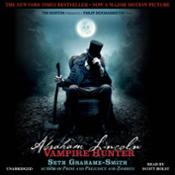
Download from Audible.comNow the author has produced an original novel with another great high-concept title: Abraham Lincoln: Vampire Hunter. (He had been impressed by Doris Kearns Goodwin's Team of Rivals, among others, and credits the Internet with making this book much easier to research.)

Like Pride and Prejudice and Zombies, the title of Abraham Lincoln: Vampire Hunter alone will sell the book — or at least encourage curiosity. But it's more than that: this book is also the story of its "author," who whiles away nearly a decade behind the counter of a small-town five-and-dime store, trying to write then abandoning novel after novel until the day a friendly regular leaves him a package wrapped in brown paper, containing letters and journals, on the condition that he write a book about them. The first line: "This is the journal of Abraham Lincoln."

The fellow obsesses for seven months over these documents, losing his family then nearly his mind as he pores over the secret diaries of our sixteenth president and his lifelong pursuit to rid America of the bloodsucking menace that had run unchecked since the founding of Jamestown in 1607, and eventually would become the deciding factor in the beginning of the Civil War. Mostly because one killed his mother.

The journals cover Lincoln's life from his frontier boyhood through his presidency and death, with Grahame-Smith inserting necessary historical details to fill in the gaps. Lincoln writes of the suspicious deaths of his aunt and uncle and then his mother, who was called "milk sick" until the truth came out. Lincoln learns from his father Thomas that vampires killed his own father and Abe's mother. Thomas owed a debt that could not be paid, and the vampire shylock took payment in another way.

At age 12, young Abe writes, "I hereby resolve to kill every vampire in America" and proclaims God as his enemy for allowing such things to happen. For a while he devotes himself to occult studies and physical improvement, such as developing his ax-wielding technique. Also pivotal is Lincoln's first encounter with slavery. He finds that "bargain" slaves (the weak, the old, etc.) are being bought in great numbers to be used as vampire food. Since no one cares what happens to a slave, there's not the trouble with the authorities that results when "real" people are sucked dry. In that way, the vampires were the first equalizers, realizing that blood is blood, whatever the skin color. Lincoln soon realizes that "So long as this country is cursed with slavery, so too will it be cursed with vampires."

Grahame-Smith takes a while to find his way with Abraham Lincoln: Vampire Hunter. At first, it seems to have been put together in much the same way as his Jane Austen zombie novel. In the beginning, the historical chronicle of Lincoln's life is readable and engaging, but the vampire aspects feel dropped in and not part of the whole, as if he wrote the history first and the fiction later.

So clumsily are some of these early portions added that I began to question whether perhaps the author had perhaps merely obtained an extant Lincoln biography (in the public domain or even unpublished) and added his own parts to it. (Before you scream "libel," just remember that even the best historians are sometimes accused of plagiarism. Controversy only sells more books.)

Later, as the main conceit takes precedence over the genuine history, this is much less of a problem. Abraham Lincoln: Vampire Hunter tells of Lincoln's political ambitions (and his vacillating nature toward them), and of his friendships with Edgar Allan Poe and his close and complex friendship with his mentor, the uncommon Henry Sturges. This relationship is one of the highlights of the book and shows Grahame-Smith's skill with masculine emotions.

Audiobook reader Scott Holst has difficulty overcoming the dry nature of the prose early on. But he shines in the "quoted" materials from the letters and journals, using a subtle country twang to embody Lincoln and his forebears with skill. The audiobook contains a conversation with the author; a bonus PDF document of historical photographs, paintings, and engravings; and a preview of Michael Koryta's novel So Cold the River.

The book's main success is also its greatest weakness, which is that it reads like a genuine history, but with vampires folded into the reality. Thus, I think it would appeal only to those readers who enjoy history and vampires: history buffs will likely balk at the liberties taken with the facts — a good deal of true stories from Lincoln's life are included, some of which are even more interesting than the slaughter of the undead — while horror fans will be disappointed in the long spans between kills.

Grahame-Smith makes at least one mistake for the sake of narrative immediacy, telling the last moments of a dying man from the perspective of omniscience, therefore reminding us we are reading fiction and breaking the spell momentarily. He also falls prey to the easy out, giving nearly every person who disagrees with Lincoln on any minor point connections with vampirism. It becomes so predictable, that when names like Jefferson Davis, Stephen Douglas, and John Wilkes Booth come up, you'll immediately guess "vampire" and nearly always be right.

But even with its flaws, Abraham Lincoln: Vampire Hunter not only solidifies Grahame-Smith's standing as a genre-blender, but also shows bright spots of creativity, suggesting that a completely original novel might not be too much of a stretch. He manages the impressive feat of making the reader believe — if only during the reading — in an Abraham Lincoln that could have been.

I know I'll never look at a five-dollar bill the same way again.

Thursday, February 11, 2010

The Monster of Florence by Douglas Preston with Mario Spezi (unabridged audio book read by Dennis Boutsikaris)

In 2000, author Douglas Preston (best known for his Agent Pendergast thrillers written in collaboration with Lincoln Child), moved his family to Florence, Italy. He intended to write a murder mystery set during the great Florence flood, so he began researching police procedures. This put him in contact with Mario Spezi, a crime reporter for over 20 years. ("'He knows more about the police than the police themselves,' I was told.")

During their first conversation, Preston learned something extraordinary. Right outside his apartment was a local landmark where one of a series of horrific murders took place by The Monster of Florence (locally, "Il Mostro"). It seems that Florence — the birthplace of the Renaissance (which practically created our idea of the modern world), which was funded in large part by the famous Medicis — had its own Jack the Ripper, a serial killer who has yet to be caught.

With this, Preston's pursuit of a fictional book was largely forgotten (though he would use a lot of Italy's atmosphere in the next Pendergast novel, Brimstone), and he focused his efforts on learning all he could about the Monster of Florence. He and Spezi became friends, and they decided to collaborate on a book about the case.

Little did they know how personally it would affect them, especially when Spezi was investigated as a suspect, with Preston accused of being an accessory. (The writer was heavily suggested to leave the country and never return, in essence becoming part of his own story.)

Thus, The Monster of Florence is part crime study, part memoir. The first portion brings the reader up to date and focuses on Spezi and his coverage of the original string of murders during the early to mid-1980s, with the main suspects first coming from a well-known group of local Peeping Toms called Indiani.

Given the nature of the mutilations of the victims, it was suspected (like in the Jack the Ripper case) that the killer was well educated and skilled, perhaps even a surgeon. Spezi, a young reporter, took advantage of the great amount and breadth of material connected with the Monster (he coined the name himself) and produced a wealth of varied and well-received articles that made his reputation as the city's expert on "Monstrology."

A later investigation centers on a doorstop, collected in lieu of any other evidence 20 years before. Other avenues include a possible Satanic sect involving "picnicking friends," and the so-called Sardinian Trail: the search for the owner of a Beretta 9mm used in every crime — including an apparent crime of passion from 1968. Preston and Spezi do not solve the case, but they do lead the reader down the most logical road of possibilities.

The Spezi portion of The Monster of Florence lays out all the facts of the case up to 2000, when Preston came onto the scene. It's a little dry at times, but the information is needed to understand the rest of the book, and it paints Spezi with the necessary "heroic" colors for us to disbelieve his accused guilt later on. The second part focuses on the entry of Preston into the case, their collaboration on their first Monster of Florence book together (an Italian-language edition and the catalyst that brought the government down on their heads), and the aftermath.

It is reported that author Thomas Harris based Hannibal Lecter in part on the Monster. He was seen at several of the trials, taking copious notes, and he set Hannibal in Florence itself, using as its antagonist a fictional member of the famed Pazzi family as a police inspector who solved the Monster case. In fact, there are so many mentions of Hannibal and Harris in The Monster of Florence that I was surprised to discover that they don't share a publisher.

The Monster of Florence illustrates the danger of running afoul of a foreign government when you're barely fluent in the language. It is also an interesting portrait of a seemingly incompetent police force, whose members would rather pursue a line of inquiry involving possible Satanists than search for any plausible evidence.

Audiobook reader Dennis Boutsikaris (whose Russian inflections were highlights of his readings of Tom Rob Smith's novels Child 44 and The Secret Speech) once again uses his skill with accents (this time Italian) to add realism and authenticity to the telling of this horrific tale. (The unabridged audiobook of The Monster of Florence also contains an interview with Douglas Preston.)

Friday, January 8, 2010

The Secret Speech by Tom Rob Smith (unabridged audio book read by Dennis Boutsikaris)

Author Tom Rob Smith's The Secret Speech opens in 1949 with the destruction of a war-damaged Russian Orthodox church — stained glass exploding outward and lacerating the expectant crowd gathered to watch the spectacle.

It's the beginning of a series of events that will lead to new MGB agent Leo Stebanovich Demidov's first arrest. This is an excellent way to remind readers of Child 44 how Leo was before he underwent a sea change due to the events four years later, as chronicled in that novel (which you should probably read before this one).

Smith breaks the tension with a humorous segue into 1956 (the year The Secret Speech takes place) about a bookbinder with a famously bad reputation, that quickly turns tragic when his murder is investigated by the relatively new homicide squad begun by Leo in the years intervening between the two novels: a murder disguised as a suicide disguised as a murder.

It's 1956. Stalin is dead, and his tyrannous reign is at an end. His replacement, Nikita Krushchev, has had a typewritten "secret speech" delivered to every household in a box stamped "NOT FOR PRESS" giving the news that the new regime is going to be different. And the previously state-supported villains (read: government agents like Leo used to be) are to be publicly identified. The Soviet Union is under new management, so to speak.

Where the government was previously thought to be just, right, and infallible, Krushchev's speech states that things got way out of hand under Stalin. This causes a lot of inner turmoil in those who trusted and believed — and, like Leo's wife Raisa, taught the newer generation to do the same.

Meanwhile, an "untouchable" gang leader offers Leo an opportunity: "Free my husband, or I will murder your daughter." So Leo uses his contacts to get himself sent to Gulag 57 to break the man out. But the gulag is not a place where plans are easily carried out, and things begin to go awry by increasing orders of magnitude.

In some ways, The Secret Speech proves to be more viscerally entertaining than its predecessor, as Smith shows himself to be fairly adept at action scenes. Especially during the sea journey to the gulag, where a rough storm occurs at the same time as a prisoner uprising, with Leo's partner Timur Nesterov left to battle both.

But Smith doesn't skimp on the emotional turmoil that drove Child 44, either, with the Demidovs' adopted daughter Zoya (now 14) having a dramatic breakdown as she learns to deal with the fact that Leo was indirectly responsible for the death of her parents. (This shows an interesting flip in focus from the previous book's child murderer to this book's murderous child.) Also, Raisa is forced to choose between two people she loves.

Actor Dennis Boutsikaris continues with the skill and comfort with Russian accents that he displayed so well in Child 44. He reads with deftness and confidence, and his voice is smooth and flows easily into the ear. Boutsikaris is also given a chance to display his range in The Secret Speech, with a wider array of characters from a troubled teenager to a female gang leader to a world-weary investigator, and exhibits a surprising facility with them all.

Though The Secret Speech is not as fully gripping as its predecessor, especially toward the end where it eases into a conclusion, it's still worth a listen, particularly for those with interest in the repercussions of an important event in Russian history.

Friday, December 18, 2009

Child 44 by Tom Rob Smith (unabridged audio book read by Dennis Boutsikaris)

In 1933, a time when hunger is rampant, two young Russian brothers chase down a cat, and one of them disappears. Twenty years later in 1953, another of a different pair of brothers meets a mysterious end, and MGB agent Leo Demidov follows the official line that it was an "accident."

For, in the Stalinist Soviet Union, crime officially does not exist. This is an era when bad driving can get you sent to the gulag for twenty years. But some growing doubts Leo has about the government's interrogation methods (like the popular practice of torturing until a confession is made) come to a head when he is asked to investigate his own wife, Raisa.

Meanwhile, a serial killer runs free, eventually amassing over 50 victims — a killer with an astonishing motive. But this "killer" officially does not exist in a time and place where paranoia is a survival tactic under a dictatorship that believes even sadness to be a punishable protest against the government's policies.

Author Tom Rob Smith crafts his debut with care, though Child 44 does require some patience. Smith introduces the murders, then spends a great deal of time developing the character of Leo and his surroundings before returning to the violence some time later. Though I predicted the "revelation" early on (it could not have going any other way and still have been fair to the truly attentive reader), that did not lessen the novel's effect, due to the author's admirable skill.

Actor Dennis Boutsikaris reads Child 44 with deftness and confidence. He exhibits a level of comfort with the complex prose (not to mention the ubiquitous Russian accents) that one suspects would exceed even that of the author himself.

In addition, his voice is smooth and flows easily into the ear, reminiscent of Kevin Spacey (himself an audiobook reader at one time), with an undercurrent of menace that matches well to a story wherein one wrong word can mean instant death — and where even a slow death may be preferable to government sanctioned "justice." (Where even a government agent's reputation can rise and fall as often as the barometric pressure.)

The first sequel in this projected trilogy of novels, The Secret Speech, is already available. It is also read by Boutsikaris, who won a 2009 Audie Award in the Thriller/Suspense category for his work on Child 44.

Thursday, December 3, 2009

The Cabinet of Curiosities by Douglas Preston and Lincoln Child (audio book read by Rene Auberjonois)

During work at a Catherine Street construction site in lower Manhattan, a charnel of bones is discovered: 36 bodies, all told, buried around 100 years before. FBI Special Agent Pendergast takes one skull to archeologist Nora Kelly, who places that victim's age at 13. When Pendergast gets Kelly access to the site, she learns that the victims were nearly all teens, primarily boys, and that they all appear to have had similar injuries to the lumbar spine.

While Nora gets in trouble for her work with Pendergast, her on-and-off boyfriend, reporter William Smithback, Jr., of The New York Times is working so hard to get a scoop that he's ruining his relationship with Nora. Later, Smithback gets himself into hot water when he discovers an address before Pendergast and Nora do and goes to check out the location.

The discovery of a sheaf of letters leads to the identity of the perpetrator of the century-old murders — a scientist searching for the secret of longer life — but that turns out to be only the beginning of the mystery when the body of a 27-year-old woman is found with the same portion of the spinal cord (the cauda equina, or horse's tail) removed. This grotesque surgery was likely done while the woman was alive, and was thus the cause of death.

Is a copycat killer at large, or did the scientist actually find what he was looking for and has chosen to recommence his spree? Or is something even more sinister and mysterious going on? Pendergast is sure that "The solution to the new murders lies in the old." One thing is for sure: with authors Douglas Preston and Lincoln Child, it will be something other than the mundane and will be somehow connected to "the Cabinet of Curiosities."

In this first Preston/Child collaboration to feature Pendergast as the protagonist, we learn that a streak of insanity runs in his family when he asks advice of his great-aunt Cordelia about other family members. An odd duck anyway, Pendergast see an attack on him as a "positive development" since it means he's getting close to a solution.

The Cabinet of Curiosities is altogether a fascinating read, commingling old and new science with the tropes of horror fiction. Preston and Child don't shy away from the horror of having a deranged surgeon perform his signature surgery without anesthesia (and fully awake) on a major character.

One particular highlight was highly unexpected. From his hospital bed (following the aforementioned "positive development") — in a supernatural twist on The Daughter of Time — Pendergast travels through time and puts himself back into late-19th-century New York (on a fact-finding expedition) using only his mind.

For a novel so otherwise grounded in reality, however strange and obscure that reality may sometimes be, it takes a definite leap of faith to follow Pendergast along on his flight of fancy. But it is simultaneously a very rewarding trip into the period and takes The Cabinet of Curiosities another notch above the fray.

Other authors would have simply had their characters find old documents or the like. This choice, though unorthodox, is an imaginative improvement, especially since the authors work hard to make it believable. (Though Pendergast is inscrutable enough to make it plausible that he would spend his time developing this skill.)

Actor René Auberjonois — probably best known for his television work on Benson (for which he was Emmy-nominated), Star Trek: Deep Space Nine, and Boston Legal, as well as in the film version of M*A*S*H — shows off his impressive vocal range in the audiobook of The Cabinet of Curiosities. Auberjonois makes each character different while retaining a familiar thread throughout (though he doesn't quite achieve the "mellifluous" tone frequently attributed to Pendergast).

The Cabinet of Curiosities has a wonderful sense of atmosphere that will particularly delight fans of the novels of Robert Bloch. (Enoch Leng is an especially Blochian character.) The authors' highly descriptive style immerses the reader in a richly drawn, though unfamiliar, world. And their intelligent approach appeals to more literate readers while their plot operates solidly within the confines of the genre.

Tuesday, November 3, 2009

Ravens by George Dawes Green (unabridged audio book read by Robert Petkoff and Maggi-Meg Reed)

Tara Boatwright's life is about to change, and when she first hears the news, she doesn't even believe it as her mother, Patsy, screams that they've just won the $318 million lottery jackpot. Tara sees this as her opportunity to get out of Brunswick, Georgia, but a couple of outsiders have other ideas. Ravens is author George Dawes Green's first novel since his 1995 bestseller The Juror. (He won an Edgar Award for his debut, 1994's The Caveman's Valentine. Both were made into movies.)

Shaw McBride and Romeo Zderko are Ohioans who have hit the road trying to escape their soul-killing tech-support jobs. Stopping off in Georgia on their way to Florida, Shaw overhears the news of the lottery win and immediately sees it as an opportunity not to be missed. He decides that he will get the Boatwrights to give him half of their winnings, and uses Romeo as an off-site enforcer, giving him a gun and a map to the homes of the family's loved ones.

But navigating Georgia backroads waiting for Shaw's signal (or lack of one, as the case may be) leaves one time for reflection. Romeo begins having second thoughts about all the things he's done for Shaw and whether he really wants to continue.

In Ravens, Green and his co-author, Molly Friedrich, have great insight into their characters. (Friedrich is credited in the acknowledgments, and she is also Green's literary agent.) This is no better displayed than with Patsy Boatwright's quick descent from unbelievable riches to greed. She actually gets angry that, instead of her $40 million dream home, she can only afford upkeep on a $22 million "snack bar." Equally fascinating is Tara's friend Cleo, who represents the effect of the Boatwrights' lottery winnings on the supporting players in the family's life.

Though a single narrator is the general tactic with audiobooks, some books get deeper into the character's psyches, and multiple readers are needed to do the work justice. (Reservation Road was another notable case.) With Robert Petkoff (Beat the Reaper, BoneMan's Daughters) handling the perspectives of outsiders Shaw and Romeo, Maggi-Meg Reed is able to devote her talents to the Southern-accented Boatwright clan.

This double-narrator arrangement makes it easy to detect a change in point of view as well as making the contrast greater between captors and captives. And therefore, it serves to enhance the experience of Ravens, a story of faith, love, power, and hypocrisy, with more than a little dramatization of Stockholm Syndrome, into something larger than mere text can provide.

Wednesday, October 21, 2009

The Liar in Your Life: The Way to Truthful Relationships by Robert Feldman (unabridged audio book read by Bob Walter)

"Deception forms a common part of ordinary social interactions.... If we didn't lie, we would be considered socially awkward, not to mention something of a jerk." — from The Liar in Your Life

You're a liar. And you're lied to every day. Think you're not? Count the number of times someone answers "Fine" to your "How are you?" when they're obviously bothered by something. Even your "How are you?" is a lie, because how often do you really want to hear about an acquaintance's personal problems? And how many times have you said, "What a beautiful baby" when you really believe the child looks just like its ugly parents?

Why do we lie so much? Why are lies like, "That dress looks great on you" and "The dinner was delicious" considered vital for social interaction when, if we knew the person was lying to us, we would likely be disturbed — and yet, according to the research of author Richard Feldman, just as likely to increase the number of our lies to that person?

In The Liar in Your Life: The Way to Truthful Relationships (which is being marketed as self-help when it's really a wonderful psychological portrait of deception), Feldman shows that even trained lie detectors like police officers are statistically only as good as the average person at detecting a lie: accurate less than half the time (this is worse than random guessing). He also describes the liar's advantage and the truth bias, and offers tips on encouraging truth and how to find the balance between "radical honesty" and blatant deception.

Feldman shows how the legend about George Washington and the cherry tree is a made-up story that we ironically use to keep children honest. And there is a politeness / honesty paradox. We teach children to always be honest, but then we want them to be polite, a practice that often involves outright lying if not merely the omission of the truth.

Surprisingly, Feldman's take on lying is not entirely negative. He goes on in The Liar in Your Life about how, in our society, knowing how (and more importantly, when) to lie is a sign of proper social development. There is even evidence that deception is a survival instinct. Natural selection favors deceitful practices like camouflage and "playing dead," and even infants as young as 6 months will use false crying to get attention. Is it possible we're born to lie?

Dr. Feldman may be mildly long-winded, but he has so much interesting information to impart that it's rarely a problem. Instead, his conversational narrative style makes the bulk of The Liar in Your Life go down easily. Remarkably, audiobook reader Bob Walter adopts this style as his own so completely that it seems as if the author is reading it himself.

From self-deception to cognitive dissonance, from blind dates to job interviews, from résumé padding to online avatars, from Lou Pearlman to Bernie Madoff, lying is a part of our everyday life, even a part of being human. So maybe it's less important to be honest all the time than it is to be aware of the deception that surrounds us. That sounds like a more reasonable expectation, at least until something better comes along.

Tuesday, October 13, 2009

First Family by David Baldacci (unabridged audio book read by Ron McLarty)

During a birthday party at Camp David, President Dan Cox's niece Willa Dutton is kidnapped and the girl's mother killed. Suspicious eyes turn toward Tuck Dutton, father of the girl and brother to First Lady Jane Cox. Almost immediately, Jane calls private investigator Sean King.

Years ago, when Dan Cox was a senator and Sean was in the Secret Service, he saved the young senator from a potentially career-ruining situation, and now Jane trusts Sean completely. So, he and partner Michelle Maxwell begin investigating the mysterious murder/kidnapping, until she is pulled away by the death of her mother, and she notices that all the evidence points to her father.

Elsewhere, Sam Quarry is angry. His daughter Tippi has been in a coma since a tragic occurrence years ago, and all he can do is wait — and read to her from her favorite book, Jane Austen's Pride and Prejudice. Or is that all he can do? Could it be that revenge is the answer?

First Family takes its time getting started; there's a lot of character history to impart before the book can really get moving. After disc 3, I was close to putting it down for good, but two discs later I didn't want to turn it off. This is a testament to author David Baldacci's skillful plotting.

He has three different main plots going simultaneously (only one of which feels redundant), and yet things never get confusing or out of control. And he really knows just the right spot to spring a surprise bit of information. Although I had low expectations for First Family, I ended up being very impressed. Which is especially surprising since I generally don't care for this brand of mainstream mystery-thriller.

Baldacci offers a highly sympathetic villain. In fact, by the end of First Family, you'll be asking yourself just who the villain really is. Protagonists King and Maxwell (Simple Genius) are comparatively weak. Their developing relationship is such a minor part of the story, since they're so busy, that scenes that bring them alone together feel forced.

However, audiobook narrator Ron McLarty gives one of his best readings yet (assisted by the occasional melody and sound effect). He is equally proficient at all types, but it is his portrayal of Sam Quarry that really shines. Sam is a full-bodied individual. He is really the only character in First Family that feels that way. It almost seems as if McLarty were not involved at all, and that Sam himself were simply caught on record. This is one case where the narrator is able to bring more to the experience than just words on a page.

Wednesday, August 26, 2009

BoneMan's Daughters by Ted Dekker (unabridged audio book read by Robert Petkoff)

Navy captain Ryan Evans has never been much of a husband to his wife Celine or father to his daughter Bethany. His work with military intelligence has always taken first priority and has caused not only his absence in their lives but even their house via his multiple deployments. In fact, Celine and Bethany have decided to continue their lives as if Ryan were never a part of them, which they've believed for years.

But Ryan's experience as a prisoner of war changes his priorities, and suddenly he wants nothing more than to be the perfect husband and father. Meanwhile, Phil Switzer, whom district attorney Burton Welsh prosecuted to conviction for the "BoneMan" killings, has been released from prison due to new doubts about the evidence.

Elsewhere, the real BoneMan is making plans for his next abduction. In his search for the perfect daughter, and after seven unsuccessful tries that had to be eliminated (shades of The Stepfather), he thinks he's found just the right girl: Bethany.

In early 2005, I was sent a review copy of a novel by an author totally new to me. Obsessed was Ted Dekker's eleventh novel for Christian fiction publisher Thomas Nelson, and it suffered from Dekker's insistence on making the characters purely "good" or "evil." Four years and twenty (!) novels later, Dekker's craft has greatly improved, and his characters have gotten far more complex. All the people in BoneMan's Daughters are flawed, and yet all also manage to elicit our sympathy. (The book is Dekker's first with a mainstream publisher, namely the vast Hachette conglomerate.)

BoneMan's Daughters is utterly compelling from start to finish, though Dekker still relies too heavily on Judeo-Christian God and Satan metaphors for my taste (especially the pervasive father/Father motif) and the ending is unbelievable. Despite these major flaws (though some readers will not see them as such), the author has produced a thrilling and worthy addition to the canon of serial-killer fiction. In BoneMan, he has created the most fascinating serial killer since Francis Dolarhyde. (You'll never look at Noxzema lotion the same way again.)

Audiobook reader Robert Petkoff (Beat the Reaper) does a marvelous job with the varied characters, capturing the voice of each character perfectly. His ability to go from hero to villain, switching between two characters displaying very different emotions from each other in a single conversation, is nothing short of stunning. I don't think BoneMan's Daughters would be nearly as effective on the page.

Saturday, July 11, 2009

Drood by Dan Simmons (audio book read by Simon Prebble)

Author Dan Simmons's novel Drood ostensibly tells the story of the last five years of Charles Dickens's life — focusing on the events inspiring his classic unfinished novel The Mystery of Edwin Drood — as told by his close friend and fellow author Wilkie Collins.

That summary is all well and good if you're a bookseller trying to move product based on a familiar author's name and work. But Dan Simmons has produced something much more intriguing than that little attempt at conciseness would lead you to believe.

Simmons's greatest achievement is his accomplished characterization of the true protagonist, Wilkie Collins. Simmons has allowed Collins plenty of room to breathe, and to stick his own foot in his mouth. Simmons shows all of Collins's facets, and even allows him to be mostly unlikable while still managing to retain the reader's interest and sympathy. Collins's narrative voice feels so true, it's as if you could try out Collins's own novels (like The Woman in White or The Moonstone) and it feel like revisiting an old friend.

Simmons also exercises his usual firm control over the setting — something he has excelled at since his debut, Song of Kali. In Drood, Victorian England is as much a character as its people, and Simmons's portrait is as detailed as a pointillist painting.

At first I was disappointed by the direction Simmons was taking. But I slowly realized that this was due to my own preconceptions. What had happened was the author had circumvented my expectation and was going in a different direction, taking me completely by surprise. I love it when an author sneaks up on me like that. from that point on, I was willing to let Simmons lead me where he wished, and it became much clearer what an astoundingly original novel Drood really is. Simmons uses history as a starting point but adheres closely only when it suits him. Yet at no point does Drood veer off into the unbelievable.

Audiobook reader Simon Prebble's embodiment of Collins is nothing short of phenomenal. Prebble's skill with various regional British accents adds depth to Simmons's characterizations (though he seems to have learned his Chinese accent from Ben Wright on radio's Have Gun, Will Travel). Prebble also gets the often-dry humor across that written text often does not. His reading of Drood is sure to be an award contender, and I'll be going immediately in search of other audios by him.

It takes time to travel the twisty, treacherous path Simmons has designed, but the destination is far more than worth it. Simmons's characterization of Collins transcends any interest in Dickens the reader originally had, leaving one with doubts and sadness along with a new insight into the antagonistic friendship between a greater and lesser writer. It's hard to predict these kinds of things in advance, but Drood feels like a modern classic.

Tuesday, May 19, 2009

Beat the Reaper by Josh Bazell (unabridged audio book read by Robert Petkoff)

Peter Brown is an intern at New York's Manhattan Catholic Hospital, but he used to be Pietro Brnwa (a.k.a. "Bearclaw"), a hired assassin for the mob, and now he's hiding out with the help of the Federal Witness Relocation Program. While doing his usual rounds, he comes across a familiar face: Nicholas LoBrutto (a.k.a. Eddy Squillante, a.k.a. Eddy Consol), who immediately thinks they've sent Peter to kill him.

But Eddy soon realizes the true situation and proposes a deal (of sorts): keep him alive (Eddy has signet-cell stomach cancer), and Eddy won't pass along Peter's location to David Locano, the father figure Peter turned over to the Feds (which got him put in WITSEC in the first place).

Beat the Reaper is the debut novel from author Josh Bazell. Titled after a Firesign Theatre skit, this book has the same sort of frenetic nature as the work of that comedy troupe. The main plot is pretty thin (I just summarized it entirely), so just like life, the book consists mostly of the stuff between events: flashbacks, various medical crises, and Peter's darkly humorous philosophy on the happenings.

We get to learn all about Peter's backstory, including the murder of his grandparents, his search for revenge, his "adoption" by David Locano and antagonistic brotherhood with Locano's son "Skinflick," his love for the beautiful Magdalena, and why he doesn't care much for sharks. Bazell slips from present to past tense with the ease of a more seasoned writer. This is especially impressive considering that he reportedly wrote Beat the Reaper while finishing his own residency (Bazell has an M.D. in addition to a B.A. in creative writing). This makes him the latest in a line of doctors/writers that includes two of my favorites, F. Paul Wilson and Somerset Maugham.

Bazell's medical expertise gives us lots of educational tidbits throughout the many footnotes in Beat the Reaper. (These footnotes are included seamlessly in the audio version.) And the medical details such as the arrangement of the bones in the forearm actually serve to make the surrounding narrative that much funnier (though we're later warned away from taking any of it as factual — and I'm not sure that the LD50 of defenestration will come in handy any time soon, anyway).

I've also never learned so much about the camps at Auschwitz in one sitting; this novel is definitely much more than it seems — and so entertainingly written. The jabs at the mafia are particularly astute ("The Godfather [is] a movie from the 1970s about the 1950s that mob guys model their lives on to this day").

Beat the Reaper is a wholly modern venture into crime fiction with Peter Brown (you'd think WITSEC would've given him a moniker not quite so close to his own; that's purely old-style Ellis Island–quality naming right there) as the currently preferred hardcase antihero who is only likable in comparison to everyone else (and because of his biting, cynical sense of humor). Yet it retains a mainstream appeal and should draw anyone from fans of classic noir fiction to horror aficionados (with its incredibly gut-wrenching finale).

Narrator Robert Petkoff pulls all this off admirably in his reading of the unabridged audiobook of Beat the Reaper, especially his integration of the footnotes into the running text. His world-weary delivery fits the character so well that one could be excused for thinking it was Bazell himself at the microphone. Also, the two musical pieces that open and close the audiobook (one jazz, one hip-hop) perfectly bookend the experience with percussion that both sets up and carries off the "badass" feel of the novel.

The storyline requires a good deal of suspension of disbelief, and the love story is the weakest portion — two guys having a close friendship with little in common is a regular occurrence, but I seriously doubt any woman would put up with Peter's garbage — but the narrative voice is so strong that it carries the reader or listener smoothly over any of Beat the Reaper's bumps in logic. Josh Bazell is definitely an author to keep an eye out for. He makes writing a novel this layered look easy, and his style is one that could translate to many different tales, though how he can follow this debut is anyone's guess.

Monday, May 11, 2009

Cemetery Dance by Douglas Preston and Lincoln Child (unabridged audio book read by Rene Auberjonois)

Respected New York Times journalist William Smithback Jr., best known for his exposés, has been murdered. His wife Nora Kelly, archeologist with the Museum of Natural History, was brutally attacked as the killer left. But this is an open and shut case. The perpetrator, the couple's neighbor Colin Fearing, was identified by five witnesses and was captured clearly on security cameras. There's only one problem: Colin Fearing's death certificate was signed ten days ago.

When voodoo artifacts are found at the scene, the press cries "Zombie!" And when DNA testing confirms that the killer was indeed Fearing, things start to get really strange. Is there really some form of zombi voodoo involved, or is the solution as simple as a local multimillionaire paying for a hit on Smithback, the reporter who smeared his name? And what does a well-hidden Manhattan commune (connected by Smithback in the press to animal sacrifices) have to do with it all?

Both angles are thoroughly investigated by FBI Special Agent Aloysius X.L. Pendergast and New York police lieutenant Vincent D'Agosta (the heroes of several of authors Douglas Preston and Lincoln Child's previous novels), with the added incentive that Smithback was a friend of theirs and accompanied them on previous cases. But you can be sure that the authors will not let us off with an easy answer.

Cemetery Dance is my first of the Preston/Child collaborations. I had previously enjoyed Preston's solo novel The Codex (one of the best books I read in 2008), and it's great to learn that he and Child work together equally well. Readers interested in voodoo and other similar practices will find a lot of good information here, as Pendergast's mentor arrives and acts as a veritable encyclopedia on the various forms, specifically obeah.

But Cemetery Dance is not all talk. There is plenty of action, and no character is ever truly safe. One particular highlight is a chase through a large museum storage room housing dozens of plastic-covered whale skeletons. And Preston and Child manage to leaven the intensity inherent in a murder being investigated by the friends of the deceased by including some slower scenes delving into D'Agosta's other personal struggles, particularly his relationship with fellow cop Laura Hayward. In the process, this makes him much more fully developed than the sometimes chimerical Pendergast. (A Sherlock Holmes type, Pendergast is prone to unconventional methods of investigation, often leaving D'Agosta to clean up the mess, and D'Agosta is getting a little tired of this role.)

The authors' highly descriptive style immerses the reader in a richly drawn, though unfamiliar, world. And their intelligent approach appeals to more literate readers while their plot operates solidly within the confines of the thriller genre. This includes, of course, a number of cliches that must be expected, if not necessarily welcomed, such as how, no matter what information is needed, Pendergast magically seems to have access to it. (Perhaps Cemetery Dance will boost sales of the works of Wade Davis, whom Pendergast references by name.)

In addition to D'Agosta and the fascinating Pendergast (though flawed, surely one of fiction's great idiosyncratic investigators), Cemetery Dance is peopled with other terrific characters — people like Bill Smithback, Nora Kelly, and Laura Hayward — who I am eager to encounter again. Luckily, most or all of them are featured in the many previous Preston and Child novels, like The Cabinet of Curiosities (the one I'm most likely to try next).

Actor René Auberjonois — probably best known for his television work on Benson (for which he was Emmy-nominated), Star Trek: Deep Space Nine, and Boston Legal, as well as in the film version of M*A*S*H — shows off his impressive vocal range in the unabridged reading of Cemetery Dance. Auberjonois makes each character different while retaining a familiar thread throughout (though he doesn't quite achieve the "mellifluous" tone frequently attributed to Pendergast).

Delving into their world for the first time, I did not expect something so akin to a horror novel coming from this duo. But I'm not complaining. Preston and Child walk the line of mainstream thriller and zombie horror deftly in Cemetery Dance, and it makes me wonder if perhaps the zombie subgenre is not as over and done with as it would seem, if such a literate and intelligent plot can be gleaned from it. Maybe more authors need to go back to the original roots of the phenomenon.

Friday, May 1, 2009

You've Been Warned by James Patterson and Howard Roughan (unabridged audio book read by Ilyana Kadushin)

Kristin Burns is a photographer, but until she can make a living from her pictures, she works as the nanny to Michael and Penley Turnbull's two children, Dakota and Sean. She's also having an affair with Michael, a successful businessman with international connections, but she refuses to let him ease her own path to success.

Sounds like she thinks she's got her life all worked out at age 26. But just like Hamlet said to his childhood friend Rosencrantz, "I could be bounded in a nutshell and count myself a king of infinite space — were it not that I have bad dreams."

And Kristin has a doozy: a recurring nightmare that causes her to scream herself and her neighbors awake every morning. Who needs an alarm clock? (Interestingly enough, the neighbor that complains the most is named Mrs. Rosencrantz.)

When the nightmare — which involves the Falcon Hotel and four body bags — seems to be coming true, Kristin wonders if she's losing her mind. Is she? After all, she sees her father (dead for 12 years) on the streets of Manhattan and hears a repetitive snippet of music coming from inside her head. And she doesn't know what to make of the strange "warnings" she's getting from a guy in a ponytail, or the homicide detective who follows her, even out of state.

But authors James Patterson and Howard Roughan (Honeymoon, Sail) aren't going to let us off with an easy answer like "she's crazy." They've got something very different in mind for You've Been Warned. And it's not something usually encountered in a mainstream bestseller.

Ilyana Kadushin (who also narrates the Twilight saga — maybe you've heard of it? — in addition to being half of the music duo Lythion) gives a tour de force performance in You've Been Warned, personifying every one of Kristin's idiosyncrasies without judgment (something the authors cannot claim to do). Her sweet-sounding voice makes it easy to root for Kristin, even when we realize she has a serious impulse-control problem and really needs a best friend to talk some sense into her.

You've Been Warned is a totally gripping psychological thriller whose ending lifts boldly from two familiar films in that genre (in fact, so familiar that if I named them, it would give the whole game away, and the ride is too good to spoil). The ending has disappointed many readers, and I guessed part of it early on. But Patterson and Roughan have created such memorable characters, and the rest of the book is full of such fantastic twists and turns — including questions that only seem to lead to more questions — that I don't begrudge them.

Saturday, March 7, 2009

The Almost Moon by Alice Sebold (unabridged audio book read by Joan Allen)

When Helen Knightly killed her mother Clair, the first thing she felt was relief — the horror didn't come till later. But in the next 24 hours, she will make her ex-husband an accomplice after the fact, have sex with her best friend's son ("'Fuck me,' I said, and hoped that no one's God was watching"), and realize she may just have killed the only person stranger (crazier?) than herself.

Author Alice Sebold has made a career of chronicling the aftermaths of violent acts; first with Lucky, her memoir of her own rape. Next came her debut novel, The Lovely Bones, the story of the rape and murder of a young girl told by the girl after her death.

The Lovely Bones was a sleeper phenomenon — the kind of book (like The DaVinci Code) that becomes popular because people actually read and liked it and recommended it to others, not because some ephemeral influential force says they should — and is the reason Sebold's name is well known today.

With a combination of dark crime tropes and a stream of consciousness narrative style, Sebold's sophomore novel The Almost Moon is a literary noir that is true enough to each to appeal to both audiences. Fans of Gillian Flynn's recent Sharp Objects should especially flock to it, as the pair have thematic similarities though their approaches are distinct. However, it's entirely possible that fans of Sebold's earlier work will be turned off by Helen's completely unlikeable nature.


The narrative of The Almost Moon is filled with Helen's reactive behavior combined with the character's insights into dysfunctional families ("When was it that you realized the thread woven through your DNA carried the relationship deformities of your blood relatives as much as it did their diabetes or bone density?") as she flashes back to her memories of her childhood and after.

Sebold skips back and forth between past and present with an abandon that expresses confidence in the intelligence of the reader (and it is hard to keep up sometimes). She is nonjudgmental about Helen's mostly shocking actions and winds a thread of dark humor throughout, offering some laugh-out-loud moments among the horrific elements.

Academy Award® nominee Joan Allen has a cool, detached delivery that matches the character beautifully. Many times I even forgot The Almost Moon was being read by someone other than Helen herself, which I think is the best compliment I can give. A good audiobook reader is like a good editor — if they're doing their job properly, both should be invisible.

The strength of Sebold's literary voice suggests that she is not finished stretching herself. I only hope that she also expands the boundaries of the readers that picked up The Almost Moon expecting something more like The Lovely Bones and stayed for the great writing.
Related Posts with Thumbnails