Showing posts with label vampires. Show all posts

Wednesday, August 25, 2010

Twilight and New Moon by Stephenie Meyer (unabridged audio books read by Ilyana Kadushin)

Curiosity gets me every time. I often feel compelled to try to understand the appeal of popular literary and cinematic phenomena. I've read and seen many things I was not actually interested in, just for that reason.

Many of them proved to be major disappointments, such as Forrest Gump, The Da Vinci Code, and The Dark Knight. But some have led me to a long-lasting appreciation of their respective merits, like The Crying Game and the Harry Potter novels.

Despite its apparently huge success, I had never even heard of the Twilight saga until the fourth one, Breaking Dawn, was being published, but with all the unavoidable hype surrounding the release of the film adaptations, I decided I needed to see what the big deal was. I started with the first one, Twilight, read on unabridged audiobook by Ilyana Kadushin (You've Been Warned) — and I was completely drawn in.

In case you don't know, Twilight begins the story of Bella Swan, who leaves her soon-to-be-remarried mother to move in with her father, the chief of police of Forks, Washington. Bella is a clumsy teenager who is inevitably drawn to the pale and mysterious Edward Cullen, one of a "family" of vampires who abstain from human blood. (Their patriarch, Carlisle, is even a doctor devoted to saving lives.)

Author Stephenie Meyer draws the complicated relationship between Bella and Edward with affectionate detail as they navigate the multiple conflicts inherent in a vampire–human romance. And don't think for a moment that Twilight isn't a romance — fans of the brutal variety of bloodsucker should stay away. But I was completely absorbed by Meyer's easy prose and Bella's engaging narration enough to go straight on to the next book.

New Moon begins with the Cullens' moving away from Forks to avoid putting Bella in more danger after a birthday celebration for her goes horribly awry. But Bella can't stand being away from Edward. She gets pretty whiny and mopey here, and I almost stopped listening, but reader Kadushin fully embodies the feeling in the text to the point that I began to feel genuine sympathy for Bella, so I stuck it out.

Bella even begins to do reckless things simply in order to hear Edward's advising voice in her head. This includes buying a couple of motorcycles, something her father would be extremely against. So, she hides them at the home of her childhood friend, Jacob Black. Anyone who has seen the trailer to the New Moon film will know that werewolves are a part of this story, but none show up for ten chapters. So, as with vampire aficionados, lycanthrope lovers may be bored.

In the meantime, Meyer fills the space with the deepening friendship between Bella and the two-years-younger Jacob as he slowly falls in love with her. This will lead to the triangular conflict so often discussed by fans of the series as Bella sees the benefits and drawbacks of each individual, and they both fight to stay uppermost in her mind.

References to Romeo and Juliet abound, both subtle and trite (the first book was reportedly styled upon Pride and Prejudice), and New Moon is generally a weaker offering than Twilight, but it presents information and relationship development that is built upon later in the series, and it is still an absorbing, if not particularly well-written, read.

I only got about four chapters into the third book, Eclipse, before putting it down in favor of other books, but it does attempt to draw me back into its thrall occasionally. Luckily, it's not a complex story, so it is easy to exit and reenter with little loss of comprehension. But at this point, I feel I know enough about the draw of the series through Twilight and New Moon to not have to see it to its conclusion.

At least not right now....

Friday, May 14, 2010

Abraham Lincoln: Vampire Hunter by Seth Grahame-Smith (unabridged audio book read by Scott Holst)

Author Seth Grahame-Smith spearheaded the public-domain horror-mashup genre with his huge bestseller Pride and Prejudice and Zombies, which was popular not because it was well done (it wasn't particularly; Ben H. Winters's Sense and Sensibility and Sea Monsters is much better executed) but because people loved the idea of it and had to have a copy for their shelf, unread, to occasionally pull out and chuckle at.

Suddenly, Grahame-Smith was in demand, so he brought out an idea he'd had the year before. In 2008, author Seth Grahame-Smith noticed that all the books in the front of his local bookstore seemed to be either Abraham Lincoln biographies (the sixteenth president's 200th birth anniversary was approaching) or the Twilight saga and its ilk. So, why not combine them?
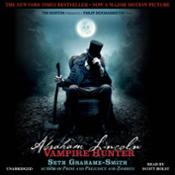
Download from Audible.comNow the author has produced an original novel with another great high-concept title: Abraham Lincoln: Vampire Hunter. (He had been impressed by Doris Kearns Goodwin's Team of Rivals, among others, and credits the Internet with making this book much easier to research.)

Like Pride and Prejudice and Zombies, the title of Abraham Lincoln: Vampire Hunter alone will sell the book — or at least encourage curiosity. But it's more than that: this book is also the story of its "author," who whiles away nearly a decade behind the counter of a small-town five-and-dime store, trying to write then abandoning novel after novel until the day a friendly regular leaves him a package wrapped in brown paper, containing letters and journals, on the condition that he write a book about them. The first line: "This is the journal of Abraham Lincoln."

The fellow obsesses for seven months over these documents, losing his family then nearly his mind as he pores over the secret diaries of our sixteenth president and his lifelong pursuit to rid America of the bloodsucking menace that had run unchecked since the founding of Jamestown in 1607, and eventually would become the deciding factor in the beginning of the Civil War. Mostly because one killed his mother.

The journals cover Lincoln's life from his frontier boyhood through his presidency and death, with Grahame-Smith inserting necessary historical details to fill in the gaps. Lincoln writes of the suspicious deaths of his aunt and uncle and then his mother, who was called "milk sick" until the truth came out. Lincoln learns from his father Thomas that vampires killed his own father and Abe's mother. Thomas owed a debt that could not be paid, and the vampire shylock took payment in another way.

At age 12, young Abe writes, "I hereby resolve to kill every vampire in America" and proclaims God as his enemy for allowing such things to happen. For a while he devotes himself to occult studies and physical improvement, such as developing his ax-wielding technique. Also pivotal is Lincoln's first encounter with slavery. He finds that "bargain" slaves (the weak, the old, etc.) are being bought in great numbers to be used as vampire food. Since no one cares what happens to a slave, there's not the trouble with the authorities that results when "real" people are sucked dry. In that way, the vampires were the first equalizers, realizing that blood is blood, whatever the skin color. Lincoln soon realizes that "So long as this country is cursed with slavery, so too will it be cursed with vampires."

Grahame-Smith takes a while to find his way with Abraham Lincoln: Vampire Hunter. At first, it seems to have been put together in much the same way as his Jane Austen zombie novel. In the beginning, the historical chronicle of Lincoln's life is readable and engaging, but the vampire aspects feel dropped in and not part of the whole, as if he wrote the history first and the fiction later.

So clumsily are some of these early portions added that I began to question whether perhaps the author had perhaps merely obtained an extant Lincoln biography (in the public domain or even unpublished) and added his own parts to it. (Before you scream "libel," just remember that even the best historians are sometimes accused of plagiarism. Controversy only sells more books.)

Later, as the main conceit takes precedence over the genuine history, this is much less of a problem. Abraham Lincoln: Vampire Hunter tells of Lincoln's political ambitions (and his vacillating nature toward them), and of his friendships with Edgar Allan Poe and his close and complex friendship with his mentor, the uncommon Henry Sturges. This relationship is one of the highlights of the book and shows Grahame-Smith's skill with masculine emotions.

Audiobook reader Scott Holst has difficulty overcoming the dry nature of the prose early on. But he shines in the "quoted" materials from the letters and journals, using a subtle country twang to embody Lincoln and his forebears with skill. The audiobook contains a conversation with the author; a bonus PDF document of historical photographs, paintings, and engravings; and a preview of Michael Koryta's novel So Cold the River.

The book's main success is also its greatest weakness, which is that it reads like a genuine history, but with vampires folded into the reality. Thus, I think it would appeal only to those readers who enjoy history and vampires: history buffs will likely balk at the liberties taken with the facts — a good deal of true stories from Lincoln's life are included, some of which are even more interesting than the slaughter of the undead — while horror fans will be disappointed in the long spans between kills.

Grahame-Smith makes at least one mistake for the sake of narrative immediacy, telling the last moments of a dying man from the perspective of omniscience, therefore reminding us we are reading fiction and breaking the spell momentarily. He also falls prey to the easy out, giving nearly every person who disagrees with Lincoln on any minor point connections with vampirism. It becomes so predictable, that when names like Jefferson Davis, Stephen Douglas, and John Wilkes Booth come up, you'll immediately guess "vampire" and nearly always be right.

But even with its flaws, Abraham Lincoln: Vampire Hunter not only solidifies Grahame-Smith's standing as a genre-blender, but also shows bright spots of creativity, suggesting that a completely original novel might not be too much of a stretch. He manages the impressive feat of making the reader believe — if only during the reading — in an Abraham Lincoln that could have been.

I know I'll never look at a five-dollar bill the same way again.

Tuesday, April 6, 2010

The Vampire Affair by Livia Reasoner (paranormal romance)

Everybody thinks Michael Brandt is a millionaire tycoon playboy with nothing on his mind but his money and his seemingly endless string of beautiful women. Jessie Morgan, a freelance reporter of Native American descent (she was raised by her grandmother on a Cherokee reservation) is on assignment from a tabloid to get the scoop on Michael's latest alleged starlet romance.

In pursuit of her story, Jessie gets by Michael's security and stumbles onto the truth: Brandt is actually the latest in a family of generations of vigilante vampire hunters. Now that she knows, he can't just let her go, so Michael takes Jessie back to his Bruce Wayne–style headquarters/mansion and opens himself up to her.

They soon fall for each other — the fair Eastern European and the dark Native American — and this causes Michael pain because he doesn't want to lose Jessie the way he lost Charlotte years ago. He's lost one love to these creatures before. Will he lose another? He will if vampire overlord Jefferson Rendell has anything to say about it. Some people just never learn....

Author Livia Reasoner (also a writer of popular mysteries under the name Livia J. Washburn) offers readers all they expect and more in her Harlequin debut for the Silhouette Nocturne paranormal romance line. Traditional romance and vampire tropes get a good workout (as do Michael and Jessie in a steamy locker-room shower scene), but mostly The Vampire Affair is just a ripping yarn.

It's full of action and suspense, teeming with emotional conflict and sexual tension, and peopled with engaging characters in surprisingly plausible situations that make it easy to suspend the necessary amount of disbelief. Reasoner exhibits considerable talent in the equal effectiveness of both romance and battle scenes — with an exciting scene of bloodlust well balanced with a steamy scene of the other kind.

It's a bit on the long side, and the ending will surprise no one, but the Native American connection offers an original twist. The Vampire Affair is more than worth your time. It's pure pulp, with few surprises but lots of entertainment. Its combination of romance, suspense, action, horror, and adventure are just the kind of escapist reading this reader seeks.

Reasoner is currently working on her followup to The Vampire Affair, a werewolf novel (Enemy of the Wolf) that was changed from a shape shifter novel (Shifting Affections) due to the demands of the marketplace. Reasoner is a true professional who never forgets that publishing is a business, and you must change to meet its needs, not the other way around. Read about it in her blog post Do You Write from the Heart or for the Bucks?

Wednesday, April 29, 2009

Books I Couldn't Finish, April 2009 Edition

Bloodlist by P.N. Elrod (unabridged audio book read by Barret Whitener) — This first book in author Elrod's Vampire Files series begins well. Jim Fleming wakes up after his murder to find himself a vampire; he then sets off to find his killer. It's a classic plot (think D.O.A.) with a twist, and Elrod sets up the time (the 1930s — Dracula has just been released) and place (Chicago, the Al Capone era) with the proper amount of detail.

Fleming is a traditional vampire in some ways but not others, and the mix is interesting. Unfortunately, he has a tendency to talk more than do, and his nonaction eventually gets wearying. About a quarter of the way in, I shut off the audio (read by Barrett Whitener) of Bloodlist and never felt the need to start it again. Those more interested in vampires as characters may stick it out, but I was looking for more of the noir revenge tale.

The CEO of the Sofa by P.J. O'Rourke (unabridged audio book read by Dick Hill) — Humorist P.J. O'Rourke wrote perhaps the funniest piece I've ever read ("So Drunk" in Age and Guile Beat Youth, Innocence, and a Bad Haircut), and I was reading Give War a Chance when I met my wife, so I tend to give him more of an opportunity to make me laugh than I would give others of his ilk. But The CEO of the Sofa (at least the parts I got through) was pure disappointment.

This may be in part because of the date of publication: 2001. Timely humor can be terrific when experienced in a timely manner, but anyone who has watched reruns of Saturday Night Live knows that political humor especially grows quickly stale. The pieces in The CEO of the Sofa — including Bill Clinton jokes, a rundown of the presidential candidates of the 2000 election, and a rant on cell phones(?!) — are hardly interesting as anything more than history.

Friday, January 23, 2009

The Book of Lists: Horror edited by Amy Wallace, Del Howison, and Scott Bradley (introduction by Gahan Wilson)

The Book of Lists began a franchise in 1977 that has lasted over 30 years. It has resulted in a New York Times bestseller, three other general collections, and one each on the 1990s and punk rock. Now they move even further out of the mainstream with The Book of Lists: Horror.

"Trying to prod a thing as elusive, sneaky, and totally out-of-bounds as horror into an informative and highly usable book of lists would seem to be pretty much impossible," states author/illustrator Gahan Wilson (one of the first artists I learned to recognize by style) in his introduction. But it seems that editors Amy Wallace, Del Howison, and Scott Bradley have managed to somehow compile over 400 pages' worth of opinions, recommendations, and commentary into this endlessly fascinating volume. If you're a fan of the genre, The Book of Lists: Horror is a must read; if you're not, it will make you one.

Here's just a sampling of the contents, limited to lists by 15 of my favorite authors (and not necessarily my favorite lists):...and that's just scratching the surface. The Book of Lists: Horror took up every free moment I had from the day I got it until ... well, I still refer back to it now and then and expect to keep it on my reference shelf right next to another horror-list classic: Horror: 100 Best Books. In fact, my only real complaint is that there is no comprehensive index or table of contents that would allow the reader to relocate a favorite list. But there are so many terrific takes on the genre included in The Book of Lists: Horror, however, that the search will undoubtedly result in finding something else great in the process.

Sunday, October 12, 2008

Horror Is Not a 4-Letter Word by Matthew Warner (horror essays)

Subtitled Essays on Writing and Appreciating the Genre, short story writer and novelist Matthew Warner's first collection of nonfiction, Horror Is Not a 4-Letter Word, is ideal reading during the month best known for ending with Halloween. And it's a must-have for fans of the horror genre.

In these articles that span from 2002 to 2007 — with all but two coming from the author's tenure as a columnist for Horror World — Warner covers a variety of diverse topics from horror stereotypes (and why we need them) to the importance of research for verisimilitude, from why Buffy the Vampire Slayer is an example of excellent plotting to the secrets of a successful collaboration, from how to write "invisible" dialogue to tips on public speaking.

Warner even gives new readers a taste of his short fiction ("With the Eyes of God") and then shows how he got there. (Those whose appetites are whetted can seek out Death Sentences, his short fiction collection). Horror Is Not a 4-Letter Word also contains a critique of Left Behind from the horror writer's perspective, one essay each focusing on the subjects of his two novels to date (The Organ Donor and Eyes Everywhere), a lengthy exposé on his summer working for notorious "book doctor" Edit Ink, and even insightful articles on censorship and the connection between horror and violence.

Warner has an engaging conversational style that makes even the most indepth material go down easy. But I'm not sure I can bestow a greater compliment than the fact that reading Horror Is Not a 4-Letter Word is the first time I've almost been late for work because of essays. As I finished one, the next one's title intrigued me to continue. Kudos to the author and Guide Dog Books for assembling a collection of horror-related articles that are just as accessible to the horror reader as to those who want to write in the genre — and is far more readable than others of its ilk.

Sunday, July 6, 2008

British Invasion edited by Christopher Golden, Tim Lebbon, and James A. Moore

This review originally appeared in somewhat different form on The Green Man Review. Copyright 2008. Reprinted with permission.

Oh, the things people get themselves into over drinks. To hear the British Invasion trio of editors Christopher Golden, Tim Lebbon, and James A. Moore tell it (in their foreword): "No one had properly chronicled [the] extraordinary number of British writers [impacting] the American horror and fantasy scene." Ten minutes later, they had sold this alcohol-inspired idea to Cemetery Dance Publications. (This quick sale actually makes a lot of sense since an anthology with this loose of a theme seems like its audience is built-in.)

In an anthology that set no restrictions on its contributors other than they be British and write horror, James Lovegrove sets himself one in the writing of "At One," the story of one man's individual hell. The restriction is unnoticeable until Lovegrove reveals it, but it gives "At One" a great deal of punch that sets it apart. (Interestingly enough, "At One" is a reprint from 2002 in an anthology that Cemetery Dance advertises as having "all new dark fiction.")

Sarah Pinborough recalls a previous British invasion (the one that changed modern music) with "The Nowhere Man," a dark fantasy (or is it?) about a boy's search for his disappeared sister. With an ending that deliberately leaves out information, Pinborough cements the unsettling effects of what preceded it. "Beth's Law" by Joel Lane is a haunting tale of how the disappearance of another young girl turns into a vendetta against outsiders.

Allen Ashley's "The Spaces in Our Lives" isn't even a horror story — unless you consider the mundanity of daily life horrific. If you do, you'll love Gary Fry's "Black Dogs," which delves deeply into a family's psychology. With "The Crazy Helmets," Paul Finch presents a "rise from the grave for revenge" story, then pulls a completely unexpected twist that changes the perception of everything involved.

Phillip Nutman's "The Misadventure of Fat Man and Little Boy, or How I Made a Monster" is by far the best. The story involves low-budget filmmakers, a naive screenwriter, a succubus, and an accidental murder. With chapters named after Warren Zevon songs, it is based on real events (Nutman is himself a low-budget filmmaker). It goes from reality to fantasy and from horror to pathos in the span of a paragraph, and contains enough actual story for a novella, making it seem deeper and wider than its mere 24 pages.

The centerpiece of British Invasion is a piece called "British Horror Weekend" by the ever-prolific Anonymous, an extraordinarily funny story of mass murder at a genre convention. It seems someone wants to kill off all the British horror writers (several contributors to this anthology make cameo appearances) and so devised to gather them all in one place. Cross-pond politics of course play a role, as does a certain amount of Anglophobia when the killer is revealed to be an "Amrk'n" tired of "imagination" in horror and eager for more "close-up detail." One imagines this to be the work of two or more of the editors, since the tone is British and the voice of the "Amrk'n" is frighteningly authentic.

Peter Crowther, whose short-story collection The Spaces Between the Lines so impressed me, does it again with "Leaves." Crowther has a fascinating ability to make the mundane terrifying (what is less frightening than a leaf?), and "Leaves" brings real chills, especially during the supposed "slow" scenes when Crowther is just setting up the situation and we're waiting for the other shoe to drop.

Late in the anthology, Mark Morris impresses with "Puppies for Sale," where a man's life is destroyed by a different kind of vampire that only operates via long-distance. And speaking of "blood-suckers," Adam L.G. Nevill knows there are few things worse than an uninvited flatmate who won't bathe — or leave! — and he expresses it with textured sensation in "Yellow Teeth."

Of the 21 stories in British Invasion, only the few above rated mention, but none of them were really turkeys; they simply were not as effective as their brethren. I'm not sure how to take the fact that the under-the-radars seemed to do a better job at scribing scares than their more famous colleagues, but it's good to know that fans of British horror have a lot to look forward to.
Related Posts with Thumbnails