Showing posts with label adventure. Show all posts

Saturday, September 15, 2012

Shadows from Boot Hill by L. Ron Hubbard (western multi-cast audiobook)

On the run from the law for the hired killing of a banker, Brazos asks livery man Whisper Monahan to help him out. Brazos had to light a shuck immediately after the murder and had been unable to collect his fee: $500 in double eagles.

Scotty Brant has been poisoning lands downstream by using cyanide to get gold from iron oxide, killing entire herds of sheep and allowing Whisper to buy thousands of acres on the cheap.  Whisper offers Brazos $200 to kill Brant, giving Brazos much-needed funds and simultaneously allowing Monahan to make good on his land investment.

Trouble is, it's going to take three deaths to get one, because to get Scotty, Brazos has to get through son Swifty Brant and the family jujuman, Bilbo.  But a lack of superstition and a silver cross given by a Mexican girl are no match for a curse spat out by a dying witch doctor.

A supernatural Western originally published in June 1940 in Wild West Weekly, Shadows from Boot Hill, and its ilk were a rarity in the days of the pulps.  But author L. Ron Hubbard once again shows his talent and imagination, and this audio version, directed by Tait Ruppert with Firesign Theater alumnus Phil Proctor playing Whisper Monahan and Scotty Brant, is bound to appeal to fans of both the "weird" and the traditional.

The audio of Shadows from Boot Hill also features two more Western stories Hubbard wrote in the 1940s, "Gunman!" and "The Gunner from Gehenna", both directed by Jim Meskimen performed with equal skill by the participants, including Proctor and Meskimen himself.

Tuesday, February 28, 2012

Sky Birds Dare! by L. Ron Hubbard (aviator pulp adventure audio)

I am continually impressed at the breadth of material produced by author L. Ron Hubbard during the second half of the 1930s. He wrote everything from Westerns and suspense to adventures of the air, sea, and foreign lands. First published in the September 1936 issue of Five Novels Monthly, Sky Birds Dare!, as its title suggests, centers around aviation.

Breeze Callahan is one of the best glider pilots around. Unfortunately, that doesn't mean much in the age of motors. Though Breeze's gliders would keep a plane in the air after its motor failed — and would be able to soar into enemy territory without a sound — the Navy is more interested in the training ships of Breeze's rival, Badger O'Dowell, for the war effort.

Breeze has to prove that his gliders are good enough, and that he is good enough for the hand of Patty Donegan (his designer's daughter) — who has recently taken a shine to sailors — even if he has to crash and burn to do it.

As is fairly common in Hubbard's fiction, narration carries the day over dialogue in Sky Birds Dare!, allowing the author to display the extensive knowledge he seems to have gleaned from his time as president of the George Washington University Glider Club. (The promotional materials from Galaxy Audio often emphasize how much of Hubbard's verisimilitude came from personal experience.)

Regular narrator R.F. Daley once again puts his all into delivering the power of the words. And some of Hubbard's most effective prose is in Sky Birds Dare! — during the soar in chapter 3. Every detail is painted from the POV of the cockpit, first the exhilaration of flying, then when things start to go wrong, the fear and rush of thoughts. I felt like I was in the glider with Breeze, and that's precisely what I want from escapist fiction.

Sunday, November 21, 2010

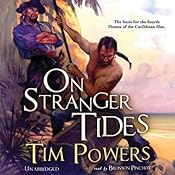
On Stranger Tides by Tim Powers (unabridged audio book read by Bronson Pinchot)

This review was originally published on SF Site.

John Chandagnac, son of a puppeteer, is still mourning his father's death when he sets out for Jamaica to get back his inheritance from the uncle who stole it. To this end, he charters the Vociferous Carmichael but gets to see another side of sea life when it is attacked by Phillip Davies, privateer and captain of the sloop Jenny.

Chandagnac gets on the wrong side of a pirate captain (by defeating him with sword techniques learned for puppet shows) and is offered the choice to either join them or die. Now christened "Jack Shandy," he discovers that the people he thought were on his side are simply out for themselves (isn't that always the way?) — including one's strange plan for the legendary Fountain of Youth, which has very different powers than usually supposed.

On Stranger Tides, the 1987 novel from author Tim Powers now available in audiobook form, is also the source material for the fourth film in the Pirates of the Caribbean series, gladdening many of Powers' fans since that will undoubtedly bring his work closer to the mass appeal they have long felt he deserved. The option apparently existed long before it was revealed, since the third film in the series most definitely foreshadows this book's Fountain of Youth plot.

For those who have not experienced his work before, Powers is a discovery. On Stranger Tides combines the mundane and the supernatural into a gripping narrative filled with high adventure. It has the potential to please readers of most forms of genre fiction, with plenty of gunfire and swordplay alongside voodoo, zombies, ghost ships, and sorcery, with numerous startling twists that never stretch the bounds of plausibility. There's adventure, revenge, romance, and intrigue all folded together into a cohesive whole as Powers never loses sight of his primary goal of telling a ripping yarn. He maintains a consistent level of tension throughout, along with a great deal of humor, toward a thoroughly satisfying conclusion.

Another discovery made through listening to On Stranger Tides is the highly advanced narrative skill of actor Bronson Pinchot. Pinchot is probably still most widely known for either his seven-year stint as the pseudo-Greek naïf Balki Bartokomous on the situation comedy Perfect Strangers or for his scene-stealing turns as Serge in two Beverly Hills Cop films. But his deft handling of unplaceable accents in those roles does not prepare one for his reading of Powers' work. The sheer number of accents Pinchot tackles is impressive, and his ability to distinguish characters while juggling various dialects within a single conversation is nothing short of astonishing, making the audio rendition a much fuller experience than the text alone could provide.

Tuesday, November 9, 2010

Zenith Rand, Planet Vigilante by Richard Tooker (pulp sci-fi adventure short stories)

Richard Tooker was obviously meant to tell stories of adventure. Born in 1902, Tooker's father's family were sea captains, soldiers, and adventurers. The storytelling part came from his mother, who knew the author of the classic adventure Alice of Old Vincennes. Tooker published his first story at the age of 15, then after finishing school, worked as an editor and reporter and was enlisted in the Marines. He felt that his life contained parallels with Jack London's Martin Eden and published his first novel, The Day of the Brown Horde, in 1929 (from whose dustjacket the substance of this paragraph comes).

Tooker's skill at writing cracking sci-fi adventure is well evidenced by Black Dog Books' collection of the three longish stories featuring his hero Zenith Rand, as published in three consecutive issues (June, August, and October 1936) of Mystery Adventure Magazine. Zenith Rand, Planet Vigilante contains the title inaugural tale plus two others, "Revenge on Scylla" and "Angels of Oorn" (the source of the book's appealing cover illustration).

"Zenith" (whose given name is never revealed) was named by his fellow Terran Spacemen for his "indomitable fighting spirit" in the midst of playing "sky-the-limit stakes in the grim game of stellar conquest and exploration" (zenith, of course, being the sky's own upper limit). Nevertheless, Rand has a weakness, and her name is Sandra Yates.

As we discover in "Zenith Rand, Planet Vigilante," the first of the trilogy, Pilotess Yates — a Valkyr Amazon — broke Rand's heart (or perhaps merely bruised his pride) when she chose another over him. It was, in fact, this event that led him to choose the distant post on Camia, moon of Orthos, and subsequently necessitated Yates's arrival just in time to save Rand from the Camian goat-women. O, sweet irony!

In addition to the color art by Norman Saunders found on the Zenith Rand, Planet Vigilante's front and back covers (from the very issues in which the first and third stories appeared), Black Dog Books publisher Tom Roberts has also included the black-and-white illustrations (uncredited and unknown) that accompanied the stories' first appearances inside the magazines. In doing this, Roberts has done his best to replicate the original reading experience as closely as possible while offering a cleaner presentation of the text.

"Revenge on Scylla" finds Zenith on the titular "somber sphere ... on the fringe of Altair's Titan gravity" in a search for Sandra among the slime seas. Since the events of their previous outing, Yates and Rand became "mates for life" (something involving having "simply signed the book" — no marriages for these even-steven fiftieth-century Terran couples), much to the chagrin of "Death" Lamson, Rand's supernumerary on this rescue mission to reclaim Yates from the half-snake Scyllans. If that's not enough to deal with, the group will also face betrayal from their own side.

Tooker's prose is not the most accessible. Several sentences required a second or third reading to completely suss out their meaning. But the author definitely understands action, and the writing in Zenith Rand, Planet Vigilante improves with each story.

"Angels of Oorn" posits Zenith Rand on the titular moon of Procyon, required to (once again) save Mate Yates from its denizens, highly unsavory despite their epithet ("Zenith snorted derisively ... 'If you Oornites are angels, I'm Mercury's half-brother'"). This story is definitely the most interesting, with the threat coming not only in physical form but also mental, as a directed gaze from the hypnotic, shape-shifting Oornites can kill, and even a mere glance can incapacitate or madden.

This last story engenders an appetite for further adventures, but there are only these three, for whatever reason (there is no background explanatory material included). Nevertheless, Zenith Rand, Planet Vigilante offers a chance to read these pioneering spicy pulp sci-fi adventure stories that would otherwise have been lost to the casual enthusiast.

Monday, August 30, 2010

Sea Fangs by L. Ron Hubbard (unabridged audio book performed by a full cast)

Bob Sherman, one-time land owner and boat captain, had his dreams taken away by Herbert Marmion, who commandeered Sherman's property for the U.S. government's use. Trying to get to the bottom of things, Sherman hires himself out as a sailor on Marmion's ship, the Bonito. A hurricane then tosses them about, bringing forth the captain's ineptitude and Marmion's daughter Phyllis, a black-haired beauty.

The ship eventually anchors, but on the Island of Death, the headquarters of Venezuelan pirates from whom Sherman just escaped after an 18-month imprisonment. ("It would be just like the sea to bring me back where I least want to return.") It looks like Sherman is destined for recapture, but the Bonito puts up a good defense when attacked, with eight full minutes of shells and bullets making "the air ... alive with lead" on this fantastic audio adaptation of author L. Ron Hubbard's novella Sea Fangs.

Sea Fangs is a relatively early short novel from Hubbard, appearing first in the June 1934 issue of Five Novels Monthly, so it's not as skillfully crafted as works like Six-Gun Caballero and Under the Diehard Brand that were published only four years later.

The cast of Sea Fangs is, as usual for these Galaxy Audio productions, generally first-rate, with Firesign Theatre alumnus Phil Proctor tackling three relatively prominent roles and director Jim Meskimen juggling five other supporting parts. The only real fault in the production lies with the lead actress. The heroine, Phyllis, as written by Hubbard, goes through numerous emotions from devotion to grief to fear, but Kristen Proctor never gives anything more than the same flat line-readings.

Miss Proctor's performance actually detracts from the story instead of adding insight to the character. She is never once believable as the clever, strong-willed woman of action Hubbard imagined. Protagonist Bob Sherman fares considerably better, though this is due more to narrator R.F. Daley's reading of Sherman's thoughts and actions than to Shane Johnson's effort with the dialogue. That said, the audiobook of Sea Fangs is still a fine way to pass two hours, especially if you're commuting and you'd rather be on the high seas than stuck in a sea of traffic.

Tuesday, April 6, 2010

The Vampire Affair by Livia Reasoner (paranormal romance)

Everybody thinks Michael Brandt is a millionaire tycoon playboy with nothing on his mind but his money and his seemingly endless string of beautiful women. Jessie Morgan, a freelance reporter of Native American descent (she was raised by her grandmother on a Cherokee reservation) is on assignment from a tabloid to get the scoop on Michael's latest alleged starlet romance.

In pursuit of her story, Jessie gets by Michael's security and stumbles onto the truth: Brandt is actually the latest in a family of generations of vigilante vampire hunters. Now that she knows, he can't just let her go, so Michael takes Jessie back to his Bruce Wayne–style headquarters/mansion and opens himself up to her.

They soon fall for each other — the fair Eastern European and the dark Native American — and this causes Michael pain because he doesn't want to lose Jessie the way he lost Charlotte years ago. He's lost one love to these creatures before. Will he lose another? He will if vampire overlord Jefferson Rendell has anything to say about it. Some people just never learn....

Author Livia Reasoner (also a writer of popular mysteries under the name Livia J. Washburn) offers readers all they expect and more in her Harlequin debut for the Silhouette Nocturne paranormal romance line. Traditional romance and vampire tropes get a good workout (as do Michael and Jessie in a steamy locker-room shower scene), but mostly The Vampire Affair is just a ripping yarn.

It's full of action and suspense, teeming with emotional conflict and sexual tension, and peopled with engaging characters in surprisingly plausible situations that make it easy to suspend the necessary amount of disbelief. Reasoner exhibits considerable talent in the equal effectiveness of both romance and battle scenes — with an exciting scene of bloodlust well balanced with a steamy scene of the other kind.

It's a bit on the long side, and the ending will surprise no one, but the Native American connection offers an original twist. The Vampire Affair is more than worth your time. It's pure pulp, with few surprises but lots of entertainment. Its combination of romance, suspense, action, horror, and adventure are just the kind of escapist reading this reader seeks.

Reasoner is currently working on her followup to The Vampire Affair, a werewolf novel (Enemy of the Wolf) that was changed from a shape shifter novel (Shifting Affections) due to the demands of the marketplace. Reasoner is a true professional who never forgets that publishing is a business, and you must change to meet its needs, not the other way around. Read about it in her blog post Do You Write from the Heart or for the Bucks?

Friday, March 26, 2010

Wraiths and Worlds by Darrin Charles Wilson (dark fantasy)

Six years ago, I read author Darrin Wilson's debut novel, Pine Shallow, and saw behind the unpolished writing that there was an original thinker with a talent for storytelling. Since then, Wilson's writing has improved markedly, and he's still coming up with new ideas.

Wraiths and Worlds is a formerly online serial novel now available in print with a previously unseen ending. Tired of playing publishing games, for this story Wilson went straight to the Internet. He posted the first chapters and was about to move on to his next project when he received inspiration in the form of readers from around the world wanting to know what happened next.

The story concerns Grace Tiffen, a black, 23-year-old law student who dies in a car crash and finds herself naked in the middle of an Arctic wasteland. Helped by some other local denizens, she learns that this is the afterlife but that God has left. The one person Grace really wanted to see, her father, is also absent, so she and a fellow who calls himself Deacon go off to find them both. But soon people start dying, and what kind of afterlife kills you after you get there? And what kind of afterlife does God ditch when the going gets tough?

Meanwhile, during Grace's funeral, her psychic aunt Abigail is confronted by Jonathan Sand. He's looking for a book, and he has traced it to Abigail's grandmother. When Abigail find the strange, fleshy book in her library, Sand kidnaps her and takes her on a quest through the Middle East, including a place called the Devil's Needle, where wind storms can result in death by airborne scorpion swarm. When Abigail is able to make contact with Grace, things just get weirder, like the formation of a snowy crevasse in the middle of the desert.

Wilson combines tropes from sci-fi, fantasy, adventure, mystery, and horror fiction to produce a book that has a little something for everyone. He studied and combined numerous world religions to come up with the theology he presents here. I don't usually get into books with such a high reliance on "otherworldliness" — although my appreciation for it is increasing — but Wilson's characters are so well drawn I had to know what happened. Sometimes his words get in the way of his story, but there's enough pure talent in Wraiths and Worlds to carry the reader through to the end.

Wilson was probably right to avoid traditional publishing routes with this book, since they would not know how to market it. Which genre's audience do you focus on? In any case, Wilson poses some very interesting ideas about the nature of God, and he's left plenty of room for a sequel. Wraiths and Worlds is smart fiction, that rare kind that successfully brings a new perspective to an age-old concept.

Tuesday, February 16, 2010

A Princess of Mars by Edgar Rice Burroughs (first of the Barsoom / John Carter series)

Former Confederate captain John Carter, left with no means of income after the war, heads to Arizona and strikes a quartz mine. Trying to rescue his partner from Apaches, Carter takes a wrong turn and comes to a cave, in which he finds a large room, where he is overthrown by a paralytic gas. With a supreme effort, he attempts to move his muscles, but instead his spirit/soul/whatever leaves his body, and he thus exits the cave completely naked. Staring out at the night sky, Carter sees the planet Mars and feels called to by the god of war. He reaches out his arms, senses cold and darkness, and opens his eyes "upon a strange and weird landscape. I knew that I was on Mars."

If you can get past that extreme leap of faith, the rest of A Princess of Mars is pretty easy to stomach. Author Edgar Rice Burroughs (author also of the numerous Tarzan stories) peoples his debut novel (expanded from the short story "Under the Moons of Mars" and serialized in All-Story before being published as a novel in 1919) with characters that are easy to identify with, though they happen to be green-skinned Martians. Though I had long heard of the stories, I was first intrigued to try this one due to its being listed in the Encyclopedia of Weird Westerns, which stated that it falls firmly into the subcategory of Space Western (the same category under which Star Wars falls).

It was primarily this, but also the fact that I had enjoyed Tarzan when I read it so long ago, that led me to seek it out — preferably in audio, through which I do most of my literary experimentation. I found the Books In Motion audio at the library. Jack Sondericker reads A Princess of Mars from the perspective of time, much as the early part of the novel suggests. His voice is that of an man much older than the protagonist, leading a semblance of retrospective realism to this fantastic tale. (The Librivox audio is also a solid interpretation, with Mark Nelson offering a professional-quality reading that can be downloaded for free.)

Because of the lighter gravity of Mars ("Barsoom" to the locals), Carter finds himself a superman among his new neighbors, able to leap 30 feet in the air and 100 feet away when threatened. The early chapters of A Princess of Mars are mostly given to writing of the expository sort, involving Carter's observations of the strange details of Martian life, peppered throughout with feats of his prowess, which impresses the seemingly unemotional Martians in the only way important to them. Carter even becomes a chieftain of the Tharks after defeating one of them.

I don't usually get into books filled with made-up names and long descriptions of the differences between Earth and whatever planet the story happens to be set on, but Burroughs manages to make it interesting through sheer imagination, with just enough things not so different to balance the very different. A Princess of Mars is such a mythic success at this, it is impossible not to get involved in the exploits of John Carter and the female prisoner he comes across, who looks very different from the green-skinned Martians and who turns out to be Dejah Thoris, red-skinned princess of Helium.

The rest of the book involves the duo's escape from Thark, as they fall for each other, get separated, then reunited, and eventually make a go of it. The ending would be a downer if I didn't know that there are numerous sequels, the first of which is The Gods of Mars. But if you're looking for a full reading experience, with plenty of action, adventure, and even romance, you'd do well to pick up a copy of A Princess of Mars.

Tuesday, February 2, 2010

Spy Killer by L. Ron Hubbard (unabridged espionage/adventure audio book)

L. Ron Hubbard is probably best known as the founder of Scientology and creator of Dianetics. These days, his name is largely connected with the antics of the some of the more "outspoken" members of the religion, overshadowing the fact that the man really knew how to tell an entertaining story. All 150 of the stories Hubbard wrote for the pulp magazines of the 1930s and '40s are being rereleased in paperback and audio under the evocative title Stories from the Golden Age.

The recordings I've tried so far are just terrific. They are a professionally produced combination of traditional narrated audiobooks (with narration deftly handled by R.F. Daley) and old-time radio, with skilled actors playing the characters (often multiple roles) and genre-specific music and sound effects rounding out the experience.

When bucko mate Kurt Reid escapes the ship Rangoon (with help, it turns out), he has two choices: go into hiding as a fugitive of the Chinese government, or assist Russian beauty Varinka Sevischna in her project against Chinese intelligence. Since hiding in unlikely, and Kurt is always "spoiling for a fight," he accepts her offer — and soon finds himself in over his head, hot least of which when Varinka's friend (and Kurt's ex-fiancée) Anne Carsten resurfaces with an equally enticing offer.

Soon the two women disappear, however, and Reid is faced with Chinese warlord Lin Wang, who offers freedom from pursuit. In a delicious ironic twist, in order to avoid punishment for the murder he did not commit (and the reason he was a prisoner in the first place), Reid must murder someone else, namely a Japanese spy named Takeki ("the courageous"). But when Reid gets there, he recognizes Takeki and has to make a difficult choice.

Author L. Ron Hubbard fills Spy Killer with action and suspense in a land where death waits as a consequence for nearly every decision — especially inaction. But he also offers up a love story (however implausible) that adds an extra layer to events to this wonderful example of the "yellow peril" genre.

Lin Wang is a great villain — deformed physically and mentally — and Tait Ruppert plays him with gusto. Likewise, Lori Jablons is terrific in her dual role of Varinka and Anne, underscoring the fact that the two women embody separate halves of Reid's ideal.

Anyone who pays attention to things like dialogue that makes no sense unless something unspoken is true, will figure out the big twist early on. (Those who solve TV mysteries by assuming that the guest star with the least amount of air time must be the murderer, will also have an advantage.) Despite this flaw (if it is one), and its slight overlength for the breadth of its story, Spy Killer is still a pretty good adventure tale of Oriental espionage, provided you don't mind overlooking implausibilities and suspending a certain amount of disbelief. But, then, many pulp fiction enthusiasts merely consider that all part of the experience.

Bonus: for more of the story behind Spy Killer, watch the following tongue-in-cheek interviews with Kurt Reid and Varinka Sevischna, as conducted by Lawrence Carpetburner (director Jim Meskimen) on the fictional program Elbows on the Table:

Kurt Reid


Varinka Sevischnya


Tuesday, December 22, 2009

The Chase by Clive Cussler (historical action mystery)

April 1950 — A fisherman searching the bottom of a lake for his lost outboard motor finds something quite a bit more impressive, and soon a dredging company unearths (unwaters?) Baldwin locomotive #3025 (and its 3 saponified corpses) from the silt and muck it sank in back in 1906.

Nearby, a tall, anonymous observer watches closely. He knows what happened 44 years ago. He was there....

January 1906 — A bank robber disguised as a wino makes off with a $325,000 mining payroll, leaving three dead victims in his wake. This is at least his fifteenth such undertaking, and the public knows him as the Butcher Bandit.

Joseph Van Dorn, founder of the famous detective agency that carries his name, puts his best man on the Butcher Bandit case: Isaac Bell, who feels that the bandit plans his escapades so well that he will undoubtedly be tripped up by a single overlooked mistake. Bell proposes that it is the job of the Van Dorn detectives "to find that insignificant mistake."

Jacob Cromwell is president of the Cromwell National Bank, but where he got his initial capital is a mystery. His sister Margaret seems to have some connection with the Bandit, but that, too, is not clear. With little else to go on, Bell focuses his sights on the Cromwell siblings, though they appear to be San Francisco's biggest philanthropists.

Clever villains make for the most interesting reading, and author Clive Cussler's The Chase offers up one of the cleverest in the Butcher Bandit. He robs and kills, and yet always escapes due to his very careful planning. (Some may say that this much planning is unbelievable, but Cussler never allows it to slip into parody, though he may have his tongue in his cheek.) But the Butcher's ambition and ego may just be his downfall.

However, as bright as the Butcher is, Cussler's newest hero Isaac Bell is at least as clever. Bell is from an independently wealthy family, so his interest in investigation is pure; he's not doing it for the money. He has his quirks, but he is a mostly relatable hero. The reader learns who the Bandit is fairly early on, and from then on The Chase offers a suspenseful ride of wondering when Bell and the Bandit will meet.

The Chase also features a close-up view of the San Francisco earthquake of that year. And Cussler caps things off with a thrilling locomotive chase across the Sierra Nevadas and north to Montana, with no working telegraph lines to warn of oncoming trains keeping the suspense at similarly mountainous heights.

The historical aspects of The Chase are also fun. It takes place mostly just after the turn of the 20th century, so it has many aspects of a Western (since that's only about 25 years after most Westerns are usually set). I especially enjoy a good Western-mystery, so this one really fits the bill, especially with the added adventure.

The Chase was first appreciated as a standalone thriller. But an also train-related sequel set the following year in 1907, The Wrecker (written with Justin Scott), has since appeared, with presumably more to come.

Trivia: Cussler tips his hat to a classic bank-robbery film by having Salt Lake police detective John Casale have nearly the same name as John Cazale, the actor who played Sal to Al Pacino's Sonny in Dog Day Afternoon.

Thursday, October 22, 2009

Hunt Through the Cradle of Fear by Gabriel Hunt (as told to Charles Ardai)

Author Charles Ardai met his "co-author" Gabriel Hunt at the Yerebatan Sarayi (Sunken Palace) in Istanbul. (No, really — just read page 144 of Hunt Through the Cradle of Fear.) And I guess they hit it off because Hunt later enlisted Ardai's assistance in chronicling his adventures. ("I would have done it myself, gladly, but I was unfortunately tied up with some matters in Brazil," quips Hunt. "And I do mean tied up.")

Who's Gabriel Hunt? Why, he's only the multimillionaire globe-trotting adventurer (shades of Jim Anthony, but Hunt provides his own wisecracks) — sort of a modern Indiana Jones (in fact, they may have known each other, as alluded to in Hunt's first book) with up-to-date gadgetry like a cell phone with GPS.

Hunt's adventures are funded by the $100 million Hunt Foundation, paid for with the money of his parents, best-selling religious historians who were lost at sea and are presumed dead. Gabriel also has a brother, Michael, who helps him out on occasion, and a sister, Lucy (whose full name made her relationship with her parents more than a little strained), whom neither of the brothers has seen since their parents' disappearance.

His exploits are scheduled to be written down by a selection of writers skilled at action-oriented stories: James Reasoner, Charles Ardai, Nicholas Kaufmann, Christa Faust, David J. Schow, and Raymond Benson. For the first book in the Hunt chronicles, Hunt at the Well of Eternity, Reasoner was praised by Publishers Weekly as setting the bar for modern adventure "to nosebleed heights," stating also that the pulp-adventure genre had been "smashingly resurrected."

This Ardai-penned adventure continues the quality (not surprising, since Ardai came up with the concept and created the "bible" for the other writers to follow). In Hunt Through the Cradle of Fear, Gabriel hops from Manhattan to Hungary, from Egypt to Greece, and on to Turkey. He answers the riddle of the sphinx, meets a son of Homer, and soars, shoots, and slices his way to a mysterious treasure that is both invaluable and inscrutable, with the deliciously evil Lajos De Groet dogging him every step of the way.

Tongue is planted firmly in cheek with frequent references to how implausible things get, especially at the end when the story loops around to something said at the beginning. It is not only entertaining but informative: every chapter seems to have some educational tidbit to take away. Hunt Through the Cradle of Fear is intelligent and ironic and still every bit a full-blooded adventure novel.

As a bonus for readers, Hunt asked Ardai to include a separate, unrelated novella. "Nor Idolatry Blind the Eye" is a sort of hard-boiled adventure story that shows Ardai's darker side, with an ending that gets under the fingernails and sinks its teeth into the quick.

Thursday, October 1, 2009

Crimson Shadows: The Best of Robert E. Howard, Volume One (edited by Rusty Burke, illustrated by Jim and Ruth Keegan)

This review originally appeared in somewhat different form on The Green Man Review. Copyright 2009. Reprinted with permission.

Robert E. Howard wrote short stories during the heyday of the pulp era, mostly for Weird Tales, from 1924 until his death by suicide in 1936 at age 30. Howard wrote in various genres, but he is now best known for his stories popularizing the fantasy subgenre "sword and sorcery," and especially the Cimmerian hero popularly known as Conan the Barbarian. His range of talent, however, is becoming better known, as pulp-era fiction regains a modern readership. Subterranean Press and Del Rey Books are doing their part to keep Howard's name in front of book-buyers with, respectively, their limited-edition hardcover and affordable trade-paperback collections of his work. Crimson Shadows: The Best of Robert E. Howard, Volume One is the first of two "best of" retrospectives.

Compiler and editor Rusty Burke has done a great job selecting 16 stories and 12 poems that offer an idea of the range of Howard's output. Helping him in his selection was a poll of Robert E. Howard fans; 19 of the top 25 vote-getters are included. Everything from sword and sorcery to adventure to horror, from crime to boxing to Westerns, is showcased here. This does give the collection a scattered feel sometimes, but what holds them all together is the quality of the author's writing.

Both versions of Crimson Shadows are illustrated by Jim and Ruth Keegan. I find their art serviceable but too static for Howard's active prose. It probably would have been good enough had I not first read The Horror Stories of Robert E. Howard, illustrated by Greg Staples. His art in that collection is so emotionally and physically realistic, often seeming to glower or move on the page, that it makes the Keegans' work pale in comparison. Rarely do the couple choose to depict action scenes, and when they do, the positions feel posed, where Staples seems to catch his subjects in mid-motion.

For Keegan devotees, however, the Subterranean Press limited edition hardcover is a must have. It is not only signed by the artists but also has four new color plates (one of which also serves as new cover art) not included in the Del Rey trade paperback.

Opening the collection is "The Shadow Kingdom," featuring Kull from Atlantis, usurping king of Valusia. Kull meets his own attempted usurpers in the Serpent Men, a fascinating race of snake-headed individuals who deal in mesmerism and shape-shifting. Kull has to struggle with his own doubts to maintain the throne. Though similar in many ways to the later character of Conan (the first Conan story was a rewritten Kull story), I find Kull superior due to his tendency toward deeper thinking. (He appears twice more in this collection.)

"Red Shadows" introduces Howard's 17th-century Puritan hero Solomon Kane. Avenging the death of a young woman, Kane travels for years to find Le Loup ("the wolf"), meeting "good juju man" N'Longa — who later plays a larger role in Kane's life — for the first time. Howard doesn't shy away from the action here, putting Kane in peril no less than three times. Many consider this the beginning of the sword-and-sorcery genre — "The Shadow Kingdom" also has its supporters for that title — with the main difference being this one's use of a realistic setting (Kull lives around 100,000 years B.C.). I've experienced "Red Shadows" multiple times, in print and audio, and it never loses its power to entertain. Both Kane and Le Loup are indelible characters, and the action sets up Kane admirably well for his later stories. (The poem "One Black Stain," also included here, has Kane stand up to Francis Drake in the face of an execution.)

In "The Dark Man," Turlogh Dubh goes to save a girl from his family though his family no longer recognizes him. This story is a terrific adventure with a surprise that connects it to another Howard stalwart, Pict king Bran Mak Morn. "Kings of the Night" brings Bran and Kull together through an ancient lineage. A wizard conjures Kull up from the ancient past when Bran's potential fighters ask for "a king, neither Pict, Gael, nor Briton" to lead them against the invading Romans. This is truly one of the great battle stories, with realism, history, and myth blended in ideal measure.

Sailor Steve Costigan is confronted with the prospect of a dog fight involving Costigan's best pal Mike, a bull dog,in "The Fightin'est Pair." This story, one of Howard's famous boxing yarns, showcases in a surprisingly sensitive manner, without getting blubbery, the love of a man (who talks with his fists) for his dog. Those wondering if Howard had a more romantic side need only read "For the Love of Barbara Allen," a story of love across time, told in the style of a Southern folktale. I was so surprised at how moving it was, that it just may be a new favorite.

An unexpected highlight of this collection is a selection of Howard's Lovecraftian horror. H.P. Lovecraft was Howard's friend and mentor, and they corresponded by mail for years. Howard's confidence is astonishing, as he boldly makes his own additions to the Lovecraft canon (Von Junzt's Nameless Cults, poet Justin Geoffrey) that have become as much a part of the Mythos as Lovecraft's own works. But even as he adds to another author's world, he remains firmly in Robert E. Howard territory, and these tales are just as enjoyable with no prior appreciation for such "Yog-Sothothery" (what Lovecraft called the practice of Mythos-sharing, which he supported).

Having long been enthralled by tales of rare books and their supernatural effects on unassuming readers, I was deeply engaged by "The Black Stone," especially by the fact of its tangential relationship to "Worms of the Earth" (wherein Pict king Bran Mak Morn searches for the same Black Stone). Read together, they immerse the reader in a fascinating otherworld in a way that would be impossible encountering the pieces individually.

As you may surmise from the title, "Lord of the Dead" is less a mystery than an adventure tale, though it is up to oversized detective Steve Harrison to figure out why someone who died 30 years ago is trying to kill him right now. The confrontation with Erlik Khan was reminiscent of The Mask of Fu Manchu, but I'm still interested in reading more about this "big dick" (as the narration refers to him) because, unless I miss my guess, Harrison is the first detective to so deftly use an ancient axe against his enemies.

Though many Howard fans are bound to be appalled, I must state here that his most famous character, Conan the Cimmerian, is vastly overrated. I've read around half a dozen of the author's Conan stories and, apart from Howard's wonderful way with words, have found little to impress. Conan seems rather uncomplicated when compared to Solomon Kane or Bran Mak Morn, and Howard seems to run off at the pen writing of the barbarian in a way not seen in his other, more tightly written tales. (By far the longest, these two stories alone take up just under one-quarter of the book's 500 pages.) The result is I consistently found my mind wandering during "The People of the Black Circle" and "Beyond the Black River," something that never happens with his other work. Since I had not read these two before — and since they are considered the best of the best, so to speak — I was more than willing to let them convert me. But they did little but confirm my belief that Conan, while a source of great pleasure for many, is simply not for me.

But the Cimmerian has been popular from the beginning, and perhaps with good reason. Howard himself stated in a letter to Lovecraft that "his supernatural adventures aside — he is the most realistic character I ever evolved... he seemed to step full-grown into my consciousness when I wrote the first yarn of the series." So, Howard may have continued to write Conan's adventures if not for the convergence of two things: his steadily growing interest in the facts and legends of the West, and a steadily growing sum of money owed to him by Weird Tales. Both combined in such a way that Howard write primarily Westerns until his death.

"The Valley of the Worm" distinguishes itself from a plethora of sword-fighting stories by virtue of its unexpected conclusion. In most other ways, it is merely average Robert E. Howard, though any story that features the beheading of a giant snake (another mythos link?) is OK in my book. "The Grey God Passes" is the story of heroic Conn the kern and his role in the historic Battle of Clontarf. It contains a full-fledged epic story in just 30 pages.

"Hawk in the Hills" is the second of the five El Borak (Arabic for "the swift") tales published during Howard's lifetime. And the man who was born Francis X. Gordon is certainly fleet of foot, finger, and faculties, but he also talks too much, which often slows down the action in an otherwise fine story. This Texas gunfighter transplanted to the Middle East (Howard reportedly created the character when he was ten) gives the author the opportunity to write a Western character who confronts the same kind of exotic villains his other heroes did.

Breckinridge Elkins, Howard's most popular Western character by far, intends to bring a pretty schoolteacher from nearby Chawed Ear to Bear Creek by whatever means necessary in "Sharp's Gun Serenade" ("Bear Creek is goin' to have culture if I have to wade fetlock deep in gore to pervide it"). This was the last of the Elkins stories, and it is told, like the rest, in a "tall tale" style peppered with low-brow humor and Howard's deft touch with dialect.

Not only does Howard write gripping tales, but he also uses the English language with a skill I've not yet seen in genre fiction. His vocabulary range is immensely impressive, and I've never seen so many semi-colons all in one place — and used with such skill. Howard picks his words with a master's touch, making unconventional choices that still retain easy readability, like in selection from "Beyond the Black River": "A heavy chopping crunch sounded behind the leaves. The bushes were shaken violently, and simultaneously with the sound, an arrow arched erratically from among them and vanished among the trees along the trail."

Not difficult language, by any means — merely the right word for the purpose. One never gets the sense that such and such a word was "good enough," but that only the perfect one would do to set the proper mood. Yet his descriptive narrative style flows smoothly even as it speaks poetically.

Readers who tend to eschew modern poetry need not skip Howard's verse. There's a lot here to appreciate. It is written in an older style that any student of literature will find familiar. This makes it highly approachable. "The Song of a Mad Minstrel" seems to be sung by a demonic entity. It is filled with Howard's wonderfully specific word choices, like "There were crimson gulfs unplumbed, there were black wings over a sea; / There were pits where mad things drummed, and foaming blasphemy." The selection of "The Dust Dance" included is particularly effective in illustrating the epic span of man, as told by one of the first. "The Tide" has much the same effect as "For the Love of Barbara Allen." And that's just three of the dozen poems that act as palate cleansers of a sort to Crimson Shadows. Interspersed throughout, they only add to the total effect.

For the Howard completists, the editors have included an exhaustive rundown of how the versions of the pieces published in Crimson Shadows: The Best of Robert E. Howard, Volume One are different from their original sources, from the placement of commas to the cleaning up of misspellings and further. I was for some reason enthralled by this information, mostly because it shows that Burke and company are fans and scholars who want nothing more than to present Howard in the best possible light. Their choice to use en-dashes instead of em-dashes throughout is mildly irritating, but the text is otherwise nearly pristine. Other extras include a foreword from the Keegans, an introduction and a short bio of Howard from editor Burke, and Charles Hoffman's "Robert E. Howard: Twentieth Century Mythmaker."

As a final note, I would just like to mention that, before being introduced to the work of Robert E. Howard, I was under the impression that fantasy was a tired genre with nothing to offer me. Also, short stories held no appeal. These two perceptions were turned on their ears upon entering Howard's world. After only one book, The Horror Stories of Robert E. Howard, I was an instant enthusiast, and Crimson Shadows has given me all the more reason to remain that way. It confirms my opinion (formed by the Horror Stories) that Robert E. Howard was a Great Writer and one who deserves to be reevaluated by those who feel that men who do their best communicating with swords, guns, and large fists are not to be taken seriously. This collection strongly suggests otherwise.

Saturday, September 5, 2009

Plunder of the Sun by David Dodge (Hard Case Crime)

Since September 2009 marks the fifth anniversary of Hard Case Crime, I will be reprinting my reviews of the first 40 books from my old (and now mostly defunct) Craig's Book Club site — 2 for the first 10 days, and 1 a day for the next 20. I hope you enjoy this refresher course in the variety of crime fiction that this fascinating publisher has to offer.

"When the nocturno pulled out for Cuzco, we slept in separate compartments .... I suppose I was getting old, but it was a dirty racket and the arithmetic was simple: eighty-four divided by two is forty-two, eighty-four divided by one is eighty-four.

"I didn't want to shoot Jeff if a locked door between us made it unnecessary." — from Plunder of the Sun

It's a first: a novel from Hard Case Crime that I didn't particularly like. Not that there's anything especially wrong with David Dodge's Plunder of the Sun; I'm just not a big fan of the international-treasure-hunt genre, which actually made it a struggle to get through the book. So much so that I would finish other books in the time between I put this one down and picked it up again. Purely a matter of personal taste, but it does make a difference.

Plunder of the Sun is the second of three novels by Dodge starring Mexican-born private detective Al Colby. It was made into a 1953 movie (recently released on DVD), produced by John Wayne(!) and starring Glenn Ford, with only minor plot changes. It was previously adapted for the radio series Escape (and a copy of that show is available for download).

The plot, in essence, is fairly simple: Colby, vacationing in Chile (he is fluent in Spanish) is paid a too large a sum of money to ignore, in order to smuggle an unknown package to Peru. (He should have known better, but a thousand dollars is a thousand dollars.) Before long, his client is dead and a cadre of people are trying to get their hands on the mysterious package, which is alleged to contain information leading to an ancient Incan treasure. Can Colby decipher the message and get there first, or will he survive to get there at all?

As implied earlier, I didn't give two bits about Colby, his priceless Quechua pergaminos, or any of the losers tripping over themselves to get their hands on whatever lay at the proverbial spot marked X. But I wouldn't say it was Dodge's fault. In fact, it was his way with words, plotting skill, adept characterization (surprisingly enough, the females were especially well-drawn), and detailed setting (the author also wrote travelogues) that actually helped me make it to the end.

I liked Dodge's style enough that I would likely try another of his books, as long as it contained a significantly different setup. Apparently, the three Colby books are all similar, so maybe his other series character, accountant James "Whit" Whitney (who has been compared to Nick Charles of The Thin Man), would be more my style. However, given that Plunder of the Sun marks the return in print of any of his books (which is really hard to imagine, given that he also wrote the novel that the Alfred Hitchcock / Cary Grant / Grace Kelly romantic caper To Catch a Thief was based on), that may prove difficult.

Monday, June 29, 2009

Undress Me in the Temple of Heaven by Susan Jane Gilman (audio book read by the author)

Right after their Brown University graduation in 1986, author Susan Jane Gilman and her friend Claire Van Houten embark on an ambitious venture: backpacking around the world. Of course, after studying a placemat at the International House of Pancakes, they decide to begin in Communist China, only ten days after outsiders have been allowed to enter. Thus begins Gilman's memoir of the journey, Undress Me in the Temple of Heaven.

After deplaning in Hong Kong, Gilman gets a raging nosebleed, and only then do they realize they've packed everything but tissues — including a year's supply of tampons, a Lonely Planet guide, and the complete works of Friedrich Nietzsche (a little light reading on the trail is always good). And that's only the beginning of a truly misguided attempt at life-expansion that takes them through most of China, though they have increasing difficulty with communication as they find their Mandarin phrasebook practically useless when faced with the many different regional dialects.

The strangeness only escalates when, once they're settled, with little social contact to speak of, Claire suddenly decides to repeatedly go off by herself, doing "business," making "contacts," etc. and making less and less sense all the time. What happens later acts as the climax of this globe-trotting story and illustrates the everpresent bureaucracy of a country under Communist rule.

Gilman does her best to tell only the more entertaining parts of the story — oddly enough, the title references an event that didn't actually happen — but it's hard to stay interested in a pair of women who are so blatantly despicable. Unlikable protagonists are not the way to go with a book intended for a wide audience, though Undress Me in the Temple of Heaven is still bound to be a huge hit with reading groups. The various people that Susan and Claire meet offer money, food, help, and advice, and yet are more often than not left without even a thank you.

Nevertheless, the seemingly unending procession of one obstacle after another makes it equally difficult to stop reading/listening. And while not exactly likable, both women display a certain guileless charm: a complete lack of worldliness that makes it easy to step into their shoes and wonder what you would do in the same situation (or give thanks that you aren't).

The audiobook of Undress Me in the Temple of Heaven (read by the author) includes an interview with Gilman on the last disc, where she brings the listener up to date with her life and contact with the characters. Perhaps the time spent confirming events and writing them down overexposed her to the text and characters, but she sounds rather bored by the whole venture.

Nitpicker's Note: One would think that having Gilman read her own book would add an extra layer to the experience, but it actually detracts somewhat and emphasizes the fact that she is trying to write above her ability. She mispronounces numerous words, including "Charybdis," "depravity," "normalcy," and the verb form of "frequent" while using questionable phrases like "gouged with graffiti," and these seeming mistakes continually took me out of the story. (The moral: one so proud of her alma mater to repeatedly brag about it in the text should choose words she has mastered.)

Wednesday, February 4, 2009

The Dark Knight directed by Christopher Nolan (starring Christian Bale, Heath Ledger, Aaron Eckhart, Michael Caine, Gary Oldman, Maggie Gyllenhaal)

The Dark Knight (2008). Screenplay by Christopher Nolan and Jonathan Nolan, from a story by Christopher Nolan and David S. Goyer and characters by Bob Kane.

I never intended to review this movie — or, originally, even see it. It's just one more in the constant string of superhero films constantly fed out by Hollywood. But then The Dark Knight became one of the highest-grossing films of all time, and was suddenly declared the best film of all time by Internet Movie Database voters, and I just had to see what all the fuss was about and have my say.

Because it's simply not all that. Other than a riveting — probably a great — performance by the late Heath Ledger, The Dark Knight has little going for it besides the expected high production values and some interesting directorial choices by Christopher Nolan (particularly during the lengthy chase sequence).

Christian Bale has proven his acting abilities in numerous other films, but — and this is the main problem with every film featuring the Caped Crusader — he is given nothing to do here but react to events caused by the villains and the other characters. In a movie called "The Dark Knight," shouldn't the focus be on Batman? Just call this movie "The Joker" and be done with it because, really, even Two-Face (Aaron Eckhart) is mostly forgotten by the time the credits roll.

[Does no one else think it's a problem that role of Rachel Dawes (played by Katie Holmes in Batman Begins) was taken over by Maggie Gyllenhaal and, not only can you hardly tell but it also seems like an improvement? And what happened to Gary Oldman? He had challenging roles in the early 1990s, but here he mostly looks lost and confused while trying to look focused and determined.]

To me, the huge success and unabashed acclaim of The Dark Knight is merely a symptom of the generally poor entertainment being produced by Hollywood these days. When someone comes out with a movie that is better than average, it is instantly hailed as a modern classic. And that's just sad.

Monday, January 26, 2009

Ten More Great Reads from 2008

This is my second Best Books I Read in 2008 list. (The first one is here.) This one consists of those books that were not first published in 2008. These should not in any way be taken as lesser selections — in fact the best book I read all year is on this list — I just wanted to keep them separate.

So, here they are, in the order I finished them, along with their year of publication. Any links go to the more detailed reviews I wrote when I first read them. Others have short summaries and capsule reviews. You can research more about those yourself (and then tell your friends that you discovered them).

  1. Douglas Preston, The Codex (2004) —Three brothers compete to find the inheritance their puzzle-happy father left them ... buried along with him somewhere in the Honduran rainforest. Preston flies solo in this globe-trotting adventure that is a little long but still immensely entertaining.
  2. John Burnham Schwartz, Reservation Road (1998)
  3. Lois Lowry, The Giver (1993)
  4. Budd Schulberg, What Makes Sammy Run? (1941) — The story of Sammy Glick, a copy boy who schemes his way through the ranks of Hollywood. Schulberg makes a despicable character sympathetic by filtering through the eyes of his only friend. Sammy was originally meant to be outrageous, but soon became a "how-to" manual for those on the move.
  5. David Robbins writing as Ralph Compton, Rio Largo (2006)
  6. Ed McBain, Ten Plus One (1964)
  7. John D. MacDonald, Cry Hard, Cry Fast (1955) — The author most famous for his Travis McGee novels paints intricate portraits of every person involved in a multiple-car crash; terrific characterization.
  8. Stephen King and Peter Straub, Black House (2001)
  9. John Irving, A Widow for One Year (1998)
  10. Charles Portis, True Grit (1968) — (A repeat from last year's list: I liked it so much, I read it again and loved it almost as much!)

Thursday, October 23, 2008

Christmas Crime: Three Days of the Condor directed by Sydney Pollack (starring Robert Redford, Faye Dunaway, Max von Sydow, Cliff Robertson, John Houseman)

Three Days of the Condor (1975). Screenplay by Lorenzo Semple, Jr., and David Rayfiel from the book Six Days of the Condor by James Grady.

Joseph Turner (Robert Redford once again as the all-American) gets to read for a living, analyzing texts for the CIA through the cover of the "American Literary Historical Society." When it's his turn to go out for everybody's lunch, he comes back to find them all dead.

From then on, Turner (code name "Condor") is on the run — from the killers and from the government — with only photographer Kathy (striking Faye Dunaway) his only, albeit reluctant, ally.

Setting Three Days of the Condor during the Christmas season does little to bring tidings of comfort and joy. But the script by Lorenzo Semple, Jr. (The Parallax View) and David Rayfiel — and the direction of Sydney Pollack (his fourth of seven collaborations with Redford) — deliver the right amounts of post-Watergate paranoia and intrigue.

As an enigmatic professional killer, Max von Sydow heads an impressive supporting cast that also features Cliff Robertson and John Houseman. (Keep an eye out for von Sydow's code name. It is a nice little in-joke connected to his appearance in The Exorcist.) The result in a fun thriller that, while very tied to its period, also reminds us that the priorities of the government have been the same for a long time.

Sunday, October 19, 2008

The Cutie by Donald E. Westlake (originally The Mercenaries, also published as The Smashers) (Hard Case Crime)

Mavis St. Paul has been murdered, and Billy-Billy Cantell, a stuttering dope user/seller is the prime suspect, mostly because he was found at the scene of the crime with the gun in his hand. Only there's no way he could've done it. His friend and colleague Clay believes this and, following order from their boss, gangster Ed Ganolese, is trying to clear his name because the police aren't interested in another suspect.

But Billy-Billy has disappeared, and the police are getting too involved in Ganolese's operation, so Clay (who creates "accidents" for people who cross Ganolese) has to play amateur detective and discover who the "cutie" (as Ganolese refers to him) is that killed Mavis and framed Billy-Billy, apparently just to sabotage Ganolese's outfit.

Will Clay find out who did it? Will he get any sleep? Will his girlfriend Ella leave when she finds out what Clay does for a living?

The Cutie is a reprinting of Donald E. Westlake's debut novel under his own name. (He had previously published so-called "sex novels" under a pseudonym.) As The Mercenaries (its original title), it was nominated for the Edgar Allan Poe Award for that year (it did not win, but the author would eventually win multiple times for other books).

The Cutie was always Westlake's preferred title, and it's actually more appropriate once you read the book. The funny thing is that the girl on the cover is not the "cutie" of the book, but she is the only one referred to as "mercenary."

For a debut novel, Westlake's familiar style is already apparent: a semihumorous approach, clever plotting, and an engaging mix of smart and dumb characters. (And I have to imagine that, before Westlake, nobody else was combining those things in just that way.) It's reassuring to know that the author emerged fully formed from the literary womb. In fact, it's only in later portions that The Cutie shows signs of inexperience — even as one character practically confesses before our eyes, Westlake tries to force us down the wrong path by having Clay continually remind us who the "only" suspects are. When the solution is finally revealed, it's actually a relief.

On top of this, however, the author offers an ending that reinforces the notion (spoken throughout) that emotion has no place in business. I never saw it coming. Westlake fans will undoubtedly enjoy this reprinting of yet another early novel by Hard Case Crime. And fans of the author's Dortmunder series will appreciate that Westlake already has a character stealing a car with M.D. plates.

Wednesday, September 10, 2008

Super-Detective Flip Book: Two Complete Novels by John Grange (Introductions by John Wooley and John McMahan) (Jim Anthony, Super-Detective)

"As a manhunter Jim Anthony had no equals; his fame as an amateur scientific criminologist was world-wide. Detection was his hobby, his avocation; countless were the mysteries he had solved, the murderers he had brought to justice after the police themselves had failed. In consequence, the mere mention of his name was enough to strike terror into the heart of any transgressor." — from Murder's Migrants in Super-Detective Flip Book: Two Complete Novels

Pulp fiction seems constantly to be on the comeback. From a publisher entirely devoted to it, like Hard Case Crime, to modern-novel imitations like The Chinatown Death Cloud Peril, even to weblogs trumpeting its merits, like the "Pulp O' the Day" feature on I Was a Bronze Age Boy, it seems we just can't get enough of those seemingly undefeatable heroes like The Shadow and Doc Savage, and the hardboiled private eyes that followed in their footsteps after World War II.

During his tenure as star of his own magazine, Super-Detective, millionaire Jim Anthony was both a superhero and a detective. For 10 novels (always written under the house name "John Grange" — much like The Shadow's author, "Maxwell Grant"), Anthony fought "super-villains" in high adventure tales of science-fiction. Then, for whatever reason (not all that many world-dictator wannabes, I imagine), Jim Anthony became a more traditional shamus against foes with more earthbound ambitions.

Both of these phases are considered by aficionados to be of equal quality, and the Super-Detective Flip Book contains a "novel" (really "novella," as neither exceeds 100 pages) from each period, printed back-to-back and head-to-tail like the old Ace Double format. (Only, unlike the mass-market size that Ace used and that Hard Case Crime recently revived with its reissue of two early Robert Bloch books — Shooting Star and Spiderweb — Off-Trail Publications and Reverse Karma Press have published these books in trade paperback.)

First up chronologically is November 1940's Legion of Robots, the second of a trilogy of novels (widely presumed to be the work of pulp sci-fi author Victor Rousseau, though this is still only speculation) featuring Jim Anthony's struggle with Rado Ruric. Don't worry that two-thirds of the story is missing, however: the other two have been reprinted separately since their debut and (at least according to the introduction by John McMahan), Legion of Robots is considered to be better than its brothers (Dealer in Death and Madame Murder).

Turn the book over to find not-so-"super" detective Jim Anthony in March 1943's Murder's Migrants, one of around a dozen Anthony tales written by pulpsmiths Robert Leslie Bellem and Willis Todhunter Ballard (still under the "John Grange" pseudonym). During this era, Anthony's adventures became less kid-friendly (mostly due to his sidekick's eye for the ladies), because comics had taken away much of that audience and the publisher decided to cater to the older readers who had remained.

While Anthony was originally created as an amalgam of other heroes of the time, like Doc Savage, Superman (just check out the "Super" lettering on the cover), and possibly even Tarzan, he has his own admirable qualities — and a "legion" of fans to support him. But neither of the stories in the Super-Detective Flip Book is what I would call "good." They both have the particular pulp charm of stories that were written in a hurry, but Murder's Migrants in particular is painfully overwritten in spots. (Given its 60-page length, this is rather surprising.)

Before 10 pages have passed, Bellem (who would eventually focus his skills on television scripts) and Ballard (who would stick to novels but switch primarily to Westerns as "Todhunter Ballard," even serving as vice president of the Western Writers of America for a time), have brought out half a dozen of Anthony's superhuman powers (some from his Comanche mother, another from a Hindu yogi) before he has even met the villain. And the finale more closely matches that of the Firesign Theatre's detective parody Nick Danger, Third Eye than any other real detective novel. And in case we didn't get the point, there's that passage I quoted at the beginning of this review, which I can only refer to as a sales pitch. (No wonder author Bill Pronzini devoted an entire chapter to the duo in his book an awful crime writing, Gun in Cheek.)

Super-Detective Flip Book is a terrific time capsule of a time when pulp was king, and "escapism" was the name of the game. I'm not sure that it's going to gain the style many new fans; the quality of writing is simply too pedestrian to make a new reader hungry for more. But the pulp fan who needs something besides the same old reprints that everyone else has already done will find it a welcome discovery indeed.

Thursday, May 8, 2008

Trailin'! by Max Brand (unabridged audio book read by Rowdy Delaney)

As a fan of author Max Brand (under that and whatever other pseudonyms Frederick Faust chose to write) for a few years now, I am ever on the lookout for more books of his to read. As a fan of audiobooks for nigh on decades, I am especially fond of hearing Brand's books read to me.

But audiobooks are expensive, and libraries never seem to have the selection I'm looking for. Luckily, I recently discovered that Librivox, an online producer of audios of public-domain texts read by volunteers, has added (at this writing) two of Brand's books to their catalog: Trailin'! and Ronicky Doone.

When I got over my surprise that some of Brand's books had slipped out of copyright, I immediately downloaded the former, the second book he published (The Untamed was the first). Here is a portion of the summary submitted by the audio's reader, Rowdy Delaney:

Trailin’! (1919) tells the story of Anthony Bard [...] who sees his father murdered in the yard of their home. This starts young Anthony on a trail of vengeance that leads him to the far West. Here, Anthony, a tenderfoot with a knack for survival, must track down a legendary outlaw who waits for him — not with a gun, but with a story. Along the way he braves the elements, resists a band of cold-blooded killers, and finds love. A classic western revenge plot ... with a twist.

The classic revenge story became a specialty of Brand's. But, unlike later books like Luck and the superlative Beyond the Outposts, in Trailin'! there is nothing special that sets it apart from the work of writers with more typical aims. This would change as Brand wrote more books, but — apart from a surprise revelation at the end — it remains a little disappointing to read a Brand Western that is so ... conventional.

But reading a weak Max Brand novel is still better than reading something by a lesser writer. Librivox volunteer Rowdy Delaney does a good job. She does not give her characters distinctive voices, but the story is not hard to follow. Her somewhat raspy voice certainly adds to the atmosphere. I enjoyed her reading enough that I have already downloaded Ronicky Doone (I've already read one of its sequels, Ronicky Doone's Treasure).

(Trailin'! was originally published in the legendary All-Story Weekly [and actually under the Max Brand byline, unlike numerous others that were only reprinted with it]. The story was filmed by director Irving Cummings in 1931 as A Holy Terror. That movie — which is also known as Wyoming Wonder — stars George O'Brien of Sunrise and a young Humphrey Bogart.)
Related Posts with Thumbnails