Showing posts with label literary. Show all posts

Thursday, March 21, 2013

Re-Kindling Interest: Via Dolorosa by Ronald Malfi (literary psychological horror)

This is one of a series of reviews focusing on out-of-print works that have become available again via a variety of e-book formats.

"Whatever doesn't kill you makes you stronger, he knew. But he also knew that whatever doesn't kill you sometimes only maims you and weakens you and makes you angrier and colder than you ever thought possible. Not for the first time, he acknowledged that, sometimes, it was probably better just to have it kill you." —from Via Dolorosa

Nick D'Nofrio was a lieutenant in the Iraq war, where he saved the life of one of his men. Now he's a newly married man, paying for his honeymoon at a resort hotel on Hilton Head Island by painting a mural on their wall.

But Nick can't get away from his past, especially not with the father of the man whose life Nick saved working as the hotel's bell captain — he got him the painting gig — and his injured right hand acting up whenever he tries to do any painting.

Nick is on a downward spiral, and he won't let his wife be a support. He chooses instead to spend inordinate amounts of time in the company of a Spanish photographer who only wants details on his war experiences and any photos he has or knows about. This shakes up Nick's marriage at a time when what he most needs is stability.

I'm quite pleased to see that author Ronald Malfi has allowed Via Dolorosa to be rereleased as an e-book. I read it when it first came out in hardcover in 2007, and I was very impressed by Malfi's examination of humanity's darkness, the horrors that we inflict upon each other, most often without intending to.

Malfi's first novel, the gothic horror tale The Fall of Never, was about the negative effects of family. Its followup, The Nature of Monsters, was a departure from the genre, a sort of modernized Great Gatsby that focused on how much we'll take from the people we believe are our friends. Via Dolorosa combines elements of both styles, with Malfi turning his keen eye on marriage and how one person's emotional baggage (specifically the horrors of war) can sour the experience for both parties.

This is a dark, sad, and depressing novel but a very rewarding one. The often dreamlike quality of the prose suits this novel told from the perspective of a troubled protagonist who spends the majority of his time deep inside his own head.

But Via Dolorosa retains a modicum of hope through Nick's constant struggle for escape, in whatever form it avails itself. Whether through the guise of a Spanish photographer or in the shadows of the pointedly named Club Potemkin, or even just at the bottom of a bottle of Red Truck, Nick's continual pursuit of a way out rescues his story from utter bleakness.

Friday, March 23, 2012

Too Poor for Texas by Joe Donn Martin (short stories)

Since, as a reviewer, I come across quite a lot of writing that was not quite ready to be published, it makes the good ones all the more special. Too Poor for Texas was a particularly pleasant surprise.

It took me a long time to get through this collection, but not for the usual reason. It was the high quality of the stories and the writing that made sure I didn't just speed through.

Author Joe Donn Martin's cast of Texans are rich and real, and they refused to be forgotten immediately. Thus, I had to take my time and savor each story and each character's struggles before continuing on to the next.

Each tale is so different from the one before that Too Poor for Texas felt more like an anthology than a collection, and since Martin is a new author, his ability to inhabit the varied individuals is especially remarkable. Though each story stands on its own as is, the depth of character is such that I could easily see their lives lending themselves to longer works.

I don't usually announce this so boldly, but Too Poor for Texas comes with my highest recommendation.

Saturday, October 8, 2011

Crime Fiction and Literary Merit: the Debate (from guest blogger Anthony Garcia)

Does crime fiction have literary merit? The debate over the place of crime fiction has raged for as long as the existence of crime fiction coincided with attempts to define literature or create a literary canon. The debate has recently grown in intensity, with graduate programs in literature often discouraging students to study the genre. Crime fiction is often the center of controversy, with avid readers defending its literary merit. The fact is that this debate speaks more to the prejudices of those criticizing it than to any merits in the fiction itself.

As a genre, crime fiction encompasses a huge number of subgenres. The noir crime stories of Raymond Chandler are examples of crime fiction, as are the murder mysteries of Agatha Christie and the social commentary one can find in John Grisham’s works. In fact, the first question one has to ask is what precisely is “crime fiction”? Crime fiction can in fact cover many story styles from traditional detective fiction to police-centered and character-driven stories.

These subgenres thus make it difficult to pigeonhole crime fiction into any easy form — unlike the Western genre, for example, crime fiction cannot be restricted to a given time or place. Hard-boiled private eyes and grim noir storylines occupy the same “space” as lighthearted legal romps. Thus, trying to apply any single definition to crime fiction is an exercise in futility. This can sometimes lead people to assume that the genre as a whole has little literary merit.

It is also important for this debate to understand what the term “literary merit” means.

Literary merit includes:
  • A work that is enduring rather than ephemeral. Many best sellers are forgotten a week after their first run — works with literary merit continue to be remembered long after they have been published.
  • The literary classic has important commentary about, or illumination of the era it is set in. Stories with literary merit are not simply imaginary stories, but works of art that can be examined on a number of levels. For example, Little Women is a classic for the way it uses that family to tell us about the world they lived in.
  • Literary classics are also written to the highest standards, involving fully realized characters and story-lines. Of course this can be very much a matter of personal choice, which demonstrates one of the problems of trying to define what has enough literary merit to become an enduring classic.
By those standards, the answer is yes, crime fiction can have literary merit. Crime fiction can be both about crime and society. The noir genre of crime fiction was not just about crime, but the cynicism and hypocrisy of society and how it often influenced the less wealthy.

Many crime fiction pieces are not simply stories about crime, but ask questions about race, class, corruption, and honesty in political and legal systems. Crime fiction has the ability to cast a critical light on our modern society.

In addition, the impact of crime fiction can be enduring. The influence of the noir, police thriller, and legal drama subgenres on public attitudes and views is easily equal to any other genre. Crime fiction set in the 1960s continues to be cited in examples of ethnic and racial attitudes from a time of often-violent flux, while modern crime fiction makes enduring statements about the place of greed in our society.

The debate about crime fiction may continue, but that should not decrease the literary merit given fiction of any genre that has the power to impact society. It may be that crime fiction's focus on the seedier side of our culture makes some reluctant to give it the recognition which it deserves, but it still deserves to be discussed and noticed. After all, any view of our society would be sadly incomplete without looking at the parts we are less than proud of, but crime fiction is nonetheless part of our shared heritage, and provides a wide selection of works with undeniable literary merit.

Friday, September 17, 2010

Native Son by Richard Wright (unabridged audio book read by Peter Francis James)

A classic of African American literature — and indeed of any kind — author Richard Wright's Native Son is surprisingly accessible to the modern reader, since it is basically a crime novel with literary leanings. Bigger Thomas lives with his mother, sister, and brother in one room on the South Side of Chicago in the 1930s. They are so cramped, they have to turn away while the others dress, causing much embarrassment all around.

Bigger is not ambitious — and he actually seems a bit lazy — but a chance connection gets him a good job chauffeuring for the owner of the Thomases' apartment building, Mr. Dalton. Wright clearly shows the mixture of fear, shame, and anger that Bigger feels toward whites, and it is these conflicting yet combined emotions that cause most of his later trouble.

He is supposed to drive the Daltons' daughter, Mary, to the university his first night on the job, but she has him detour to meet up with her Communist boyfriend, Jan Erlone. The couple were previously the subject of a gossip newsreel viewed by Bigger and a friend earlier that day, a bit of a scandal since Mr. and Mrs. Dalton are most fervently not Red supporters.

Mary and Jan invite Bigger to hang out with them, whereupon they all get a little too drunk. Delivering the girl to her room late that night, Bigger nearly has his way with the barely conscious (but seemingly willing) Mary, but the blind Mrs. Dalton enters the room to check on her daughter. Bigger panics, fearing the worst if he is found in the bedroom of the white girl. He reaches for a pillow....

I don't have to tell you what happens next. And Wright doesn't shy away from any of it. Every aspect is there on the page: the fingernails scratching his hand, the glassy eyes, the realization of what he has done, his decision to cover it up and blame it on the boyfriend, his decision to simply make the body disappear, the planning, the trunk, the hatchet, the furnace ... and that's only part one of Native Son, entitled "Fear."

From there, Wright chronicles seemingly every detail of the aftermath, including Bigger's attempt to frame Jan, nearly successful through his overconfidence in the whites' underestimation of him, until his eventual slip-up in another moment of panic. Part two, "Flight," covers the manhunt as it slowly accelerates into a citywide search, resulting in another murder as Bigger tries to hide out in abandoned buildings during a snowstorm, surrounded by newspaper coverage and passionate discussions of him by both blacks and whites.

Part three, "Fate," shows the inevitable outcome: Bigger's capture, interrogation, and indictment. Wright showcases his fantastic characterization during the trial (easily as good as anything in Anatomy of a Murder) as both sides present intelligent, persuasive arguments in their favor. For this reason alone, aspiring writers should read Native Son to see how balanced presentation of the facts of the case results in gripping reading.

In fact, Native Son is probably one of the best written, plotted, peopled, and constructed novels I have ever read. (Small details presented earlier pay off later on in surprising ways.) It is most definitely one of the most powerful. Wright succeeds in presenting an indelible portrait of a time and place and the attitudes prevalent, while at the same time delivering a suspenseful narrative with a positive ending — though not necessarily a "happy" one.

Actor Peter Francis James lends gravitas to the audiobook of Native Son. His narrative voice is nicely detached, leaving Wright's words to speak for themselves. And James's characterizations are done with subtle changes. My only complaint is that Jan Erlone and lawyer Boris Max sounded very similar, and when the two were in the same room, it was hard to tell them apart, especially since their worldviews are so similar they were often reiterating what the other was saying. But his work superlative throughout, making the audio version a terrific way of introducing oneself to the work of Richard Wright and seeing why his work still resonates with readers seventy years later.

Friday, June 18, 2010

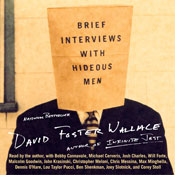
Brief Interviews with Hideous Men by David Foster Wallace (unabridged audio book read by the author and others)

This audiobook is read by Bobby Cannavale, Michael Cerveris, Josh Charles, Will Forte, Malcolm Goodwin, John Krasinski, Christopher Meloni, Chris Messina, Max Minghella, Dennis O'Hare, Lou Taylor Pucci, Ben Shenkman, Joey Slotnick, Corey Stoll, and David Foster Wallace.

The first story on the audiobook of author David Foster Wallace's short-story collection Brief Interviews with Hideous Men, "Death Is Not the End," seems to have been designed as a test to see if the listener is truly prepared for Wallace's fiction. The late author reads, but his narrative is so robotic as to be obnoxious. This is only intensified by the story's merely being a series of digressions (including the author's signature footnotes) with no real destination.

"Forever Overhead" is more successful, primarily because it covers a longer period of time: a 13-year-old's birthday spent at a public pool with his family. Wallace's incisive observations are keen, but his reading once again detracts from the piece -- or maybe it was because a glitch on my copy has caused most of track 5 on disc 1 to be a duplication of a later part of the story that shouldn't have played yet and that I therefore had to listen to twice.

Then there are the titular "Brief Interviews," in which we hear only the answers to a series of unheard questions. (These would be great for audition monologues.) There's the guy who shouts, "Victory to the forces of democratic freedom" upon orgasm; the guy whose "proclivities" originate from his father's need to be restrained from his own violence; a very personal interview with the questioner's boyfriend, who is tired of the questioner's insecurities....

Wallace's talent lies in showing everything, leaving nothing to the imagination, and punctuating it with wry humor and intensifying surprises. (Except in one special case where the final surprise is left up to the listener to figure out.)

...the pot grower who professes to know the difference between a great lover and a great lover; the guy who calls his shriveled arm "the asset"; the son of a washroom attendant; the fellow who argues that rape broadens the mind; the military brat whose supernatural masturbatory fantasies originate from a childhood fascination with Bewitched....

Wallace's fiction oozes pretensions, though Brief Interviews with Hideous Men is never unlistenable. Sometimes it's overlong and feels too much like hard work, but it's entertaining. And every so often there's a true gem, a piece so complete that it's like being rewarded for the effort of the rest. Even the title of "Suicide as a Sort of Present" adds to instead of just summarizing the experience.

...the man who loves everything about women; the duo arguing over how difficult it is to deduce what women want, given what you're working with; the guy who finds a "flake" more fascinating when he hears her rape story. The mere breadth of hideousness contained here is remarkable.

This new, unabridged edition of Brief Interviews with Hideous Men — the portions read by Wallace are taken from a previous, abridged recording — has evidently been produced to tie in with the recent film version adapted and directed by John Krasinski (best known as Jim Halpert from The Office). It includes several cast members performing their roles from the film.

Thursday, June 3, 2010

The Big Rock Candy Mountain by Wallace Stegner (unabridged audio book read by Mark Bramhall)

When her widowed father marries her best friend Sarah, Elsa Norgaard, disgusted, moves from her Minnesota home to her uncle Carl's house in Hardanger, North Dakota. There she meets Harry "Bo" Mason, and they begin a life that covers the early years of the 20th century.

Author Wallace Stegner's novel The Big Rock Candy Mountain focuses on the couple in a connected series of vignettes, broken by gaps in time but told chronologically from the characters' points of view. At first, these are primarily Bo and Elsa. Then, when they get older, their sons Chester and Bruce take the stage.

Bo is a rolling stone with an itch to make it big whatever the risk and wherever he can find "the big rock candy mountain": the "land of milk and honey" where "rivers run gold" and gambles pay off in spades and not just frustration. (The book's title comes from a song describing a hobo's idea of heaven.) To that end, he runs a series of blind pigs (places that secretly sold liquor during Prohibition) and other projects that take him and the family to different locations.

Bo tries to find the balance between security and predictability, and having the wanderlust and a fiery temper. This has both immediate and long-ranging consequences for him and his family that culminate in the fallout of a tragic event near the end of the book. Stegner reportedly based The Big Rock Candy Mountain on his own family, and long, detailed digressions from the main story into family history lend the book the feel of a saga.

At the end of the book, Bruce (Stegner's representation of himself) tries to understand the motives of his father and the actions he took, and The Big Rock Candy Mountain is a testament to his success at this. Fictionalizing the characters allows for separation that lets him get deep into the thoughts of these people and creates a novel of lasting impact.

Blackstone Audio has recently produced a selection of Stegner audiobooks. Mark Bramhall reads The Big Rock Candy Mountain. With just a slight change of voice, he manages to capture each character's individuality and brings gravity to the narration. All of this results in a literary experience that I found unexpectedly engrossing, as I could not seem to spend much time away from these people and wanted to get back to them as soon as possible.

Even now, having completed the book, I find myself thinking about its characters now and again as if I actually knew them. The fact that this was Stegner's second novel, published when he was 34 (with portions written even earlier as short stories), makes it all the more impressive.

Wallace Stegner has written a novel that will please fans of literary fiction and historical fiction (including longer Westerns). And I think it would be especially well recommended to those who enjoyed the Little House on the Prairie series but would like something a little more grown-up. The Big Rock Candy Mountain is all of that and more.

Friday, March 19, 2010

This Other Eden by Michael Hemmingson (collection of short stories and novellas)

Author Michael Hemmingson, whose works range from noir (Wild Turkey) to erotica (The Amateurs) to pop-culture scholarship (William T. Vollmann: A Critical Study and Seven Interviews), puts his wide-ranging pen to the medium of short fiction in the Dybbuk Press collection This Other Eden. All of the stories in this collection of short stories and novellas contain the word "Happen" in the title, and they all feel linked by tone if not always subject matter (though some themes do recur throughout).

Five of the tales in This Other Eden have been printed (and reprinted) in various media. (Only "What Happens When Things Happen to People" appears to be original to the collection.) Sometimes it feels like Hemmingson is trying to shock with his extreme characters; other times it merely seems like normal people aren't worth writing about (though it's often the "regular guy" who is swept up in the events).

Hemmingson has written over fifty books, and his experience shows. Not only does he inform the stories in This Other Eden with tangible details of the publishing industry, but he also imbues his characters with personalities that are displayed through his skillful use of highly individualized dialogue for each person.

"And Then It Happened" shows the dark side of winning the lottery -- or at least the dark side of people finding out you won the lottery. This story felt so real in the reading that I got stressed out whenever the phone rang for the rest of the night.

Two of the shorter pieces, "Nothing Like That Ever Happened" and "What Happens Between Literary Agents and Clients While in New York," feature barely pubescent bestselling female authors putting their sexual fantasies on paper. But each is approached in a completely different manner than the other, "Nothing" feeling more genuine emotionally while "Agents" takes a more outrageous tack.

In "What Happens When Things Happen to People" Edmond and Ivy move to the city, pursue careers, and get a hell of a lot more than they wished for. It's a terrifically told and totally engrossing story, filled with a detestable yet engaging supporting cast, that would fill a novel in the hands of a less strict prose-wrangler.

The centerpiece, at over a third of the book's length, is "Now That I Know What Happened, Could You Hold Me, Please, and Say This Is Love?" (recently expanded into the novel Shabby Town). It is the story of some time in the life of Paul Augustine, where he begins with thievery and ends with personal fulfillment. Yet nothing that happens inbetween feels forced or contrived purely to suit Hemmingson's purposes. It's a completely absorbing experience filled with real people, real problems, and really bad decisions that sometimes turn out OK.

These are stories of father and mothers, sons and daughters; of writers and teachers, agents and whores; of crack and pizza and champagne; of attacks variously political, physical, emotional, and sexual; of infidelity and loyalty; of friendship and love; of desire, ambition, and greed. Hemmingson covers the gamut of feeling and experience with This Other Eden, certainly the most impressive and consistently high-quality short fiction I've read in some time.

I didn't know anything about Hemmingson's fiction (apart from the private-eye/zombie story in Badass Horror) before I received this copy of This Other Eden for review. But based on the highly effective writing in this collection, I'm going to go searching for more very soon.

Further reading
Other Dybbuk Press titles:
Teddy Bear Cannibal Massacre edited by Tim Lieder
The Big Bow Mystery by Israel Zangwill

Other single-author collections:
The Overland Kid by Max Brand
The Nightmare Chronicles by Douglas Clegg
The Horror Stories of Robert E. Howard
Walk in Shadows by Nicholas Kaufmann

Tuesday, February 23, 2010

A Dark Matter by Peter Straub (literary horror)

It's been over five years since we've had a new novel from author Peter Straub, but he's been busy in the meantime with his nonfiction collection Sides, the short pieces in 5 Stories, and the editing duties involved in introducing readers to Poe's Children and in the overview of American Fantastic Tales. But A Dark Matter was definitely worth the wait. Not only is it his first novel since 1999's Mr. X to not feature Tim Underhill as the protagonist (though he is referenced in passing), but it is also a beautifully drawn portrait of the subjectivity of personal experience and of the consequences of self-imposed exclusion.

In it, writer Lee Harwell tells the story of his friends and their guru and the event that changed all their lives forever. If that sounds familiar, you may be noticing the basic similarity between the plot of A Dark Matter and Straub's own classic Ghost Story (as well as myriad other great novels, including It and The Secret History), but the differences only begin with the younger cast.

Harwell's high school friends Howard "Hootie" Bly, Jason "Boats" Boatman, and Donald "Dilly" Olson — and his girlfriend and future wife, the remarkably beautiful Lee "the Eel" Truax — (along with college students Keith Hayward, Brett Milstrap, and Meredith Bright) all fall under the spell of smooth-talker Spencer Mallon. The only one who thinks Mallon is a con man full of b.s. is Harwell himself, so he wasn't there at the meeting with their idol on October 15, 1966, that ended with one person's disappearance and another's gruesome death and mutilation — that basically ruined the lives of his "most intimate friends, who had shared everything with me until the moment I refused to follow them into discipleship."

More than 40 years later, though he has written a book about it, Harwell is still trying to figure out what happened. His wife won't tell him because he wasn't there, so he has to piece information together from what he can get. In true Citizen Kane fashion, he asks everyone else left for his or her piece of the story. What Harwell discovers, though (and not surprisingly), is that each participant in the big event remembers it differently. (Rashomon comes to mind — or The Outrage, depending on which one you've seen — but only in that aspect.)

I haven't always been a Peter Straub enthusiast. In fact, none of his "classic" novels (Shadowland, Julia, the aforementioned Ghost Story) could I say I enjoyed. But there was always something about his work that called to me &mdash perhaps its obvious intelligence, usually missing in most horror fiction — so I kept trying. Finally, I took a leap and skipped ahead and read lost boy, lost girl when it was still new. It had the fresh, unpracticed style I was looking for. From there, I eased backward and read The Hellfire Club, Black House, and Mr. X, all of which I found deeply satisfying. (Black House, Straub's second collaboration with Stephen King, feels much more of a collaboration than its predecessor, The Talisman, ever felt.)

These novels all have similar approaches; somewhere around the time of The Hellfire Club (perhaps before), Straub deliberately tried to adopt a more "transparent" style, and I've liked him all the better for it. Now I look forward to each release without trepidation (though I can't say I noticed the nearly six-year gap between In the Night Room and A Dark Matter, involved as I was in "catching up").

A Dark Matter is like peanut butter: rich and nutritious but with the potential to make a really great dessert. The body has obviously involved a great deal of design and thought, but there's also an offhandedness to it (and a great deal of very welcome humor) that is refreshing.

Straub is a true craftsman, folding the more horrific elements in with the more mundane and making A Dark Matter one of the few recent horror novels to actually elicit a physical response. Plus, it shows that Straub is still interested in stretching himself and in assimilating new influences, like the surreal portion that he openly acknowledges is inspired by Brian Evenson's The Open Curtain. Some readers may be dissatisfied with the ending, as it doesn't really seem to answer all the questions posed in the narrative, but if the characters themselves are, then who are we mere readers to complain?

Wednesday, January 13, 2010

The Fifth Child by Doris Lessing (literary horror)

The best horror fiction deals with the things that really scare us. Zombies, vampires, werewolves, and the like have their place. But what of the fear that comes from deep inside: questions like, what if your own child was a monster? Nobel Prize winner Doris Lessing explores this kind of horror in her novel The Fifth Child, which I first learned of in The Book of Lists: Horror in a "horror novels that don't call themselves horror novels" sort of list.

David and Harriet Lovatt seem to have been made for each other. Their meeting was the proverbial "across a crowded room," and even their ideas on children match exactly: they want many. Even though their first four children (Luke, Helen, Jane, and Paul) arrive somewhat more quickly than anticipated, everything develops easily despite protestations from relatives that their family is growing too fast.

Everything changes, however, with the arrival of the fifth child. The pregnancy is more difficult, the birth more an ordeal, and the new baby, called Ben, is very different from their other children — in ways they all find deeply unsettling and often shocking.

In addition to offering a highly gripping and suspenseful read, with The Fifth Child author Doris Lessing investigates the nature of family and the societal definition of what it means to be "human." Ben is referred to as an alien, a monster, a freak, an atavism from a race that is perhaps better suited to living underground, and various other "inhuman" monikers.

Lessing presents Ben's myriad quirks and misbehaviors with a tone that replicates that of a horror novel. This is quite appropriate given that the other family members view him with extreme trepidation that develops into fear for their lives with a family pet turns up dead.

This all results in those outside the immediate family becoming increasingly distant. Lessing skillfully illustrates this isolation through Christmas attendance, with successively fewer visitors each passing year. Eventually, Luke and Helen (away at boarding school) choose to spend the holiday with their grandparents, effectively keeping them away from home all year long.

Ben appears to be unknowable, and this is exactly the kind of thing that inspires terror in most people. At first, the family try to deal with Ben in the only way they know how. This may seem cruel at first, but the relief is palpable when their decision is reached. But Harriet then makes a pivotal decision that essentially destroys her family.

The Fifth Child does end on a note of hope, however slight. (The Nobel committee recognized this when they awarded her in 2007, writing, "From collapse and chaos emerge the elementary qualities that allow Lessing to retain hope in humanity.")

The novel was well enough received by readers to inspire a sequel, Ben, in the World. But The Fifth Child on its own is a marvel: a thought-provoking, unforgettable story that makes the reader ask what he or she would do in the circumstances — and then deal with the answer that comes.

Saturday, December 12, 2009

The Gargoyle by Andrew Davidson (mixed-genre novel)

A drunk porn actor gets in a car accident, which results in burns all over his body. (The liquor he was drinking, and spilled in his lap, flares up and does an especially bad number on his penis, leaving him with little more than a flap of skin).

During his recover in the hospital, a possibly schizophrenic gargoyle sculptor named Marianne Engel visits him regularly, saying she knows him from when she was a nun working in a monastery scriptorium (a room dedicated to Bible translation and transcription) in the 14th century. Marianne tells him stories of their life together 700 years ago, as well as myriad other stories from her multilingual experience.

The Gargoyle is a completely immersive experience. Author Andrew Davidson's debut — the product of seven years of research and writing — has something for everyone: history, horror, mystery, religion, romance, terrific storytelling, and well-crafted prose.

The story of Marianne Engel and the unnamed narrator/protagonist is one of and for the ages. Not only did reading The Gargoyle entertain and literarily satisfy me, but its breadth of scope and Davidson's unconventional style (including humor that ranges from the subtle to the laugh-out-loud — there's even a throwaway Caddyshack reference that will get past a lot of people) inspired me to try new things in my own writing.

As Marianne herself states at one point, "It was apparent from the start that the writing was unlike anything I'd ever read." The Gargoyle combines portions of Dante's Inferno, the One Thousand Nights and a Night, the Gnaden-vita, the Bible, and likely others I simply didn't recognize. It is multilayered and multilingual, and even though the novel sometimes asks a little much in the realm of suspension of disbelief, Davidson never stretches plausibility too far, especially once you give yourself over to its mythic structure and its motif of arrows and fire.

Lincoln Hoppe reads the unabridged audiobook of The Gargoyle, and his grasp of the characters is stunning. From Vikings to nuns to a man with a scarred larynx to the "bitch snake" that only morphine will quiet, he offers believable portraits of all of them. And he is not slowed in the least by all the foreign idioms and accents that he is required to master. Hoppe's reading may even make the book more accessible to those that find it a difficult read.

Tuesday, November 17, 2009

After Dark by Haruki Murakami (unabridged audio book read by Janet Song)

My reading of choice these days is genre fiction; I want something easy to follow when I read for relaxation. But occasionally I reach for something more challenging, most often by a familiar author I feel is doing something new with the form or its execution.

Ever since I read a handful of stories by author Haruki Murakami in the The New Yorker (starting with "The Ice Man" in 2003), I've wanted to try a novel of his. Audiobooks are how I do most of my experimentation, so coming across a copy of After Dark gave me the opportunity I sought.

All the action in After Dark takes place from midnight until dawn on a single night. Mari Asai, reading by herself in a Denny's in lieu of going home, encounters a handful of interesting characters.

First is Takahashi, a jazz trombonist who once met her at a party. He leads her to Kaoru, manager of a "love ho" (a hotel primarily used for trysts) and her staff, "Wheat" and "Cricket." Mari speaks Chinese and is needed to translate for them what happened to a Chinese prostitute brutally beaten at the love ho.

A touch of the eerie is added with an alternate subplot concerning Mari's sister Eri. While Eri sleeps, a man watches her, while wearing a mask that makes him look like he has no face, practically motionlessly, through her TV. I like how Murakami makes this whole setup voyeuristic. The man watches Eri, and we, through cinematographic description involving "POV camera," watch him watching her.

All of After Dark is equally visual, with descriptions so rich as to make the mind's eye unable to resist picturing the images, but I'm surprised that these Eri scenes have not already been filmed by some aspiring J-horror director: you could shoot the text as is. The set design, costuming, and camera movements are all there; Murakami has taken care of everything.

After Dark also showcases a different approach to its villain: we know what Shirikawa has done, but we didn't see if happen. Murakami only treats us to the mundane events of his life, but our knowledge casts a pall over those events, and we continually expect something else to happen, though the actual text never implies that at all.

Narrator Janet Song is invisible throughout her reading of After Dark, and that is the highest compliment I can pay an audiobook reader. She is merely a conduit for Murakami's magical-realist, post-modern narration (many questions are left unanswered) and richly drawn characters.

I'm always fascinated by authors who can make a series of seeming normal events absolutely enthralling. Half the credit must go, I suppose, to translator Jay Rubin since I can't read Japanese. The seemingly mundane appears, in reflection, to be quite profound. But Murakami shows us that, depending on the filters through which you look at life, even Love Story can appear to have a happy ending.

Thursday, October 15, 2009

Guest Blogger: Robert Greer, author of Spoon (book giveaway!)

Today, I have the honor of welcoming author Robert Greer to the pages of Somebody Dies. His latest novel is Spoon, and this new book — "set in the contemporary American West" — is somewhat of a departure from his mystery series featuring C.J. Floyd.

Below, Greer lets us in on the origins of the novel. After that, read on to find out how to receive a free copy of the book.


My novel Spoon germinated from a short story that I wrote more than twenty years ago, the summer after I finished my master's degree in creative writing at Boston University. At that time, I was still writing what some would consider to be literary pieces and hadn't yet begun to work on the mysteries and medical thrillers that have now solidified my writing reputation.

Spoon is the story of a biracial cowboy searching the West for his roots. In doing so, Arcus Witherspoon (his given name) stumbles across a ranching family in Montana who are down on their luck. Spoon, it turns out, is oddly clairvoyant, and that gift helps him when the Darleys, the family he befriends, come up against a coal company that is trying to usurp their land.

I thought about the character of Arcus Witherspoon for a long time before I decided to expand my short story into a novel. More than anything, it was Spoon's tenacity and wisdom, I suspect, that kept me tethered to him all those years.

The novel does have a degree of suspense, so I couldn’t get away from my mystery/thriller roots altogether, but all in all, the piece is literary. Personally, I don't make much of a distinction between genre fiction and literary fiction. In the end, for me writing is simply writing. So in a sense, with Spoon, mystery, thriller, and literary buffs can have what they like, all rolled into one.

Many thanks to Robert Greer for offering some insight into the origins of Spoon. Greer's publisher, Fulcrum Books, has graciously offered 5 free copies of his book to the readers of Somebody Dies.

The first 5 people to send me their mailing address (via the e-mail address located in the site description at the top of this page) will receive a free copy of Spoon direct from the publisher. (Their publicist asks that only residents of the U.S. and Canada apply, however — and no P.O. boxes, please.)

Good luck, and thanks for reading about Spoon.

Saturday, March 7, 2009

The Almost Moon by Alice Sebold (unabridged audio book read by Joan Allen)

When Helen Knightly killed her mother Clair, the first thing she felt was relief — the horror didn't come till later. But in the next 24 hours, she will make her ex-husband an accomplice after the fact, have sex with her best friend's son ("'Fuck me,' I said, and hoped that no one's God was watching"), and realize she may just have killed the only person stranger (crazier?) than herself.

Author Alice Sebold has made a career of chronicling the aftermaths of violent acts; first with Lucky, her memoir of her own rape. Next came her debut novel, The Lovely Bones, the story of the rape and murder of a young girl told by the girl after her death.

The Lovely Bones was a sleeper phenomenon — the kind of book (like The DaVinci Code) that becomes popular because people actually read and liked it and recommended it to others, not because some ephemeral influential force says they should — and is the reason Sebold's name is well known today.

With a combination of dark crime tropes and a stream of consciousness narrative style, Sebold's sophomore novel The Almost Moon is a literary noir that is true enough to each to appeal to both audiences. Fans of Gillian Flynn's recent Sharp Objects should especially flock to it, as the pair have thematic similarities though their approaches are distinct. However, it's entirely possible that fans of Sebold's earlier work will be turned off by Helen's completely unlikeable nature.


The narrative of The Almost Moon is filled with Helen's reactive behavior combined with the character's insights into dysfunctional families ("When was it that you realized the thread woven through your DNA carried the relationship deformities of your blood relatives as much as it did their diabetes or bone density?") as she flashes back to her memories of her childhood and after.

Sebold skips back and forth between past and present with an abandon that expresses confidence in the intelligence of the reader (and it is hard to keep up sometimes). She is nonjudgmental about Helen's mostly shocking actions and winds a thread of dark humor throughout, offering some laugh-out-loud moments among the horrific elements.

Academy Award® nominee Joan Allen has a cool, detached delivery that matches the character beautifully. Many times I even forgot The Almost Moon was being read by someone other than Helen herself, which I think is the best compliment I can give. A good audiobook reader is like a good editor — if they're doing their job properly, both should be invisible.

The strength of Sebold's literary voice suggests that she is not finished stretching herself. I only hope that she also expands the boundaries of the readers that picked up The Almost Moon expecting something more like The Lovely Bones and stayed for the great writing.

Sunday, November 23, 2008

Jesus Coyote by Harold Jaffe (a novel based on the Charles Manson Family)

The devoted followers of the charismatic Jesus Coyote (whom they call "Soul") have perpetrated a heinous act under his instruction: the gruesome murder of actress Naomi Self (the 8-months-pregnant wife of Polish director Jaroslav Hora), her close friend and ex-lover "hairdresser to the stars" Don Francisco, and five others including Phillip Morris heiress Kristin Barrett and Czech national Viktor Hus. But after four months, the governor's task force of LAPD, FBI, DEA, ATF, National Guard, and other "experts" have unearthed "no viable suspects."

Author Harold Jaffe expands on the concept of his short story collection 15 Serial Killers with the novella Jesus Coyote, a "docufiction" not very loosely based on the exploits of the Manson family. Using the documentary format of letters, transcripts of interrogations and phone conversations, and selected first-person accounts (from the killers and the victims) — concluding with a one-on-one interview with Coyote himself — Jaffe pieces together a gripping narrative that hews closely to the facts while retaining the fluidity of fiction.

This format gives Jesus Coyote a verisimilitude that the usual linear narrative storytelling would not. And Jaffe's stark style is such that, except for the name changes, the story reads like truth. If the real names had been used, I would just about believe everything actually happened as written (though Jaffe admits to some timeline shifting in an author's note).

Short at 150 pages, Jesus Coyote is by no means a quick read; the text is dense and rich with detail and characterization with not a sentence out of place. (I don't remember seeing any typos, either — always remarkable for a small press product.) Jaffe inclusion of revelations (based on his research) about certain characters was the single touch that affected me more than anything else; it made me see them as real people — with interests and passions of their own — and not just as the cult that mindlessly followed their leader.

This was unexpected, and with all the books I read, I'm always impressed when one surprises me. For this and the other reasons above, I feel like Jesus Coyote will live large in my memory — it's certainly one of the most fascinating books I've read this year.

Monday, October 27, 2008

Roger's Version by John Updike (unabridged audio book read by Michael Prichard)

A born-again computer whiz kid bent on proving the existence of God on his computer meets a middle-aged divinity professor, Roger Lambert, who'd just as soon leave faith a mystery. Soon the computer hacker begins an affair with professor Lambert's wife — and Roger finds himself experiencing deep longings for a trashy teenage girl.

That's what the marketing department of Ballantine Books says Roger's Version is about. And, really, that description does summarize the high points. Surprisingly, they've left out the fact that the "trashy teenage girl" is the daughter of Roger's half-sister. Wouldn't that little taste of partial incest bring in a few more readers? At least, the ones who are already familiar with author John Updike's specialty: what I like to call "the dalliances of adulterous suburbanites."

Only this time, Updike also adds in discussions about religion, computers, and astrophysics culled from the best minds in these areas (check out the Acknowledgments page for credits). In addition, also talked about freely are politics, economics, and modern music (the book is practically soundtracked to Cyndi Lauper's She's So Unusual).

In this way, Roger's Version is like an undergraduate-level class on these subjects delivered with Updike's typically gorgeous prose — and peppered with illicit trysts to keep the reader's interest. Reader Michael Prichard is the perfect audiobook reader for Updike's work. His nearly flat tone gives equal gravity both to lengthy passages on erudite subjects and to nearly pornographic sexual situations (including a description of one character's erect member so detailed that the listener could practically draw it from memory).

Monday, October 13, 2008

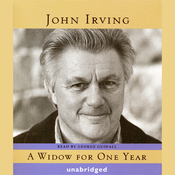
A Widow for One Year by John Irving (unabridged audio book read by George Guidall)

Is love too strong a word to describe one's feelings toward a great read? Admiration, definitely — I'll even freely admit to affection. But love? I have to imagine that everyone who reads John Irving's A Widow for One Year struggles with that question, simply because it is one of the most perfectly put together pieces of fiction I have yet encountered. I still think about the characters — especially protagonist Ruth Cole — I even miss them.

A Widow for One Year is Ruth's story. It begins when she is four years old, and her portion is tangential in the first third of the novel while Irving tells the story of her parents. Ted Cole is a successful children's book writer and illustrator who has affairs with "young mothers" under the guise of using their children as models.

Ted's relationship with his wife Marion has been over since the grief over the deaths of their two sons, Thomas and Timothy, has made her an emotional zombie. (Ruth's birth was an attempt to repair the loss, but Marion will not allow herself to love her daughter.) Ted hires college student Eddie O'Hare, an aspiring writer, to be his assistant for the summer of 1958. Soon after, Marion begins an affair with the boy, and Eddie soon discovers his job is more than advertised.

The second portion of the book begins in 1990, when Ruth is 36 and a successful writer on her own. She is still greatly affected by the decisions her parents made during her childhood, and is at a reading of her latest novel when she runs into Eddie, now 52 and a less successful writer (all the main characters are writers, yet this never becomes tedious).

During research for her latest novel, intended to be a departure from the semiautobiographical tomes written so far, Ruth gets herself into a situation that tests her to her limits. This thread lasts through the rest of A Widow for One Year, and Irving makes unexpected choices for his characters, never allowing the reader to predict just what they will do next.

I'm fascinated by how skillfully Irving assembled this story of two generations, carefully referring to past events that enhance the present narrative, and deftly paralleling those events with the novels the characters themselves write (all the main characters are professional writers, yet this never becomes tedious) — and especially drawing the story around so it reaches a full circle of sorts.

Also of note is Irving's ability to create even-handed personalities: people who do something despicable one moment and admirable the next, retaining their likeability in the process. Readers will be both literarily satisfied and emotionally moved even while they are crying tears of laughter at a couple of slapstick scenes. John Irving is really a writer who has something for everyone, and A Widow for One Year is the best book of his I've read yet. The audiobook read by the extraordinary George Guidall only enhances the experience. Not only are his characterizations awe-inspiring, but his Dutch pronunciation is immaculate.

A movie was made of the first portion of A Widow for One Year. The Door in the Floor stars Kim Basinger and Jeff Bridges as Marion and Ted Cole, respectively, and Elle Fanning as young Ruth.

Thursday, August 7, 2008

"Sense of Humor" by Damon Runyon (Broadway short story)

Any fan of crime fiction would do well to check out the short stories of Damon Runyon. One of the most most popular writers of his day, he is now largely forgotten among modern readers, except for fans of the musical Guys and Dolls (and they may not even know that Runyon's work was its source).

Part of the reason for this is undoubtedly his reputation for unapologetic sentimentality (almost completely absent in crime fiction since the "tough guy" 1950s) and his propensity for O. Henry–style twist endings — both aspects that appear dated to readers in the 21st century.

But alongside those traits runs an ironic (often pitch black) sense of humor that would probably surprise someone expecting a more "innocent" tone from 1930s fiction. Take for example this (more than somewhat edited) selection from the story "Sense of Humor" (available along with many others in the new collection Guys and Dolls and Other Writings):
"Say," [Joe the Joker] says, "I am going to play a wonderful joke on Frankie Ferocious."

"Well, Joe," I say, "you are not asking me for advice, but I am going to give you some free gratis, and for nothing. Do not play any jokes on Frankie Ferocious, as I hear he [...] will not laugh if you have Al Jolson, Eddie Cantor, Ed Wynn, and Joe Cook telling him jokes all at once. In fact," I say, "I hear he is a tough audience."

"I am going to have myself delivered to Frankie Ferocious in a sack."

"Well," I say, "personally, I see no percentage in being delivered to Frankie Ferocious in a sack, because as near as I can make out from what I read in the papers, there is no future for a guy in a sack that goes to Frankie Ferocious. What I cannot figure out," I say, "is where the joke on Frankie comes in."

"Why," Joe the Joker says, "the joke is I will not be asleep in the sack, and my hands will not be tied, and in each of my hands I will have a John Roscoe, so when the sack is delivered to Frankie Ferocious and I pop out blasting away, can you not imagine his astonishment?"

Well, I can imagine this, all right. In fact, when I get to thinking of the look of surprise that is bound to come to Frankie Ferocious's face when Joe the Joker comes out of the sack I have to laugh, and Joe the Joker laughs right along with me.
Add to that Runyon's signature use of present tense (which can come off as stilted when he forces past- and future-tense phrases into its rules but has a charm all its own), and you have something that is difficult to get into at first, but that is immensely rewarding once you "learn the language."

"Sense of Humor" ends with a twist worthy of the darkest crime fiction and had me open-mouthed, but at the same time, it's really the only ending that fits the story. Runyon's stories often wrap around themselves and tie up neatly with a ribbon, often in a way that elicits a smile at the author's craftsmanship.

Tuesday, June 3, 2008

Lemur by Tom Bradley

Spencer Sproul aspires to be a serial killer. His locker at work (he is a busboy, or "bus-bitch," at Lemuel's Family Restaurant) is papered with portraits of murderers both real and fictitious . His apartment is also loaded with memorabilia.

Unfortunately, he just isn't very threatening (he can't even growl convincingly), and when he breaks into a woman's apartment to kill her, he gets distracted by her book (about a serial killer, natch) and reads it till dawn.

Inspired by the machinations of a convenience store clerk (who he also originally intended to kill), an expert at luring obese people into his shop to consume even more questionable comestibles, Spencer realizes that his best potential murder weapon is the restaurant itself. So he turns his creative talents to marketing — and especially to ratcheting up the effect of its mascot, Lemmy the Lemur (pictured on the cover) — and rapidly moves up the ranks by capitalizing on the subliminal power of gonzo advertising.

Satire is not a strong enough word for what Tom Bradley is doing with Lemur. Every character is painted with a bizarro brush, and yet they remain relatable. Spencer can't even use English properly (Bradley calls this "oral dyslexia"), but he isn't hard to understand, and this difference actually works to make him more engaging and sympathetic.

Readers who like their social commentary wrapped up in absurdity will find a lot to like about Lemur. You can read it as a tightly written treatise on consumption in the modern age, or as the touching story of a serial killer's coming of age. Either way you choose to approach it, this darkly comic novella is sure to entertain.

Friday, March 7, 2008

Reservation Road by John Burnham Schwartz (audio book read by Cassandra Campbell, Robertson Dean, and Arthur Morey)

Sunday, July 24, 1994. 8:45 PM — Waiting for his family to come out of the gas station where they stopped to let his little sister Emma go to the bathroom, ten-year-old Josh Learner stood by the side of Reservation Road. Then a car came around the curve and knocked Josh thirty feet into the nearby shrubbery.

Local attorney Dwight Arno was in a hurry. The Red Sox game he had taken his (also ten-year-old) son Sam to went into extra innings. As Sam's noncustodial parent, he was expected to return Sam home sharply at seven. It was already almost nine. He didn't see Josh until it was too late.

But he didn't stop. The impact made Sam scream. Worried that it had somehow redone some of the damage caused by Dwight's own fist (it was an accident but was also totally preventable) years ago, Dwight continued on, wanting to get Sam home even faster now.

Ethan Learner, Josh's father, saw it all happen as he exited the gas station on his way back to the car. But it was dark, so he didn't see the driver, the color of the car, or the license plate. When the policeman at the scene tells him later that it is very possible the driver will never be caught, Ethan decides to pursue his own justice.

For me to go any further with this description would be to give away the closest thing Reservation Road has to a plot twist. It is purely literary fiction, after all, simply disguised as a crime thriller. In fact, after the crime is committed in the first few pages, there is little in the way of "action." What author John Burnham Schwartz does instead is put the reader in the minds of Dwight, Ethan, and Ethan's wife Grace as they go through the aftermath of the tragedy.

I got interested in Reservation Road from seeing the trailer for the recent film adaptation. The premise was intriguing, but I didn't expect a movie to be able to tackle the subject matter with enough depth, so I sought out the book.

It was a stroke of brilliance to have the audiobook of Reservation Road read by three different people. This helps the listener delve even deeper into the individual psyches of the characters. And "individual" is the right word. There is never any chance that the reader is going to get characters confused because Schwartz (or is that Burnham Schwartz?) has created three distinctly different personalities, and he is not clear as to which characters we are supposed to like and which ones deserve our derision.

I used to read a lot of literary fiction, but I stopped because of the popular interest in character over story. Reservation Road is an example of how both can be done well together — a compelling story with people that really exist, and a level of suspense that is unmatched, primarily because these are people we've come to know intimately.

These are not characters we've seen before in other books. There are books you read, and there are books you live. Reservation Road is one of the latter. It's a book that I believe will stay with me always.
Related Posts with Thumbnails