Monday, October 13, 2008

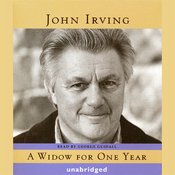
A Widow for One Year by John Irving (unabridged audio book read by George Guidall)

Is love too strong a word to describe one's feelings toward a great read? Admiration, definitely — I'll even freely admit to affection. But love? I have to imagine that everyone who reads John Irving's A Widow for One Year struggles with that question, simply because it is one of the most perfectly put together pieces of fiction I have yet encountered. I still think about the characters — especially protagonist Ruth Cole — I even miss them.

A Widow for One Year is Ruth's story. It begins when she is four years old, and her portion is tangential in the first third of the novel while Irving tells the story of her parents. Ted Cole is a successful children's book writer and illustrator who has affairs with "young mothers" under the guise of using their children as models.

Ted's relationship with his wife Marion has been over since the grief over the deaths of their two sons, Thomas and Timothy, has made her an emotional zombie. (Ruth's birth was an attempt to repair the loss, but Marion will not allow herself to love her daughter.) Ted hires college student Eddie O'Hare, an aspiring writer, to be his assistant for the summer of 1958. Soon after, Marion begins an affair with the boy, and Eddie soon discovers his job is more than advertised.

The second portion of the book begins in 1990, when Ruth is 36 and a successful writer on her own. She is still greatly affected by the decisions her parents made during her childhood, and is at a reading of her latest novel when she runs into Eddie, now 52 and a less successful writer (all the main characters are writers, yet this never becomes tedious).

During research for her latest novel, intended to be a departure from the semiautobiographical tomes written so far, Ruth gets herself into a situation that tests her to her limits. This thread lasts through the rest of A Widow for One Year, and Irving makes unexpected choices for his characters, never allowing the reader to predict just what they will do next.

I'm fascinated by how skillfully Irving assembled this story of two generations, carefully referring to past events that enhance the present narrative, and deftly paralleling those events with the novels the characters themselves write (all the main characters are professional writers, yet this never becomes tedious) — and especially drawing the story around so it reaches a full circle of sorts.

Also of note is Irving's ability to create even-handed personalities: people who do something despicable one moment and admirable the next, retaining their likeability in the process. Readers will be both literarily satisfied and emotionally moved even while they are crying tears of laughter at a couple of slapstick scenes. John Irving is really a writer who has something for everyone, and A Widow for One Year is the best book of his I've read yet. The audiobook read by the extraordinary George Guidall only enhances the experience. Not only are his characterizations awe-inspiring, but his Dutch pronunciation is immaculate.

A movie was made of the first portion of A Widow for One Year. The Door in the Floor stars Kim Basinger and Jeff Bridges as Marion and Ted Cole, respectively, and Elle Fanning as young Ruth.

Sunday, October 12, 2008

Horror Is Not a 4-Letter Word by Matthew Warner (horror essays)

Subtitled Essays on Writing and Appreciating the Genre, short story writer and novelist Matthew Warner's first collection of nonfiction, Horror Is Not a 4-Letter Word, is ideal reading during the month best known for ending with Halloween. And it's a must-have for fans of the horror genre.

In these articles that span from 2002 to 2007 — with all but two coming from the author's tenure as a columnist for Horror World — Warner covers a variety of diverse topics from horror stereotypes (and why we need them) to the importance of research for verisimilitude, from why Buffy the Vampire Slayer is an example of excellent plotting to the secrets of a successful collaboration, from how to write "invisible" dialogue to tips on public speaking.

Warner even gives new readers a taste of his short fiction ("With the Eyes of God") and then shows how he got there. (Those whose appetites are whetted can seek out Death Sentences, his short fiction collection). Horror Is Not a 4-Letter Word also contains a critique of Left Behind from the horror writer's perspective, one essay each focusing on the subjects of his two novels to date (The Organ Donor and Eyes Everywhere), a lengthy exposé on his summer working for notorious "book doctor" Edit Ink, and even insightful articles on censorship and the connection between horror and violence.

Warner has an engaging conversational style that makes even the most indepth material go down easy. But I'm not sure I can bestow a greater compliment than the fact that reading Horror Is Not a 4-Letter Word is the first time I've almost been late for work because of essays. As I finished one, the next one's title intrigued me to continue. Kudos to the author and Guide Dog Books for assembling a collection of horror-related articles that are just as accessible to the horror reader as to those who want to write in the genre — and is far more readable than others of its ilk.

The Boys Are Back in Town by Christopher Golden (dark fantasy)

This review originally appeared in somewhat different form on The Green Man Review. Copyright 2008. Reprinted with permission.

Will James, reporter and critic for the Boston Tribune, has just been passed over for a promotion — on the weekend of his 10-year high school reunion — because his articles are too "eccentric." (They are primarily exposés in the style of his idol Harry Houdini on occult subjects like Wicca and vampires.) The next day, he travels to his hometown of Eastborough, Massachusetts, for the reunion.

But since this is a Christopher Golden novel, this isn't going to be just any high school reunion. Almost as soon as Will arrives, something strange happens: when he asks about his friend Mike (Mike had sent Will an e-mail saying he would attend), his other friends look at him in horror. That's not funny, they say. You know Mike died before graduation; you were at the funeral.

Even odder is the fact that Will suddenly does have a vague memory of that series of events — where there was no such memory before. Before long, other things Will thought he remembered are changed, and he begins to notice changes in the personalities of the people around him as their memories (and therefore realities) are affected. But the worst is when he watches his best friend Ashleigh transform before his eyes from the shiny girl he loves into a world-weary sufferer, all due to a single event. Someone is messing around with their pasts, and Will seems to be the only one who realizes it. To fix it, and to find out who's behind this insidious transformation, Will has to go back into his past and rediscover a talent he has long tried to forget.

The Boys Are Back in Town represents a sort of coming of age for author Christopher Golden (then known primarily for his media tie-in and young-adult series novels). Previously, his works wore their influences on their sleeves (Straight On 'Til Morning was a Peter Pan update of sorts; The Ferryman featured Styx guardian Charon) — a practice Golden continues to adopt with his modern updates of classic stories (Bloodstained Oz, etc.) — but Boys Are Back feels truly original. The premise may feel somewhat familiar but the plot framework is Golden's own.

Golden's characters, as usual, are detailed and realistic. Since a good deal of the action focuses on their time in high school, he gets to cater to his faithful young-adult audience while not alienating the adult market. The only trouble is that the adults (with a few important exceptions) aren't really all that different from their younger counterparts (but, then again, we all know people who haven't changed since high school). Threaded among the events is a nice lesson in how our memories shape the people we later become. But his greatest accomplishment is in his very moving portrait of the platonic love between Will and Ashleigh. Even if you never had a best friend you truly loved, you'll know what it feels like when you finish this book.

I've read a number of novels where problems are caused, then solved, through the use of magic (usually spelled "magick"), but The Boys Are Back in Town is the first one that didn't resort to silly, florid incantation or spells cast in an ancient language for verisimilitude. Golden accomplishes this by a simple feat: he has his characters use magic and believe in it, and so the reader does, too. This kind of matter-of-fact approach succeeds with all of the more "out there" parts of the story, like time travel (with the usual paradox omitted, allowing characters to interact with their other-time selves), letting us be swept up in Golden's murder-mystery suspense-thriller plot that pulls the best parts from The Twilight Zone and Back to the Future, among others. And he does not slight us on the ending, offering up a conclusion that is both literarily satisfying and emotionally rewarding.

It's always fascinating to watch an author develop, and The Boys Are Back in Town is a big step forward for Golden, one that shows how he was perhaps training his literary muscles for a larger task, such as the recent Veil trilogy (beginning with The Myth Hunters), in which all of his skills come to fruition. But it's also just a solid thriller, a fully involving read ideal for anyone in search of a fast-paced, character-focused novel, even if they don't generally enjoy stories with elements of fantasy, because Golden integrates them into his story so seamlessly.

Saturday, October 4, 2008

Black House by Stephen King and Peter Straub (unabridged audio book read by Frank Muller)

Authors Stephen King and Peter Straub's second collaboration is much more than just a sequel to their first, The Talisman. In fact, Black House, draws from the earlier book's mythology only in a few scenes. An older Jack Sawyer returns as the protagonist, but now he's a talented police detective called out of voluntary retirement to help solve a rash of child murders in his newly adopted home of French Landing, Wisconsin.

This makes the vast majority of Black House reminiscent of Straub's murder mysteries (like The Throat) — which is a welcome change from the King-dominated tone of The Talisman. But King fans need not think of eschewing Black House outright because the authors have a trick up their collective sleeve: they've managed to also tie this story into the Dark Tower mythos — solidly but without overdoing it.

Everything is crafted so well and flows so smoothly that "even a blind man can see" (as the eminently quotable George Rathbun would say) that Black House is the best thing either of them had written up to that point — and is a shining example of what can be achieved when a pair's talents combine to enhance each other. Straub's literary bent gives style and intelligence to King's average-guy prose, and King's skill at pacing keeps Straub's tendency toward lengthy description from slowing things down. As a result, it offers the best of both authors with very few of their flaws remaining. The quality even transcends the distracting narrative style (using first-person plural, in the manner of screenplay directions, to reflect the book's dual storyteller).

Black House also manages to turn the impossible into the believable and can be enjoyed fully by the uninitiated, though fans who have already read The Talisman and the Dark Tower series will undoubtedly be the most rewarded and have the most fun. But I'm not sure the book as written is even as good as the audiobook as read by the late Frank Muller. His legendary vocal skills enhance the storyline with unforgettable characterizations of the colorful cast. The abovementioned George Rathbun and the villainous Mr. Munshun are particularly remarkable, making this original, exciting, suspenseful and intelligent story into something even better than the words on the page. "Case closed, game over, zip up your fly."

Thursday, September 25, 2008

Baby Moll by John Farris (writing as Steve Brackeen) (Hard Case Crime)

In the 1982 reprint of his modern classic Harrison High, author John Farris mentions in passing some "other novels" he wrote during the time it took him to write that book: "suspense thrillers ... published by Gold Medal Books under a pen name."

Baby Moll was the second of five novels that first saw print under the moniker Steve Brackeen, and Hard Case Crime is publishing it under Farris's own name for the first time. Farris also admits that, at the time of their first publication, he "fondly imagined [they] rivaled the best of John D. MacDonald."

Baby Moll is the story of Pete Mallory, who used to work for gangster Macy Barr, until he got tired of Barr (and his "whole rotten business") and walked out. Pete then settled down with a nice girl named Elaine and spent six years trying to forget his past.

The trouble comes, though, when others don't forget your past, and Barr uses Pete's most closeted skeleton to get him to come back and protect Barr from veiled death threats. But no sooner is Pete back in town than it seems he's also on somebody's hit list, so he's then on the hunt for two potential killers.

If "the best of John D. MacDonald" includes one of my favorites, Cry Hard, Cry Fast, then the young Farris comes very close, at least in terms of characterization. In general its embarrassing to realize what a skilled and confident proseslinger he was right out of high school. Because, to read Baby Moll, you'd never know that Farris wasn't a world-weary 50-year-old spilling his disappointment on the page — that he still had his whole career ahead of him.

Baby Moll offers up a rogues gallery of characters, dark underworld types and otherwise. Its not very predictable nature — along with its fairly atypical, original style — makes for an engaging read, and Farris offers an ending that is both touching and satisfying.

Wednesday, September 10, 2008

Super-Detective Flip Book: Two Complete Novels by John Grange (Introductions by John Wooley and John McMahan) (Jim Anthony, Super-Detective)

"As a manhunter Jim Anthony had no equals; his fame as an amateur scientific criminologist was world-wide. Detection was his hobby, his avocation; countless were the mysteries he had solved, the murderers he had brought to justice after the police themselves had failed. In consequence, the mere mention of his name was enough to strike terror into the heart of any transgressor." — from Murder's Migrants in Super-Detective Flip Book: Two Complete Novels

Pulp fiction seems constantly to be on the comeback. From a publisher entirely devoted to it, like Hard Case Crime, to modern-novel imitations like The Chinatown Death Cloud Peril, even to weblogs trumpeting its merits, like the "Pulp O' the Day" feature on I Was a Bronze Age Boy, it seems we just can't get enough of those seemingly undefeatable heroes like The Shadow and Doc Savage, and the hardboiled private eyes that followed in their footsteps after World War II.

During his tenure as star of his own magazine, Super-Detective, millionaire Jim Anthony was both a superhero and a detective. For 10 novels (always written under the house name "John Grange" — much like The Shadow's author, "Maxwell Grant"), Anthony fought "super-villains" in high adventure tales of science-fiction. Then, for whatever reason (not all that many world-dictator wannabes, I imagine), Jim Anthony became a more traditional shamus against foes with more earthbound ambitions.

Both of these phases are considered by aficionados to be of equal quality, and the Super-Detective Flip Book contains a "novel" (really "novella," as neither exceeds 100 pages) from each period, printed back-to-back and head-to-tail like the old Ace Double format. (Only, unlike the mass-market size that Ace used and that Hard Case Crime recently revived with its reissue of two early Robert Bloch books — Shooting Star and Spiderweb — Off-Trail Publications and Reverse Karma Press have published these books in trade paperback.)

First up chronologically is November 1940's Legion of Robots, the second of a trilogy of novels (widely presumed to be the work of pulp sci-fi author Victor Rousseau, though this is still only speculation) featuring Jim Anthony's struggle with Rado Ruric. Don't worry that two-thirds of the story is missing, however: the other two have been reprinted separately since their debut and (at least according to the introduction by John McMahan), Legion of Robots is considered to be better than its brothers (Dealer in Death and Madame Murder).

Turn the book over to find not-so-"super" detective Jim Anthony in March 1943's Murder's Migrants, one of around a dozen Anthony tales written by pulpsmiths Robert Leslie Bellem and Willis Todhunter Ballard (still under the "John Grange" pseudonym). During this era, Anthony's adventures became less kid-friendly (mostly due to his sidekick's eye for the ladies), because comics had taken away much of that audience and the publisher decided to cater to the older readers who had remained.

While Anthony was originally created as an amalgam of other heroes of the time, like Doc Savage, Superman (just check out the "Super" lettering on the cover), and possibly even Tarzan, he has his own admirable qualities — and a "legion" of fans to support him. But neither of the stories in the Super-Detective Flip Book is what I would call "good." They both have the particular pulp charm of stories that were written in a hurry, but Murder's Migrants in particular is painfully overwritten in spots. (Given its 60-page length, this is rather surprising.)

Before 10 pages have passed, Bellem (who would eventually focus his skills on television scripts) and Ballard (who would stick to novels but switch primarily to Westerns as "Todhunter Ballard," even serving as vice president of the Western Writers of America for a time), have brought out half a dozen of Anthony's superhuman powers (some from his Comanche mother, another from a Hindu yogi) before he has even met the villain. And the finale more closely matches that of the Firesign Theatre's detective parody Nick Danger, Third Eye than any other real detective novel. And in case we didn't get the point, there's that passage I quoted at the beginning of this review, which I can only refer to as a sales pitch. (No wonder author Bill Pronzini devoted an entire chapter to the duo in his book an awful crime writing, Gun in Cheek.)

Super-Detective Flip Book is a terrific time capsule of a time when pulp was king, and "escapism" was the name of the game. I'm not sure that it's going to gain the style many new fans; the quality of writing is simply too pedestrian to make a new reader hungry for more. But the pulp fan who needs something besides the same old reprints that everyone else has already done will find it a welcome discovery indeed.
Related Posts with Thumbnails